
The U.S. Coast Guard commended five boaters rescued this spring after their 60-foot motoryacht sank in the Gulf of Alaska, praising the crew’s preparedness and calm response. The crew’s equipment and training helped the Coast Guard execute what officials called a textbook rescue.
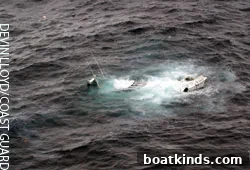
Owner Tom Alexander, 54, and the crew of the Nordic Mistress, a 1998 Bayliner, had properly outfitted the boat for Alaskan waters. The vessel carried two fixed-mount VHF radios linked to GPS, one handheld VHF, a self-inflating life raft, personal locator beacons, flares and survival suits. Petty Officer Jonathan Lally, a Coast Guard public affairs specialist, noted those items and the crew’s actions were critical to their rescue.
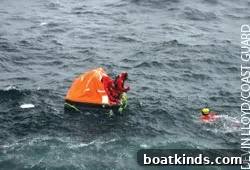
Ahead of the rescue, Alexander used the VHF to relay precise coordinates to the Coast Guard. When a MH-60 Jayhawk helicopter arrived on scene, the crew fired a flare that helped rescuers locate them and hoist all five people to safety. “They knew how to use the flare, and they knew how to get into their survival suits and get into the life raft. All of this helped the rescue go as smoothly as it did,” Lally said. Although the crew had activated both an EPIRB and a personal locator beacon, the flare and VHF position reports were what ultimately guided the rescuers to the life raft.
The Nordic Mistress was about 85 miles north of Kodiak on May 22 when the trouble began. Conditions were challenging—20-knot winds and 10-foot seas—while Alexander, a semiretired commercial real estate agent who has owned the Bayliner since 2005, was taking the boat on the familiar 260-mile trip from Kodiak to Whittier. His 14-year-old son, Jacob, was among the five aboard.
Alexander believes a mechanical failure, not the seas, sank the vessel. He suspects a shaft seal or a through-hull coupling failed, allowing rapid flooding of the engine room. “The boat has dripless shaft bearings and there’s a big coupler,” he said. “That [coupler] must have cut loose, and if it does cut loose, water comes in fast.” The Coast Guard continues to investigate the precise cause.
The rest of the crew included Brian Broderick, 46, Alexander’s first mate and close friend; Charles Blalock, 52; and James Sims, 60. As steering responsiveness declined, Alexander sent Broderick to inspect the engine room, where Broderick reported it was flooded. Alexander issued a mayday immediately and insisted the helicopter be launched from Kodiak instead of delaying with pumps or more equipment. “This boat is going down. I need a chopper!” he told dispatchers.
Co-pilot Lt. Jon Bartel, who responded aboard the Jayhawk, praised the crew’s preparation and conduct. “They were in a raft. They were all in survival suits, which was great. They also had EPIRBs. They shot off flares like they were supposed to so we could see where they were once we got close. We hoisted them all out of the water with a basket. Our rescue swimmer did a great job,” he said.
Alexander credited Broderick as the key figure during the abandon-ship sequence. Broderick activated the EPIRB and the personal locator beacon, launched the life raft and helped others into their survival suits and then into the raft. “Brian was the real hero,” Alexander said. Broderick faced the most dangerous task when he moved to the aft deck to reach the engine room amid stacked waves; he later described how that exposed position could have left him unseen if he had gone overboard.
During the escalation, Alexander suffered a back injury after becoming airborne over a large wave and later discovered he had ruptured a disc. Despite his injury, he stayed at the helm as long as possible to keep the bow into the swells and prevent an immediate capsize. When the steering system failed entirely, he used the throttles to control the vessel and maintained radio communication while preparing to abandon ship. By the time he stepped off, only the bow remained above water.
The Coast Guard helicopter took about 45 minutes to reach the reported coordinates. By then, the crew had drifted away from the original position. Rescuers were prepared to home in on the EPIRB signal when they spotted the flare and were able to recover the five crewmembers. Rescue swimmer Ralph Aguero entered the life raft to brief the occupants on the helicopter hoist procedure. “They were on edge, but surprisingly calm,” Aguero said, noting how different this mission felt after a recent response that had ended in multiple fatalities.
Both the Coast Guard and the rescue swimmer emphasized how much the survival equipment and pre-departure safety practices mattered. Alexander had held a safety briefing the night before departure in which every crewmember tried on their survival suit, practiced launching the life raft and learned how to activate the EPIRB and send a mayday. Broderick also confirmed that alcohol was prohibited for the passage—another deliberate safety choice.
Alexander had spent several days preparing the boat for the trip: changing impellers, air and fuel filters on the MAN diesels, servicing props, checking bilge pumps and replacing anchor chain. “It was a highly maintained boat,” he said. Reflecting on the incident, Alexander emphasized the harsh reality of Alaskan waters: without survival suits and safety gear, chances of surviving an emergency in near-freezing seas are slim. The crew’s equipment, preparation and calm response made the difference between tragedy and a successful rescue.
SAFETY GEAR ON MOTORYACHT
• Self-inflating Zodiac life raft strapped down on deck just outside the wheelhouse
• Six survival suits stowed in the wheelhouse
• EPIRB registered to Tom Alexander mounted to the wheelhouse superstructure, above the life raft
• PLB registered to Alexander attached to the life raft
• Ditch bag containing flares stowed in the life raft
• Two fixed-mount ICOM VHF radios in the wheelhouse linked to GPS
• One handheld VHF
STEPS THE CREW TOOK
• Safety meeting held before departure; crew taught how to operate VHF radio and broadcast a mayday, put on survival suits and inflate the life raft
• Immediately hailed Coast Guard on VHF with coordinates
• Set off readily available EPIRB and PLB
• Put on readily available survival suits
This article originally appeared in the August 2011 issue.