
The world’s largest fish tank
Milton S. Love, a research biologist at the University of California at Santa Barbara’s Marine Science Institute, has produced an unusual and engaging reference that blends science, art and storytelling. His book chronicles 490 of the more than 1,500 fish species that inhabit Pacific coast waters, pairing scientific observations with vivid color photographs, still-life reproductions and cartoons to create a richly illustrated compendium.
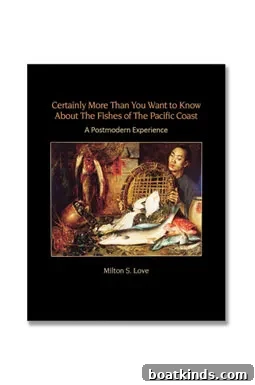
Titled “Certainly More Than You Want to Know About the Fishes of the Pacific Coast –– A Postmodern Experience” (2011, Really Big Press, $29.95 paperback, 672 pages), the volume is deliberately expansive in both scope and tone. It reads as much like an art project as a field guide: factual entries and identification notes sit alongside fish tales, limericks, poems and even quotations from William Shakespeare. That blend creates a book that is informative, entertaining and often surprising.
Love explains his motivation plainly: “The idea behind it was to create art,” he says. “My definition of art is anything that is created such that the observer or the reader will think a different thought or have a different emotion. So art can be sculpture, a painting, a performance or, as in this particular case, a book.” That intention is evident throughout the work—readers encounter scientific detail tempered by humor and aesthetic choices, so the material appeals to both specialists and curious lay readers.
Rather than presenting dry taxonomy alone, the book aims to convey the character and variety of Pacific coast fishes. Species accounts are illustrated with clear photographs and creative images that highlight form, color and behavior. Interspersed commentary and short pieces of verse relieve the density of information and invite readers to linger over individual entries. The result is a hybrid reference that serves multiple purposes: identification aid, visual gallery and source of short, readable essays about marine life.
Because it covers nearly 500 species, the book offers substantial coverage without attempting to be exhaustive. It documents a representative portion of the coastal fish fauna and can serve as a practical and inspirational resource for naturalists, divers, anglers, students, artists and anyone interested in marine biodiversity. The accessible writing style—frequently conversational and occasionally whimsical—helps bridge the gap between technical description and general interest.
From a marine biology standpoint, the work reflects an experienced researcher’s familiarity with local species and the coastal environment. From an artistic standpoint, the book demonstrates how visual and literary elements can enhance engagement with scientific subjects. Readers will find moments of rigor alongside playful asides, which together create a textured reading experience that rewards both casual browsing and focused study.
“Certainly More Than You Want to Know About the Fishes of the Pacific Coast –– A Postmodern Experience” stands out as an unconventional addition to the literature on regional marine life. Its format challenges expectations for a standard field guide while still delivering reliable information and appealing imagery. For those who appreciate books that combine scholarship with creativity, Love’s compendium offers a distinctive way to explore the diversity of fish along the Pacific coast.
This article originally appeared in the December 2011 issue.