
2011 Transatlantic Race: Record Pace, Shifting Winds and a Fierce Finish
The 2011 Transatlantic Race delivered a full spectrum of ocean racing challenges: blistering speeds, long windless stretches and a violent storm that tested the endurance and seamanship of crews still at sea. The race, a 2,975-mile course from Newport, Rhode Island, to Lizard Point off England’s southwestern coast, produced a course record on elapsed time while also rewarding solid tactical sailing on corrected time.
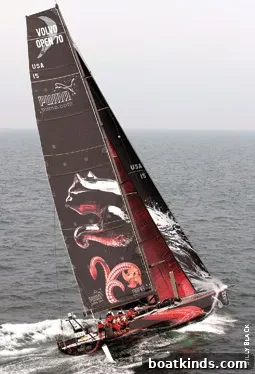
Rambler 100—widely regarded as the favorite to post the fastest elapsed time—did exactly that, setting a new benchmark with a passage of 6 days and 22 hours. Still, the overall victory on corrected time went to Mar Mostro, the Volvo Open 70 campaigned by Puma Ocean Racing Team, which entered the Transatlantic as both a serious contest and a final tune-up for the upcoming Volvo Ocean Race. The event employed three separate start dates—June 26, June 29 and July 3—allowing the 26-boat fleet to stagger departures across variable weather windows.
Puma skipper Ken Read of Newport described the team’s mindset succinctly: “We entered the race with zero expectations, just like the other IRC handicap racing we’ve done this year. We wanted to learn the boat and the crew. Now here we are … winning a race that we didn’t expect to win. We are pleasantly shocked.” Mar Mostro demonstrated remarkable speed and consistency, covering 551 miles in its fastest 24-hour period and recording top speeds up to 30 knots in favorable conditions.
Rambler 100, a much larger boat at roughly 130 feet overall, pushed even harder in bursts: she logged a staggering 582-mile day and, according to skipper George David of Hartford, Connecticut, achieved an unprecedented average across the Atlantic. “For the first 80 hours of this race we were ripping along,” David said. “Toward the end, we hit a few holes in the wind, but the net speed average was 15.7 knots across the Atlantic. Our time was the fastest average speed that any monohull has ever crossed the Atlantic Ocean, and we have got to be very happy with that.”
The race also highlighted diverse boat types and classes. In the Open division, the 66-foot Gunboat catamaran Phaedo—promoted by its owners as an exceptionally fast cruising multihull—outpaced the Maltese Falcon, the striking 289-foot, three-masted Perini Navi square-rigger that drew attention for its scale and surprisingly nimble performance. In IRC Class 3, the oldest competitor, Dr. Huntington Sheldon, 80, sailed to victory aboard Zaraffa, a familiar yacht for him after a past triumph in the Newport-to-Hamburg Daimler Chrysler North Atlantic Challenge.
For the smaller and slower boats the race turned into two contests in one. A vast calm area developed across the middle of the Atlantic, effectively forming a “parking lot” that bunched the fleet, erased early advantages and allowed trailing boats to rejoin the leaders. When the wind returned it felt like a fresh start for roughly 16 boats caught in the lull, and corrected-time scoring re-ordered final placings dramatically.
IRC Class 4 saw that dynamic play out when Carina, a McCurdy & Rhodes 48 skippered by Rives Potts, lost ground in the calm and was edged out on corrected time by the smaller Dawn Star. Carina had been a strong contender—fresh from a Newport Bermuda Race victory—and fielded a father-and-son crew including 16-year-old Dirk Johnson Jr., the race’s youngest participant.
Other notable performances included the fifth-place finish by the U.S. Merchant Marine’s Vanquish in IRC 1 and an impressive runner-up effort in the Open 40 class by Dragon. Skipper Mike Hennessy of Mystic, Connecticut, and navigator Rob Windsor campaigned Dragon as a double-handed entry and finished just thirty minutes behind Concise, a fully crewed U.K. Class 40.
Perhaps the most dramatic story of resilience involved Albrecht and Erika Peters of Germany aboard Sasha, a beautifully maintained 1970 Sparkman & Stephens 42-footer sailed with a couple from New Zealand. After a slow passage, Sasha endured a severe storm on the approach to the finish following 22 days at sea. “We had over 55 knots of wind and 40-foot breaking waves,” Albrecht Peters reported. “At times, we were hit at 90 degrees by these waves, and it was a case of survival.” Despite having reefed the sails to the maximum, the classic yacht still surfed at speeds up to 14 knots. The crew also faced structural issues, including a broken gooseneck and water ingress, possibly through keel bolt areas, but both boat and crew ultimately arrived safe.
For sailors and enthusiasts seeking detailed results and race reports, comprehensive information is available at transatlanticrace.org. The 2011 Transatlantic Race remains a memorable edition for its combination of record-setting speed, tactical handicapping drama and pure seamanship under extreme conditions.
This article originally appeared in the September 2011 issue.