
How I Enlarged a Hole in My Boat’s Steering Console to Fit a New GPS Plotter

When I installed a new GPS plotter on the flybridge, I ran into a small but real installation challenge: the cable connectors on the new unit were too large to pass through the existing hole in the steering console. The old system used a roughly 1-inch diameter opening, while the documentation for the new plotter called for enlarging that hole to about 1-1/4 inches.
At first I worried the job might leave the console looking rough. The upper surface of Betty’s steering console is flat, smooth and finished with a glossy white Interlux Perfection paint. Any ragged edges or uneven cuts would be obvious and ruin the clean factory appearance. Given that, I wanted a method that would produce a neat, circular hole without marring the surrounding paint.
Using a conventional hole saw seemed like the natural choice: it produces a clean, finished edge. The problem was guidance. With nothing inside the existing hole to steady the hole saw’s pilot bit, it would be difficult to keep the saw centered. Trying to guide a hole saw freehand through that shallow opening risked wobbling, slipped teeth and an unprofessional result—precisely what I wanted to avoid.
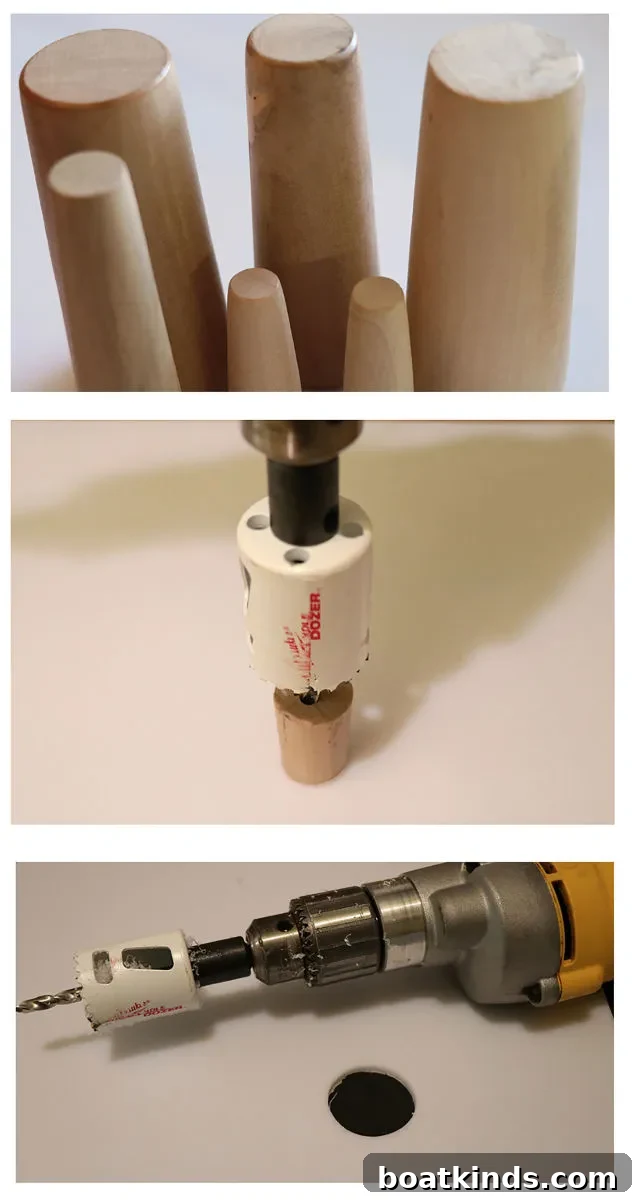
After thinking it over, I remembered a practical trick: use a tapered wooden plug as a temporary guide. I keep conical wooden plugs in a locker with flares and other emergency gear, and one of them fit the existing hole with a slight amount of the plug proud of the surface. The idea was to insert the plug so it filled and stabilized the hole, then use the pilot bit of the appropriately sized hole saw to drill straight into the plug. As the pilot bit advanced, the hole saw would be stabilized by the plug and cut a clean, centered enlargement through the console.
The approach worked exactly as intended. The tapered plug held the pilot bit steady, preventing the saw from walking and ensuring a concentric, smooth cut. Because the plug supported the teeth of the hole saw until it finished, the resulting hole had neat edges that required minimal touch-up. This simple trick let me enlarge the hole while protecting the painted surface and preserving the console’s finished appearance.
Here are a few practical tips if you try this method yourself:
- Choose a plug that fits snugly in the existing hole and extends slightly above the surface so the pilot bit has something solid to bite into.
- If the plug is too proud and the hole saw isn’t deep enough, use an extra-deep hole saw to make sure the cutter reaches fully through the console without stalling.
- For protection of the finish, consider applying a bit of painter’s tape around the cut area before drilling. This can help prevent minor chipping on delicate gelcoat or paint edges.
- Be cautious with very large hole saws. Using a high-power electric drill with a 2-inch or larger hole saw can be hazardous—use controlled speed, firm two-handed control, and appropriate personal protective equipment.
- After cutting, lightly sand the cut edge if needed and clean the surface before reinstalling equipment to maintain a tidy, professional look.
This wooden-plug technique is a low-cost, low-risk solution that produces professional-looking results on delicate surfaces such as a painted steering console. It’s particularly useful on boats, where preserving finishes is important and access can be limited. With patience and a steady hand, you can enlarge small openings for new electronics—like GPS plotters and other instruments—without sacrificing the appearance of the helm.
Ultimately, the fix was straightforward: pick the right plug, select the correct hole saw (regular or extra-deep as needed), and work carefully. On Betty, the new plotter fits perfectly, the console looks intact, and I avoided a potentially messy repair job. If you’re updating marine electronics and face the same constraint, this method is worth considering before you resort to more invasive techniques.