The National Boating Safety Advisory Council has unanimously approved a resolution urging the U.S. Coast Guard to require pleasure boaters operating more than 3 nautical miles offshore to carry an emergency locator beacon (ELB). As an alternative for those staying between 3 and 20 nautical miles offshore, the council recommends a VHF-DSC radio with integral or connected GPS. The committee that studied this proposal concluded that mandated carriage of ELBs or GPS-enabled VHF-DSC radios could save lives and significantly reduce the time, cost and risk associated with search-and-rescue operations.
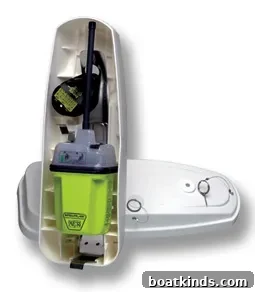
An advisory subcommittee focused on ELB carriage estimated that a rule of this kind could prevent at least 10 fatalities per year by providing rescuers with an accurate GPS position to home in on. Jeff Hoedt, chief of the Coast Guard’s Boating Safety Division, emphasized the broader benefits: “Beyond lives saved, another big benefit is the reduction in search-and-rescue costs. Rather than do a 10,000-square-mile search, you can do a 1,000-square-mile search [if you’ve got a GPS position]. You’re saving gas, you’re saving time, you’re increasing your odds of saving lives, and there is a reduction in risk to your search-and-rescue crew. Our crews are subject to substantial risks, especially when they are out in bad weather.”
David Marlow, director of product integrity and government affairs for Brunswick’s Boat Group and chairman of the Boats and Associated Equipment subcommittee, reported at the council’s November meeting in Watsonville, California, that the average search when the victim’s location is known costs roughly $150,000. When searchers do not have a GPS position, the average search cost rises to about $240,000.
One search, $1.6 million
High-profile incidents illustrate the stakes. In February 2009, a large three-day search in the Gulf of Mexico for former NFL players Corey Smith and Marquis Cooper and friends Will Bleakley and Nick Schuyler cost approximately $1.6 million. Only Schuyler was recovered alive. Officials later said an EPIRB might have helped locate the vessel faster and could possibly have resulted in additional survivors. Beyond the human cost, extended searches place rescue personnel at risk and require extensive resources.
An April 2008 Coast Guard memo itemized operational costs for common search assets: $873 per hour for a 41-foot utility boat; $1,147 per hour for a 110-foot cutter; $1,914 per hour for a 210-foot cutter; $5,731 per hour for an HU-25 jet; $6,530 per hour for a Jayhawk helicopter; and $7,648 per hour for a C-130 aircraft. The Gulf search deployed multiple cutters, aircraft and aircraft from other agencies, underscoring how quickly costs escalate when a precise location is unknown. “The Coast Guard can spend a significant amount of money deploying assets aimed at rescuing people,” Marlow said. “They never say, ‘We won’t come.’ ”
The advisory council set a desired implementation date of July 1, 2015, for a carriage rule, but the Coast Guard cautions that the regulatory process is lengthy and that additional data and analysis are required before any regulation can be finalized. The Marine Safety and Security Council must first approve pursuing the rule, and the Coast Guard must perform a detailed cost-benefit analysis that addresses how many vessels would be affected, equipment costs to boaters, the potential rise in false alerts as more beacons are carried, and broader societal impacts of added regulation.
The council has also asked the Coast Guard to define who qualifies as a “recreational boater” for this requirement. Questions remain: would the rule include paddleboarders, kayakers or canoeists? What types of ELBs would meet the standard — traditional EPIRBs, personal locator beacons (PLBs), or newer satellite messengers such as SPOT or DeLorme’s inReach? Those privately operated satellite services are not currently Coast Guard–approved for emergency signaling, though Hoedt said the Coast Guard could choose to accept devices beyond EPIRBs and PLBs.
Costs and benefits
Device prices cited during council discussions ranged from about $100 for a basic satellite messenger to $700 for a full EPIRB. Approximate price points mentioned included $150–$250 for a VHF-DSC radio with GPS capability (appropriate for 3–20 nautical miles offshore), $100 for a SPOT device, $250 for an inReach device, $300 for a PLB, and $700 for an EPIRB. For cost-benefit modeling, the federal government assigns a monetary value of roughly $6.3 million to a statistical life; saving just 10 lives a year would equate to a direct benefit of about $63 million, before factoring in the substantial savings from reduced search costs.
Marlow noted that most recreational boaters could comply without significant expense. VHF-DSC radios with integrated GPS (or radios that can be connected to an external GPS) offer an affordable way to transmit a distress signal with an embedded position, which interfaces with the Coast Guard’s Rescue 21 VHF-DSC network. Rescue 21 covers roughly 41,871 miles of coastline, including the continental United States, the Great Lakes, Puerto Rico, the U.S. Virgin Islands, Guam and the Marianas. VHF-DSC distress alerts may be received from as far as 20 nautical miles offshore; when GPS coordinates are included, watchstanders can pinpoint the source and reduce the search area dramatically.
For boaters who travel beyond 20 nautical miles, ELBs such as EPIRBs or PLBs offer global satellite-based alerting and are often worth the additional cost. Marlow pointed out practical obligations tied to these devices: EPIRBs must be registered, and units should either have built-in GPS or be connected to an external GPS so alerts include a precise position. Similarly, VHF-DSC radios require a Maritime Mobile Service Identity (MMSI) number to be programmed into the unit so distress calls carry an identifying code along with the position.
For those who don’t want to purchase an ELB, short-term rentals are an option; BoatUS, for example, offers weekly EPIRB and PLB rentals at published rates. The council’s resolution reflects a year of study and input from industry stakeholders, consumer advocates and search-and-rescue experts. Marlow summarized the committee’s view: “I think the resolutions were the right ones to make and will eventually take the search out of search-and-rescue operations in the future.”

See related articles:
- Electronics 2013
- A resolution to require emergency locator beacons
- Rescues aren’t cheap
February 2013 issue