
Man-Overboard: Plan, Practice, and Proven Recovery Techniques
I have experienced only one true man-overboard event in real life. Fortunately it occurred in calm weather during daylight. A guest on the bow stood, brought binoculars to his eyes, stumbled, and fell backward over the rail where the lifelines slope toward the bowsprit. We immediately threw a couple of cushions his way. As the boat passed he shouted, “I’m OK,” and, oddly, continued holding the binoculars overhead — a clear sign he wasn’t badly injured or panicked.
We carried out our practiced MOB procedure: one person became a dedicated spotter, we kept eyes on him, turned the boat head-to-wind, started the engine, dropped sail, and motored back with the boarding ladder ready. Within minutes we were within yards of him and put the engine in neutral. Someone tossed a horseshoe life ring and a polypropylene tether, but he was able to climb the ladder and return aboard uninjured. The incident reinforced how well training and simple gear can make a recovery routine and safe.
Losing someone overboard is one of the most serious emergencies on the water. A strong swimmer in calm conditions is one scenario; a nighttime, stormy, or injury-related MOB is another entirely. For that reason every boat needs a clear MOB plan and regular practice tailored to the vessel and crew.
Immediate Actions: Alert, Spot, and Float
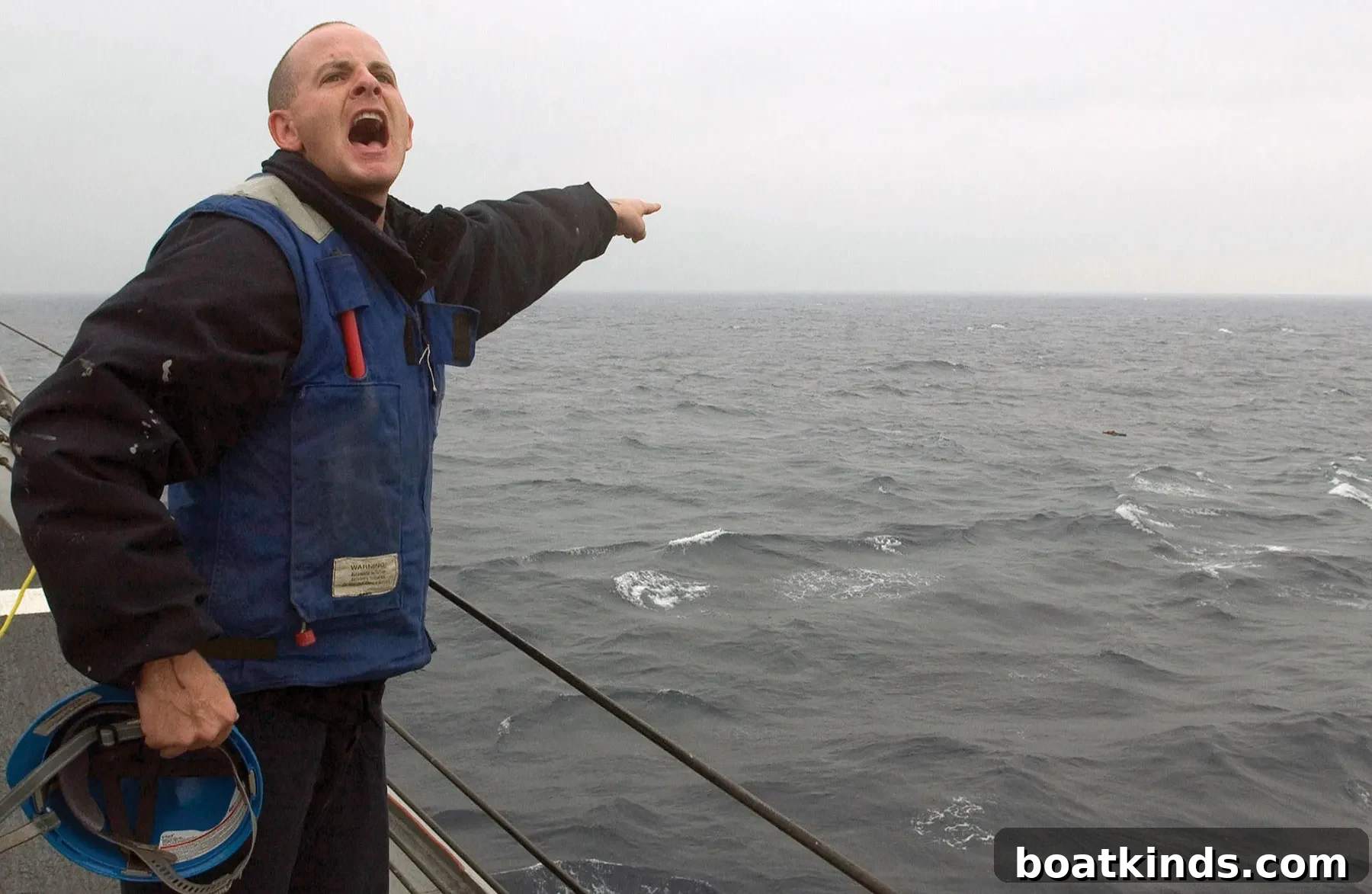
If someone goes overboard in plain sight, shout “Man overboard!” to alert everyone and bring crew on deck. Assign a single person to be the continuous spotter — their only job is to point and keep eyes on the victim until recovery begins. Simultaneously “litter the water” with anything that floats: cushions, coils of line, life rings, or a throwable flotation device. This gives the person something to hold, increases visibility, and shows set and drift.
A dedicated man-overboard kit is invaluable, especially offshore or at night. A tall pole or spar with a flag and a high-intensity strobe is far easier to see than a head in the water. If you’re the only person left aboard, that marker dramatically improves the chance of re-locating the victim.
Communications and Positioning
Once a spotter and flotation are in place, the captain should assign duties: who will navigate back, who handles communications, who prepares recovery gear. Hit the GPS MOB button after the spotter is established and flotation is deployed. A person in the water represents grave and imminent danger; use a Mayday if immediate assistance may be required and alert nearby vessels and rescue authorities.
Know how to provide an accurate position quickly and keep an emergency communications placard and procedures somewhere visible. In the heat of an emergency, there’s not time to hunt for manuals. If appropriate for the severity of the incident, send a Digital Selective Calling (DSC) distress alert to notify rescue authorities with an automatic, formatted distress message.
Returning to the Victim: Options and Considerations
There are several recovery maneuvers — round turn, quick-stop, figure-eight, Williamson turn, and others. No single technique fits every boat or every sea state. The objective is consistent: return quickly to the person and stop safely. In light conditions it may be enough to put the bow into the wind and stop. In heavy wind and seas, positioning and approach are far more complex.
Consider the advantages of stopping to windward or leeward of the victim. Stopping with the person on the lee bow shelters them from waves and can make recovery easier. But if the boat drifts down onto them, that poses a real danger, particularly if they are incapacitated. Stopping to windward risks drifting away faster than the person can swim. Devices such as a Lifesling allow the boat to deliver a floating rescue line and belt to the person rather than stopping directly on top of them, which can avoid that dilemma.
Equipment and Technology That Help
PFDs with lights and whistles, AIS-transmitting locators, and personal locator beacons (PLBs) dramatically improve a victim’s chances of detection. A strobe, flag pole, and flotation in a man-overboard kit extend visual range. Regularly inspect and practice with this gear so deployment is second nature.
Drills, Solo Practice, and Realistic Exercises
Practice regularly. Drills can be spontaneous — call “man overboard” when a hat or fender goes over — but structured training is vital, especially with new crew. Retrieval of an object simulates visual tracking and maneuvering; retrieving a live person tests stopping, holding position, and the actual recovery process. If you sail as a couple, practice solo scenarios to simulate losing one person.
I once ran a realistic two-person Lifesling drill that convinced me of its value. The owner jumped overboard while I helmed; I deployed the rail-mounted gear, circled until he grabbed the line, stopped the engine, and hauled him in hand-over-hand. He then climbed aboard using a genoa winch as a simulated solo recovery. It was hard work, but it worked.
On another occasion at anchor I had to rescue a panic-struck swimmer unable to climb a high ladder. We lowered a bosun’s chair, placed him in it from the water, and used the main halyard and a self-tailing winch to haul him aboard—another example of improvisation combined with seamanship.
Plan for Your Boat and Your Crew
Every boat and crew are different. Consider these questions when you design your MOB plan: Can the person swim? Are they conscious and uninjured? Do they have a PFD, light, whistle, AIS beacon, or PLB? Can your topsides be used for reboarding, or do you need a sling, ladder, or boarding platform? How will you protect a person from the prop? Can you safely launch a dinghy and who will helm the mother ship?
Analyze your vessel’s maneuverability, freeboard, recovery points, and winches. Practice the scenarios that match your boat’s strengths and limitations. Keep equipment maintained, train often, and make checklists or placards for quick reference.
Seamanship, clear thinking, and frequent practice greatly increase the odds of a successful recovery. Train until responses are automatic — then hope you never have to use them in a real emergency.
This article was originally published in the June 2022 issue.