
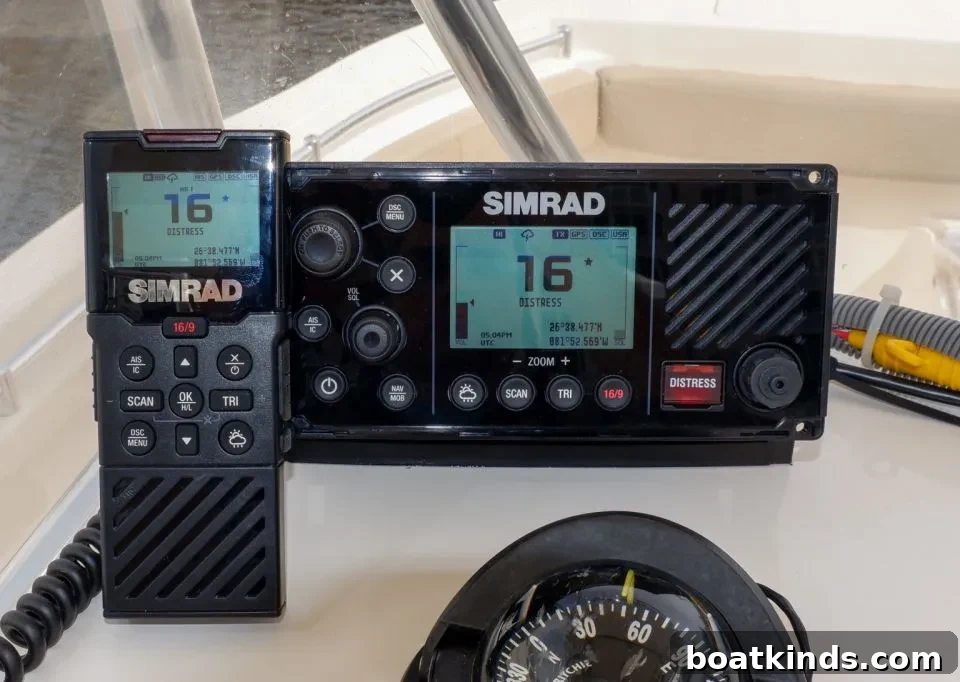
AIS and VHF voice radios share the same VHF frequency band, so integrating both capabilities into a single unit is a logical development. Achieving that integration has proven challenging for manufacturers, but Simrad and B&G (Navico) succeeded in getting their combined units through approvals and into customer hands. This review looks at real-world performance of the Simrad RS40-B (also sold as the B&G V60-B) and what to expect if you choose one radio to handle both VHF voice and AIS transceiver duties.
Simrad RS40-B / B&G V60-B — Introduced in mid-2019, this compact, full-featured radio combines a VHF transceiver and a Class B C/S AIS transceiver along with an internal GPS. The unit supports two wireless handsets, includes a speaker microphone with front and rear connections, and offers hailer, listen-back, and fog horn functions when connected to an external speaker. NMEA 2000 and NMEA 0183 connectivity allow AIS data to be shared with chartplotters and multifunction displays, and the built-in GPS enables DSC position reporting and distress transmission without an external GPS antenna, provided the radio has a clear sky view.
VHF radio functionality
The RS40-B meets most expectations for a modern VHF: DSC, dual-watch and tri-watch, channel scanning, weather channels, intercom between handsets, and many convenience features. The interface is logical and user-friendly, and DSC distress functions work out of the box once the MMSI is entered, thanks to the internal GPS.
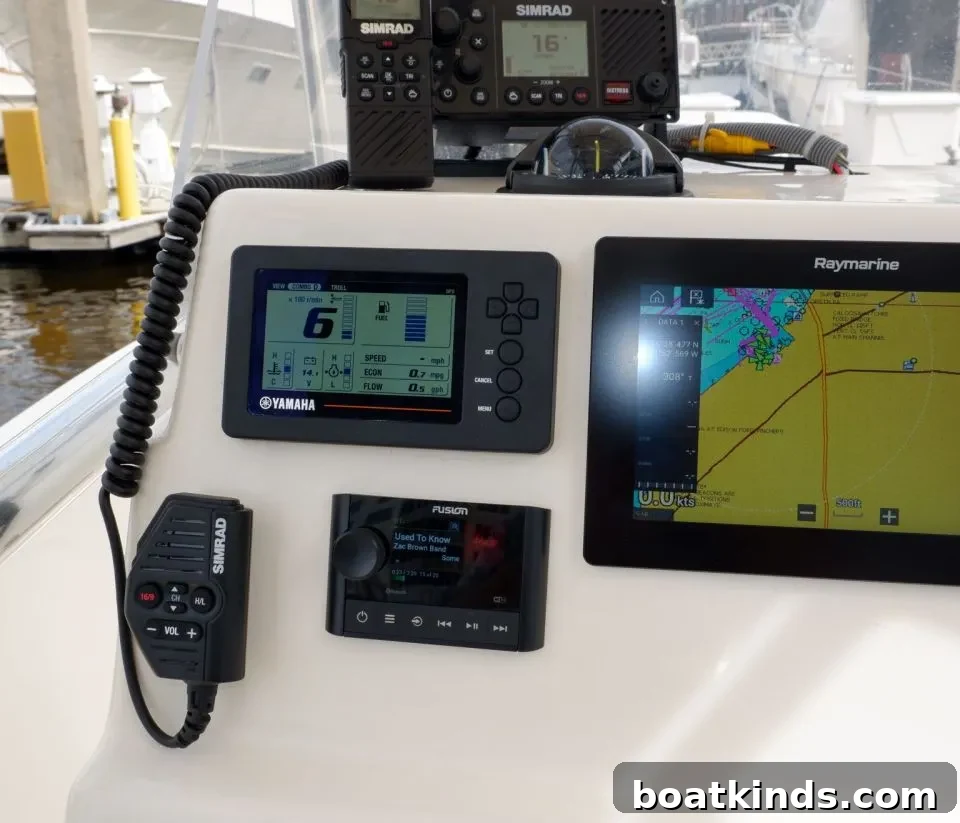
The supplied speaker microphone provides volume control, channel selection, a 16/9 quick-access button, and high/low power selection. Button placement is intuitive and the mic feels solid in the hand. On a noisy helm — like the center-console boat in this review — maximum volume is sometimes necessary to hear transmissions over wind and engine noise; an external speaker connection is available for those who need more audio output. Overall audio quality is good across the speaker mic, the wireless handset, and the internal speaker.
Wireless handset
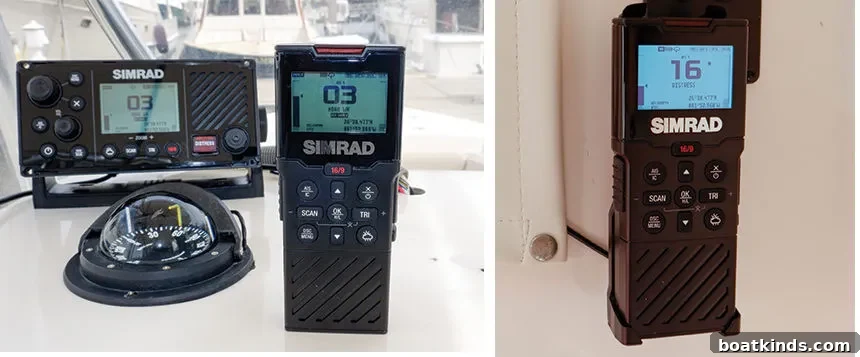
The RS40-B supports up to two HS40 wireless handsets. These cordless handsets act as nearly full-function remotes for the radio, enabling VHF voice and AIS-related features from anywhere onboard. The HS40 docks in a charging cradle that wirelessly charges the unit. Communication between handset and base uses the 2.4 GHz band; in my experience the handsets offered reliable range and resistance to interference, comparable to other wireless VHF handset implementations such as those found on some Raymarine systems.
Channel numbering
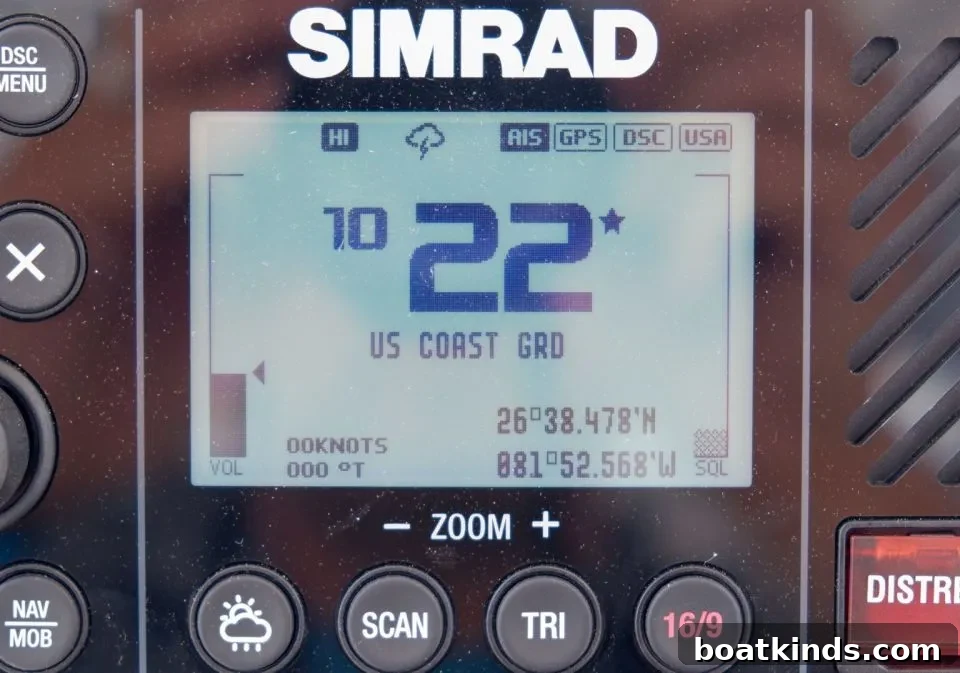
One change that can confuse users is the adoption of the new four-digit channel numbering scheme. Channels formerly labeled with an “A” suffix (for example, 22A) are now shown as four-digit numbers beginning with 10 (so 22A becomes 1022). The A and B suffixes originally indicated duplex channel pairs and are being phased out in regulatory practice. While the new numbering may feel unfamiliar at first, manufacturers are following regulatory guidance rather than choosing this format arbitrarily.
AIS performance and configuration
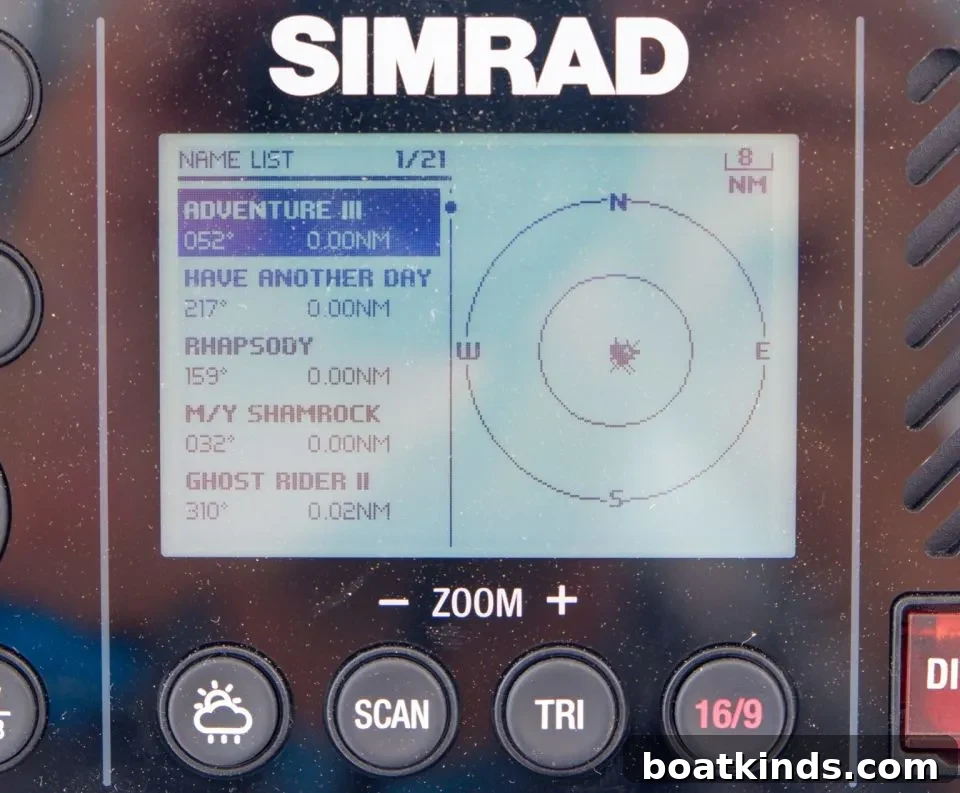
The RS40-B includes a Class B C/S AIS transceiver built into the same housing as the VHF radio. This is notable because it avoids a separate external AIS box, simplifying installations where space is limited. The internal transceiver is the C/S variant rather than SOTDMA; while SOTDMA offers higher transmit priority and potentially faster reporting under some conditions, the C/S approach is widely used and helped ensure regulatory approval for this integrated design.
Unlike many standalone AIS units that are configured via a PC application, the RS40-B’s AIS settings are adjusted through the radio’s onboard interface. I found the radio’s menu straightforward for AIS setup, and once enabled, AIS targets quickly appeared both on the radio display and on connected NMEA 2000 plotters. The radio exposes target details and permits selection of individual vessels for more information. One minor limitation is the inability to change unit display preferences from metric to U.S. units in the AIS target display.
Physically, the RS40-B requires separate antenna connections for VHF/DSC and AIS, so installations will need two antennas or an external antenna splitter. This differs from some single-antenna combination designs and is worth planning for during installation on vessels with limited antenna mounting options.
AIS alarm functionality in the RS40-B focuses on closest point of approach (CPA) alarms, which trigger when a target is projected to pass within a user-defined distance. For additional alerting, filtering, or advanced alarm logic you’ll need to rely on a chartplotter or multifunction display connected via NMEA 2000.
Final thoughts
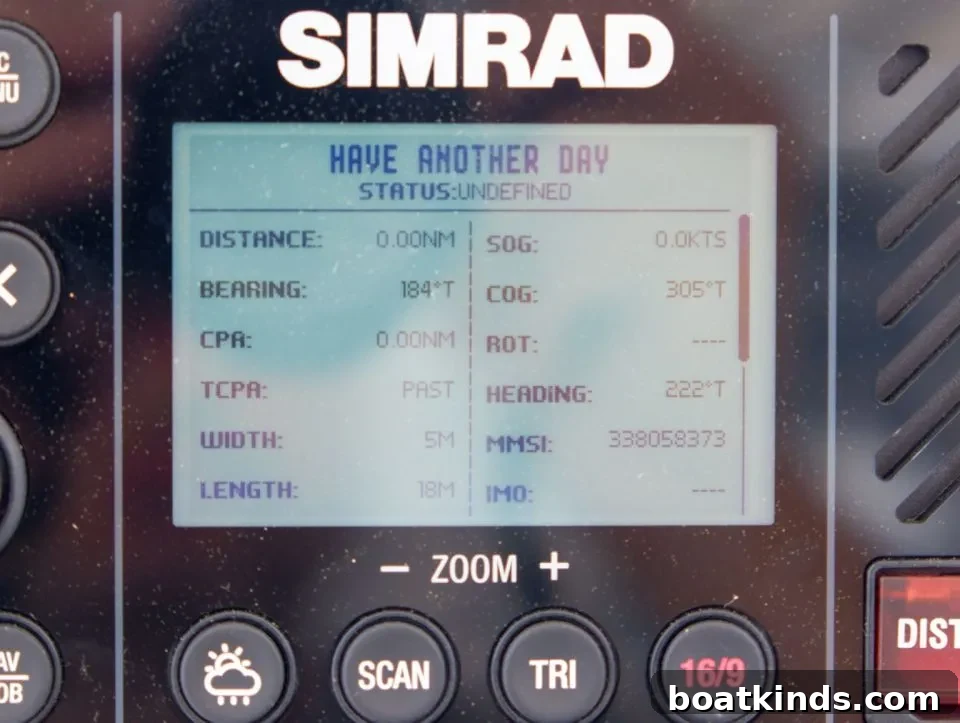
The Simrad RS40-B (B&G V60-B equivalent) is an effective combination of VHF radio and AIS transceiver in a compact package. As a VHF it offers a clean, usable interface and features expected on a modern marine radio; as an AIS transceiver it delivers reliable target display and NMEA connectivity without a separate box. The integrated GPS and support for cordless handsets increase convenience for small boats with limited dash space.
There are trade-offs: the AIS transceiver uses the C/S mode rather than SOTDMA, separate antennas or a splitter are required, and AIS alarm and display options are more basic than those found on some dedicated AIS receivers. Nevertheless, for boaters prioritizing space savings and simplicity, the RS40-B represents a practical, well-executed solution that brings VHF and AIS together in one unit without excessive complexity.
Buy Now at Defender.com