
I’ve long admired the clean, uninterrupted lines of traditional lobster boats. Like many purists, I was skeptical when builders started fitting Downeast-style hulls with outboards. But the Back Cove 34O, introduced in 2018, softened my stance. It looked right, handled well, and even earned the award for best new powerboat under 35 feet at the Newport Boat Show that fall.
So when Back Cove launched Hull No. 1 of the 39O in November 2020—the Rockland, Maine builder’s second outboard-powered model—I was eager to take the helm. The 39O (pronounced “three-nine-O,” with the “O” for outboard) arrived with plenty of attention and equipment, and I joined Capt. John Tammany of Coastal Carolina Yacht Sales in Portland, Maine, to test-drive the boat before he delivered it south to New Jersey and beyond.
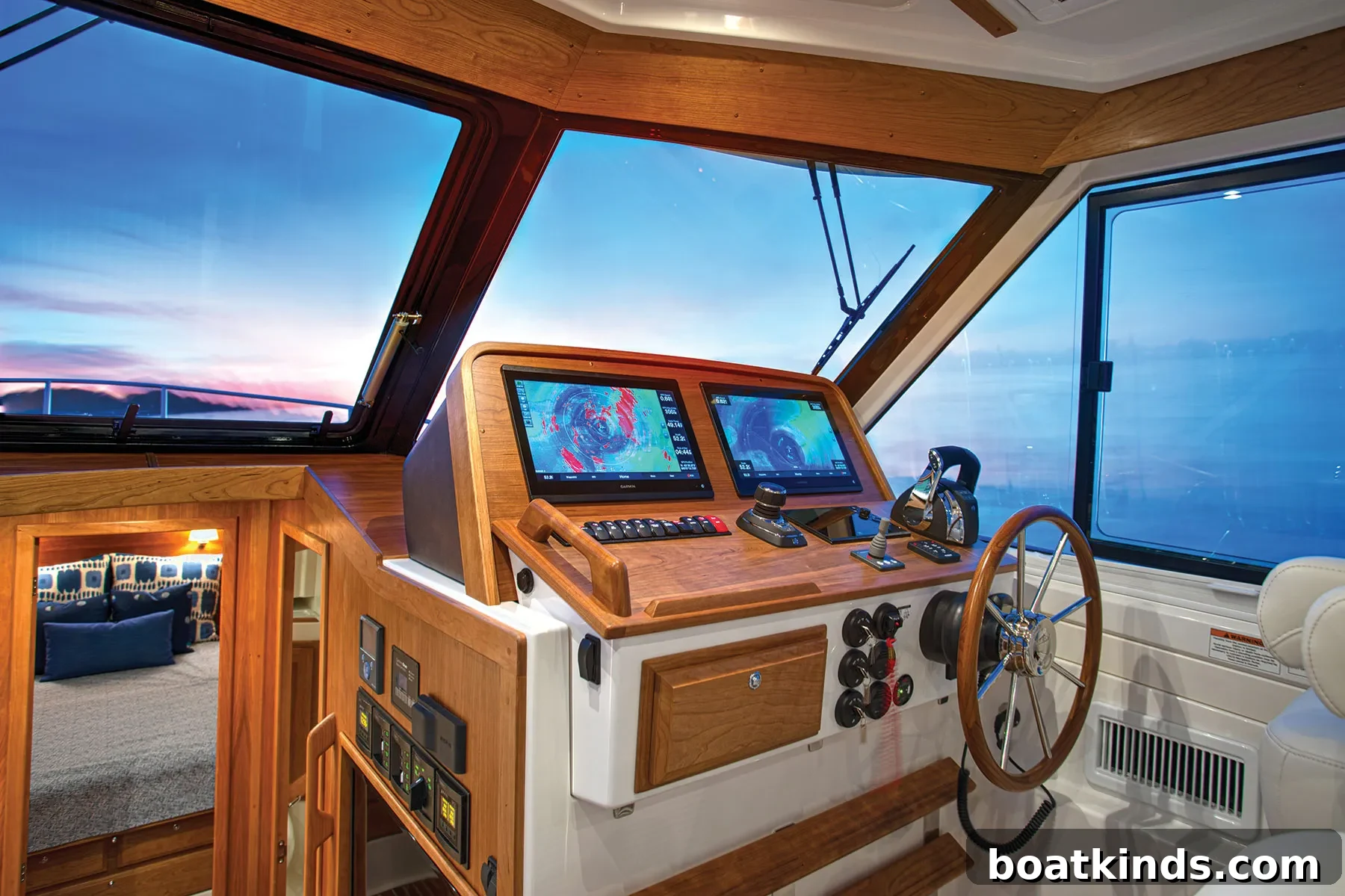
With triple 400-hp Mercury Verado outboards on the transom we slipped onto Casco Bay at 33 knots. What surprised me first was how quiet the pilothouse felt: the soft slap of one-foot waves on the hull was more noticeable than the rumble of nearly 1,200 horsepower behind us. The cockpit and console were kept intentionally uncluttered—Back Cove’s design ethos of simplicity carried over from the 34O—so the top of the console primarily houses the essential speed and course controls.
Hull No. 1 was equipped with twin Garmin 16-inch displays, Mercury Joystick Piloting for Outboards with Skyhook digital anchoring, a bow thruster, Fusion stereo, autopilot and other conveniences. Even so, the layout is straightforward, which minimizes the learning curve for an average boater. In tight spaces the optional joystick makes docking a breeze, and Skyhook lets you lock position at the press of a button.
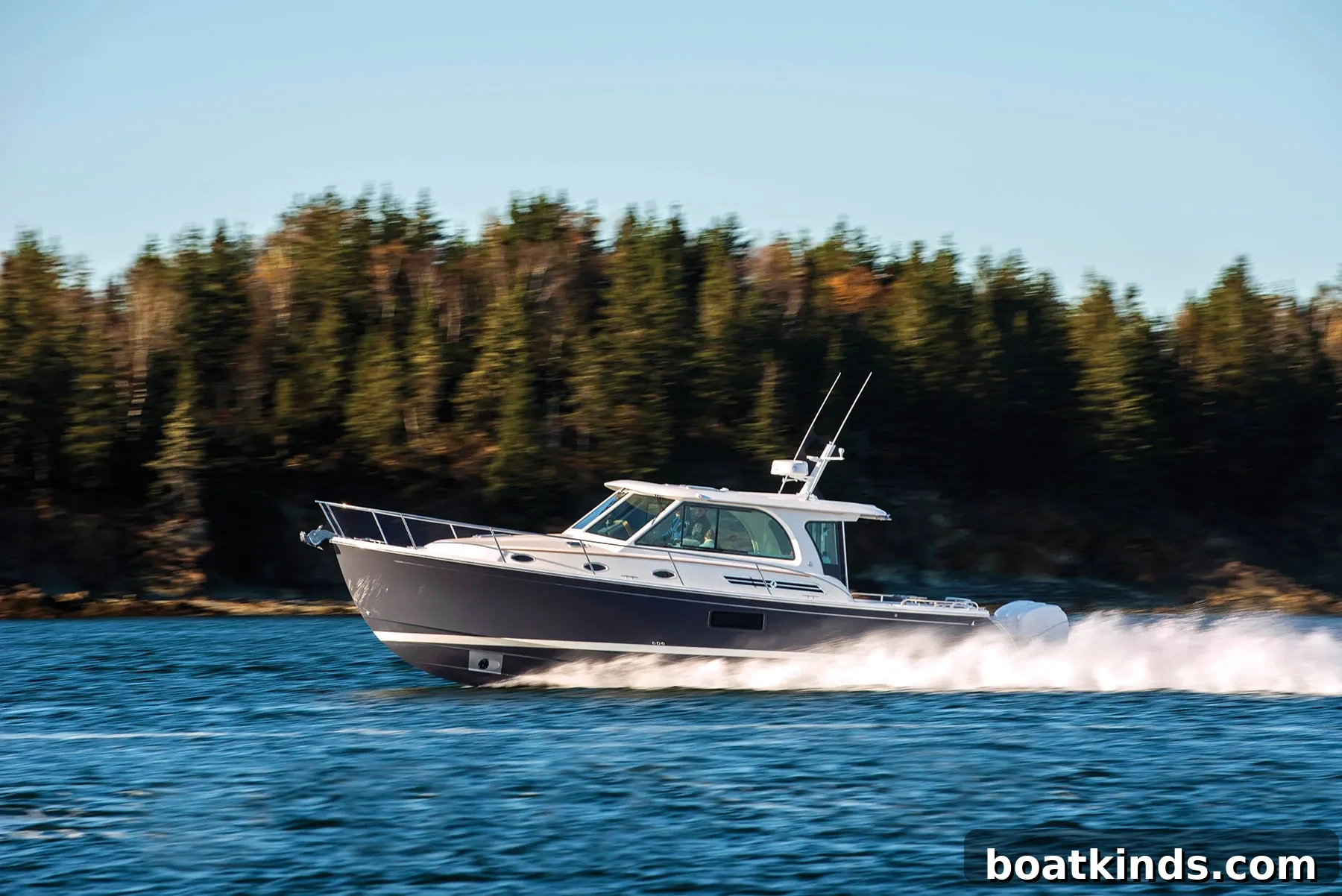
But on that calm, clear November afternoon we had little traffic and almost no wind—ideal conditions to test the 39O’s open-water manners. After finding a stretch of water with a light scatter of lobster pots, I put the boat into a 360-degree turn to cross its wake. By the time I reached our previous wake it had almost disappeared. Expecting a firm thump, I braced, but the 39O rode over the tiny wake with barely a bounce and in near silence. Later, when I pinned the throttles, the boat topped out at just over 43 knots while weaving between the lobster buoys.
Back Cove claims the 39O is its fastest model yet, a couple of knots quicker than the 34O, thanks to the optional triple 400s. Standard power is triple 350-hp Suzukis, with triple 300-hp Yamahas also offered. At high speed the 39O provided 360-degree visibility, minimal bow rise and precise response to small helm inputs—qualities that made high-speed runs enjoyable rather than stressful.
The outboard hulls for the 34O and 39O were developed in-house by the design teams at Back Cove and sister company Sabre Yachts. Both models use Back Cove’s Trailing Edge Lifting Surface (TRELIS), which Kevin Burns, Back Cove’s vice president for design and product development, credits with much of their refined behavior. TRELIS helps the hull plane earlier, allows higher outboard mounting (aligning thrust closer to the boat’s center of gravity to reduce bow lift) and can reduce wake height—explaining why the wake was so difficult to produce during my tests.
Beyond TRELIS, the outboard hulls feature a shallower forefoot, revised strake layout and increased transom deadrise. Whether it’s those elements, the lifting surface, or the combination of multiple props, the result is a boat that handles with remarkable composure. Personally, I found the outboard models more compliant and easier to control than Back Cove’s inboard boats, especially under varying conditions.
Market response supports that preference. Jamie Bloomquist, Back Cove’s national sales manager, says the builder remains committed to the efficiency of single inboards, but demand for outboard models is strong. By early 2021 Back Cove expected to have built nearly 50 of the 34O in just over two years, a figure limited in part by Covid-19 production slowdowns. The 39O was following a similar trajectory: as of mid-November 2020, 16 units had been pre-ordered. Buyers increasingly appreciate the outboard benefits—less maintenance and vibration, easier access without an engine room, more usable stowage, and, as I experienced, quieter operation.
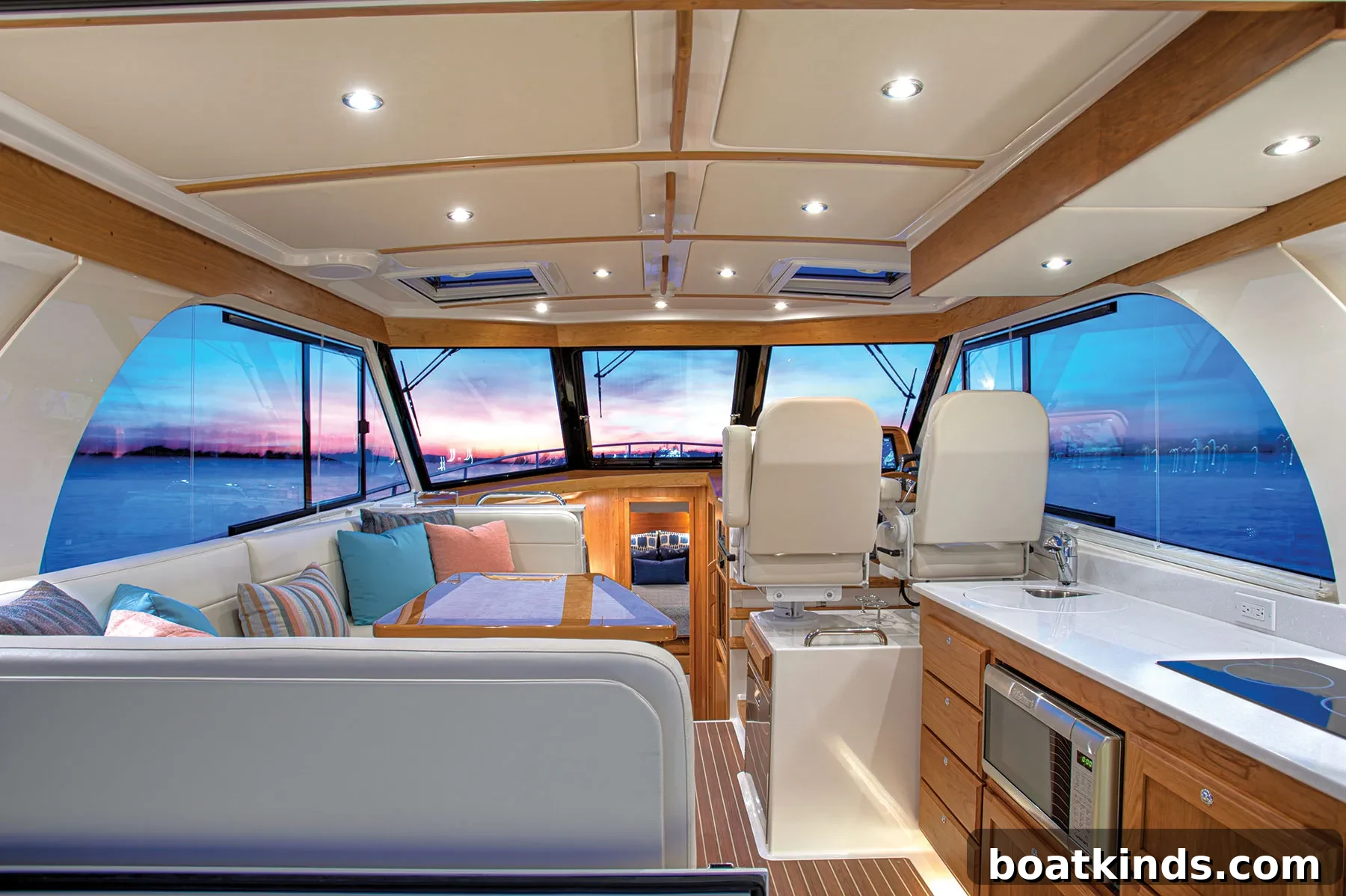
After our run, Tammany walked me through the 39O’s interior. The boat’s accommodations were drawn from scratch with an open, inviting layout. Heating and air-conditioning vents are neatly hidden behind the pilothouse supports, while overhead hatches, a center windshield panel and sliding side windows provide ventilation and daylight. OceanAir shades are built in for privacy and sun control.
A heavy-duty glass door and a bi-fold window aft open the pilothouse to the cockpit, creating an expansive social area. The galley to starboard isn’t a full gourmet kitchen, but its microwave and two-burner cooktop will comfortably serve four or more for casual cruising and entertaining. Small touches show careful attention to detail: windshield-wiper motors are concealed behind cherry trim yet are serviceable by removing a few slotted screws.
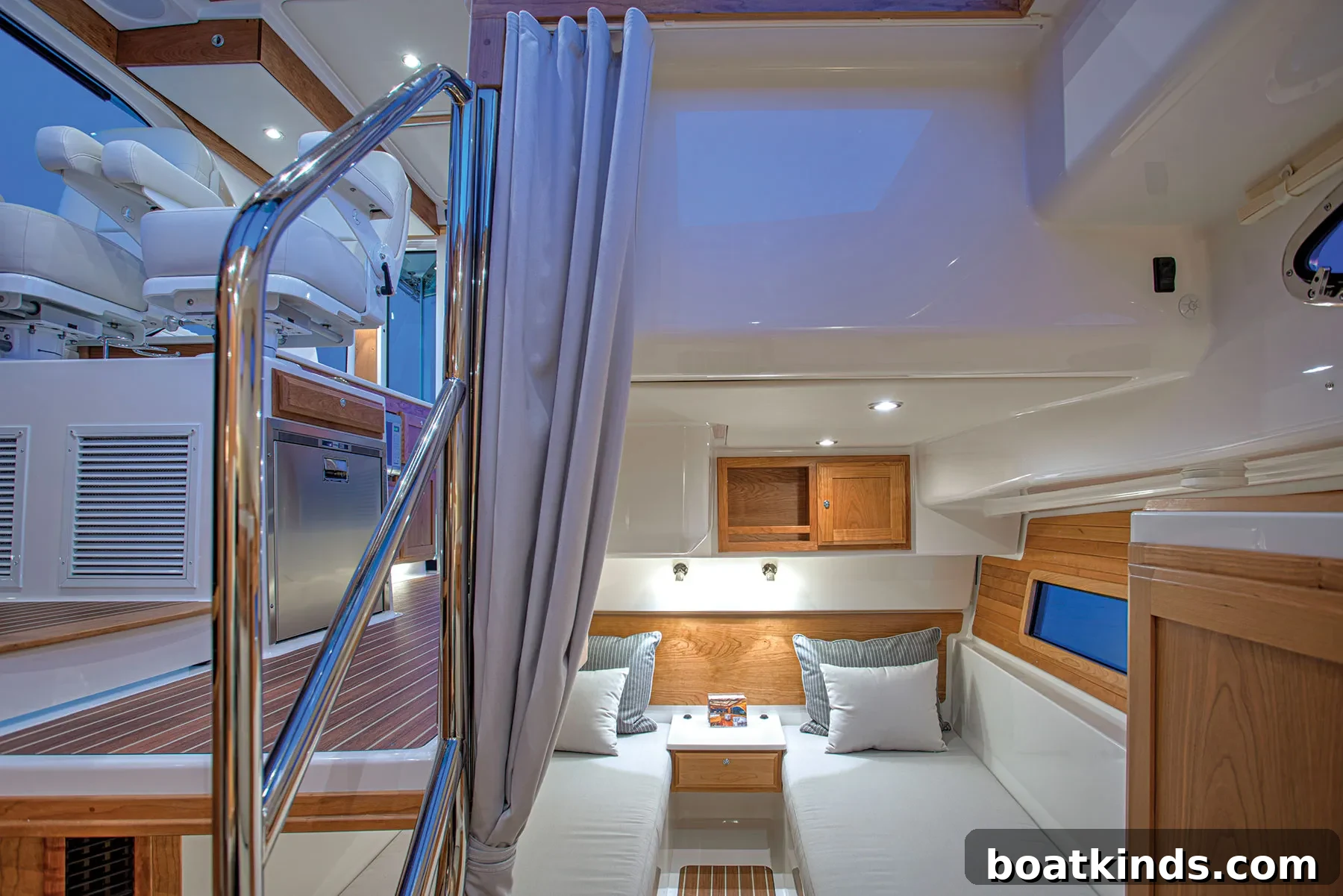
A three-step staircase leads below to the lounge and staterooms, with light from the triple-pane windshield flowing into the midships cabin. The midship cabin features twin bunks with a curtain for privacy; an optional hull window over the port bunk brightens the space. The inner bunk has reduced headroom because of the deck above, but at anchor it could be one of the coziest bunks aboard.
The interior balances white fiberglass with tasteful cherry trim in a Herreshoff-inspired style that avoids the claustrophobic feel too much wood can create. The head and separate shower to starboard are roomy—the shower is especially generous, though I admit to fumbling with a small round door handle that left me feeling older than I am.
Forward, the owner’s cabin offers a queen-sized island V-berth with light from hatches and portholes. Hull No. 1 came with the optional third TV in the owner’s cabin, complementing displays in the lounge and above the galley. A private door connects the owner’s stateroom to the shared head and shower.
On deck, teak swim platforms flank the outboards and provide cockpit access; one platform includes a swim ladder. Stainless-steel transom gates sit at either side of a U-shaped cockpit settee with a folding table. Fenders stow conveniently under the settee, allowing guests to remain seated during fender retrieval. Opposite the U-shaped seating, an aft-facing seat conceals space for an optional grill. A cockpit sole hatch gives access to a lazarette that houses the standard 9-kW genset, batteries and a 23-gallon diesel tank.
Tammany demonstrated the power-operated stern garage that opens to stow a deflated inflatable or gear. That feature highlights a trade-off between outboards and inboards: inboards make it easier to tip a dinghy onto a large swim platform or hang it from davits, while outboards often provide a convenient garage for a deflated dink. Each configuration has its advantages depending on how you cruise.
I still love the deep rumble of an inboard and the uninterrupted lobster-boat profile, particularly for slow, rugged cruising in rocky regions like Maine. But when I want speed, less vibration and noise, easier stowage and the ability to get close to sandy beaches, the Back Cove 39O is an appealing option. It combines refined handling, purposeful design and practical amenities into a fast, quiet and comfortable boat.
This article was originally published in the February 2021 issue.