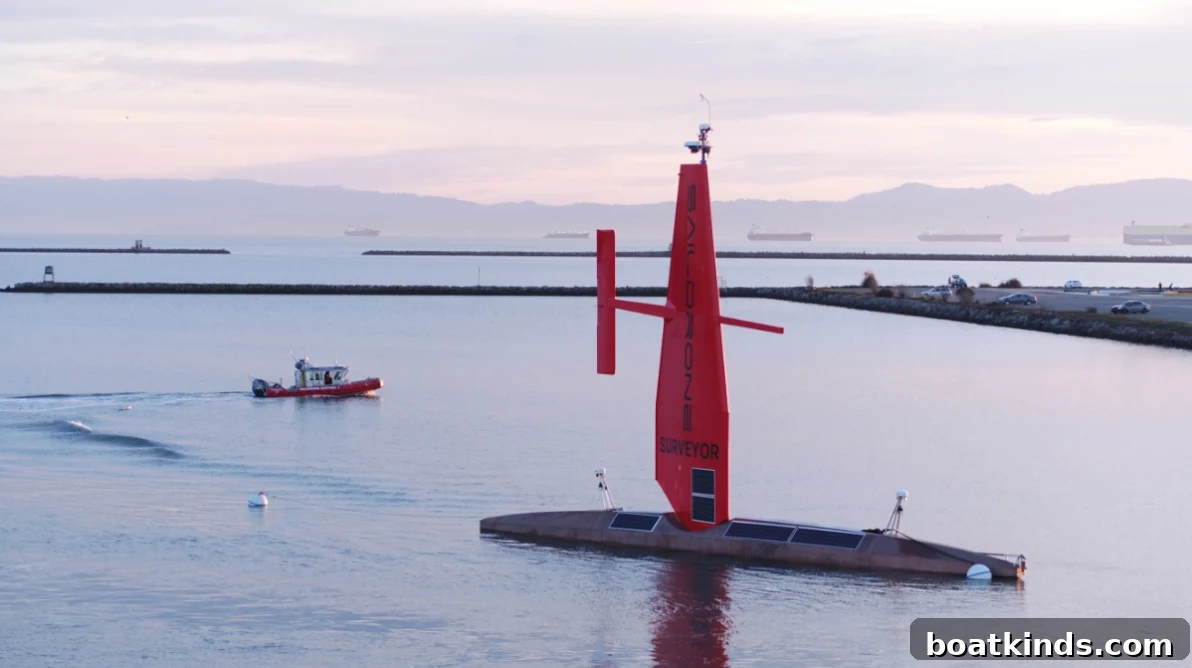
Saildrone’s 72-foot Unmanned Surveyor Aims to Map the Uncharted Ocean
With roughly 81 percent of the world’s oceans still unmapped, a California-based company is deploying an innovative approach: wind- and solar-powered unmanned sailboats. Alameda’s Saildrone has launched its first 72-foot remotely controlled vessel, the Saildrone Surveyor, into San Francisco Bay to begin advanced ocean mapping and environmental monitoring.
Advanced Sensing and Long Endurance
The Surveyor is equipped with high-resolution sonar capable of mapping depths exceeding four miles below the surface, and it also carries systems to collect environmental DNA. Designed to operate unattended for as long as 12 months, the vessel transmits real-time data back to shore-based researchers while enduring the open ocean’s harsh conditions.
Currently completing final sea trials, the Surveyor is expected to depart soon on a round-trip voyage to Hawaii for mapping missions. These autonomous saildrones offer practical advantages over traditional manned research ships, particularly in cost, endurance and environmental impact.
Environmental Benefits and Noise Reduction
One of the most visible benefits is the Surveyor’s low environmental footprint. Saildrone founder and CEO Richard Jenkins has pointed out that conventional ships consume large quantities of fuel—often costing thousands of dollars per day—whereas the saildrone relies on wind and solar energy. Its near-silent operation avoids the noise pollution associated with large motorized vessels, reducing disturbance to marine life. The company has also implemented operational protocols that limit sonar use in the presence of marine mammals to avoid interfering with animals that rely on sound for communication.
Data-as-a-Service Model
Rather than selling the vessels themselves, Saildrone provides ocean data as a service. This model makes high-quality oceanographic data more accessible to researchers, government agencies and organizations that cannot afford the cost of chartering a manned research ship. By democratizing access to data, these unmanned platforms could broaden participation in ocean science and enable more frequent and widespread monitoring.
Engineering for a Harsh Environment
Designing a 72-foot autonomous sailboat required condensing a large suite of sensors, communications and mechanical systems into a robust, compact platform. Components must withstand wind, waves, storms, salt corrosion and extreme temperatures, with no crew onboard to perform repairs. For that reason, Saildrone has emphasized durability and redundancy in its hardware and systems to ensure long-term reliability at sea.
Because satellite bandwidth is limited, the Surveyor integrates onboard machine learning to prioritize and compress data before transmission. This allows critical information to be sent in real time while reducing the amount of lower-priority raw data transmitted over costly links.
Innovative Biological Monitoring
Acoustic sensing alone can’t reliably identify the many species present in the ocean, so Saildrone partnered with researchers to incorporate environmental DNA (eDNA) sampling capabilities. An onboard environmental sample processor (ESP) collects microscopic bits of biological material shed by organisms into the water. The ESP preserves those samples chemically so genetic material can be recovered and analyzed later on land, offering a noninvasive way to monitor biodiversity without having to catch or count individual animals.
Why Ocean Mapping Matters
Detailed ocean maps are essential for safe navigation, but their value extends far beyond shipping. Accurate bathymetry and seafloor maps support climate modeling, natural resource assessment, fisheries management and cultural heritage research such as locating shipwrecks. With about 70 percent of the planet covered by ocean and the vast majority still uncharted, autonomous platforms like the Saildrone Surveyor could accelerate discovery and fill critical gaps in our understanding of the marine environment.
As the Surveyor begins operational missions, its combination of long endurance, low environmental impact and integrated sensing—coupled with a data-first business model—demonstrates a promising path for scaling ocean observation and making high-quality data more widely available to the scientific community.