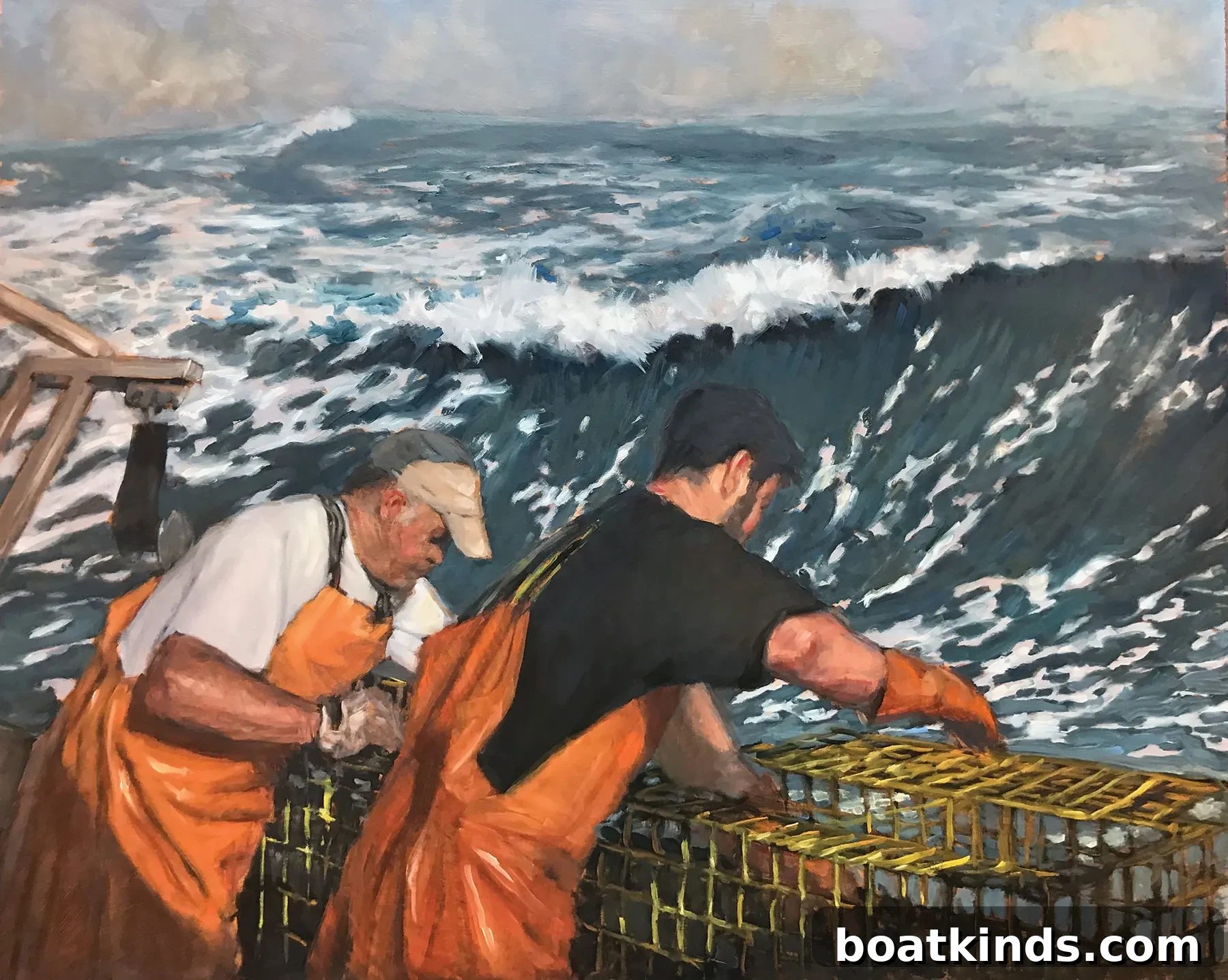
The sea is heaving. A small commercial boat pitches and rolls as it rides over the swells, but the two lobstermen on deck move with steady purpose. For them this is routine work, another day spent on a livelihood shaped by wind, wave and weather.
They have nearly 600 traps spread across the water, and as the men haul lines and work the gear, the motion of their bodies and the rhythm of the boat become almost like a practiced dance. The waves are not so violent as to stop their work, but the men never lose sight of the sea’s power. It is a generous provider and an unforgiving force: a single slip, a line wrapped around a limb, one misstep—any of those mistakes can be fatal. That tension between daily labor and constant risk is at the heart of Robert Beck’s oil painting Stormtide.
“There’s a big concern out there on the water,” Beck says. He lives in New Hope, Pennsylvania, and has spent years accompanying commercial lobstermen in Jonesport, Maine, a town he describes as remote and at times feeling like a step back in time. By observing fishermen at work, Beck tries to capture not just visual detail but the emotional weight of being at sea. “When you see a big wave, you know it can have consequences, you know it can have impact, so the water is always on a fisherman’s radar,” he explains.
The men portrayed in Stormtide are family—father and son-in-law—reflecting a common pattern in Jonesport, where fishing and boatbuilding are often passed down through generations. The village of roughly 700 households supports a community tied to the ocean; residents harvest nearly $2 million worth of lobster each year. These family networks and traditions are part of what draws Beck back to Jonesport again and again.
Beck is careful to convey both the intimacy and the menace of that life. He does not rely on photographs; instead he paints from memory, observation and feeling, intentionally selecting and arranging elements to communicate what it actually feels like to be aboard a working lobster boat. A photograph might show two men hauling traps, but a painting can emphasize the sea’s vastness, its mass and momentum, the way light and weather shape mood and meaning.
He did not grow up in a maritime environment. Beck left a corporate career at age 40 to pursue painting after studying at the Pennsylvania Academy of Fine Arts. His attraction to the coast began when he went to Maine to paint the sardine carrier Grayling at Hylan & Brown in Brooklin. From there he traveled the state’s rocky shoreline, finding subjects in boatyards, shipwrights and fishing communities. Jonesport’s boatbuilding and long-standing fishing traditions appealed to him for their authentic, time-honored processes—practical, risky, and poetic at once.
Over time Beck has become known for chronicling the Maine coast and its maritime trades, work that led to his first solo show at the Maine Maritime Museum in 2016, where he exhibited 56 paintings. Stormtide itself is being shown by the Michener Art Museum and by the American Society of Maine Artists this year, part of his continuing exploration of fishermen, vessels and the elemental relationship between people and sea.
In works like Stormtide, the sea is a central character. Beck enlarges its physical presence to underline the seriousness of life on the water: its unforgiving scale, the constant awareness required of those who make their living from it. The painting honors both the craft and the courage of lobstermen who, generation after generation, maintain a way of life that demands intimate knowledge of the tides and a readiness to confront peril.
Through careful composition and expressive brushwork, Beck translates the movement and mood of a harsh maritime day into a canvas that draws viewers into the scene. The result is a portrayal that balances romanticism and realism—respecting the dignity of the fishermen and acknowledging the persistent hazards inherent in their labor.
This article was originally published in the September 2021 issue.