
It took years of boating experience for Geoff Stone to be ready for that mid-March day at sea: aboard his 45-foot Leopard sailing catamaran, Rolling Stones, and well over halfway through a 3,150-mile Pacific crossing from the Galapagos to the Marquesas. The Wisconsin native had been around boats since childhood, waterskiing from the age of five and eventually performing in waterski shows around the world. A friend encouraged him to take the U.K. Royal Yachting Association courses, and he earned qualifications up to Offshore Yachtmaster, while much of his seamanship remained self-taught.
Stone first owned a 25-foot monohull for sailing on Lake Michigan, and in March 2021 he bought Rolling Stones on the brokerage market. The catamaran’s four staterooms made it ideal for Stone, his wife Meghan, and their three young sons. They spent six months cruising the U.S. Eastern Seaboard along the Intracoastal Waterway, then crossed to the Bahamas for what Stone calls “a magical five months.”
But the urge to push farther didn’t fade. The family sailed 200 miles to Jamaica, visited Panama’s San Blas Islands, transited the Panama Canal, and continued into the Pacific. By late January, when they reached the Galapagos Islands, everyone was committed to life aboard and to long-distance cruising.
With their boys aged 9, 7 and 6, Stone and Meghan decided the next leg—an extended open-ocean passage from the Galapagos to the Marquesas—was too much for the whole family. On March 1, Stone departed with his brother, his father-in-law and a family friend. All had sailed on Rolling Stones before, but none had attempted such a lengthy ocean crossing.
“There’s no place to drop an anchor. There are no islands, no nothing between the Galapagos and the Marquesas,” Stone says. They motored south for several days to reach roughly 11 degrees south latitude, where their weather-routing service expected steadier trade-wind conditions. For a time they enjoyed several days with sails up and good speed, savoring the dream of long-distance cruising. But about 1,200 miles from the Marquesas, that dream was interrupted.
‘We hit a whale’
A Kelly Peterson 44 named Raindancer had left the Galapagos on the same route and was about a day ahead of Rolling Stones. On March 13, owner Rick Rodriguez and his crew were in the cockpit eating pizza when they felt a violent impact and heard clanging metal. One crew member shouted, “We hit a whale!”
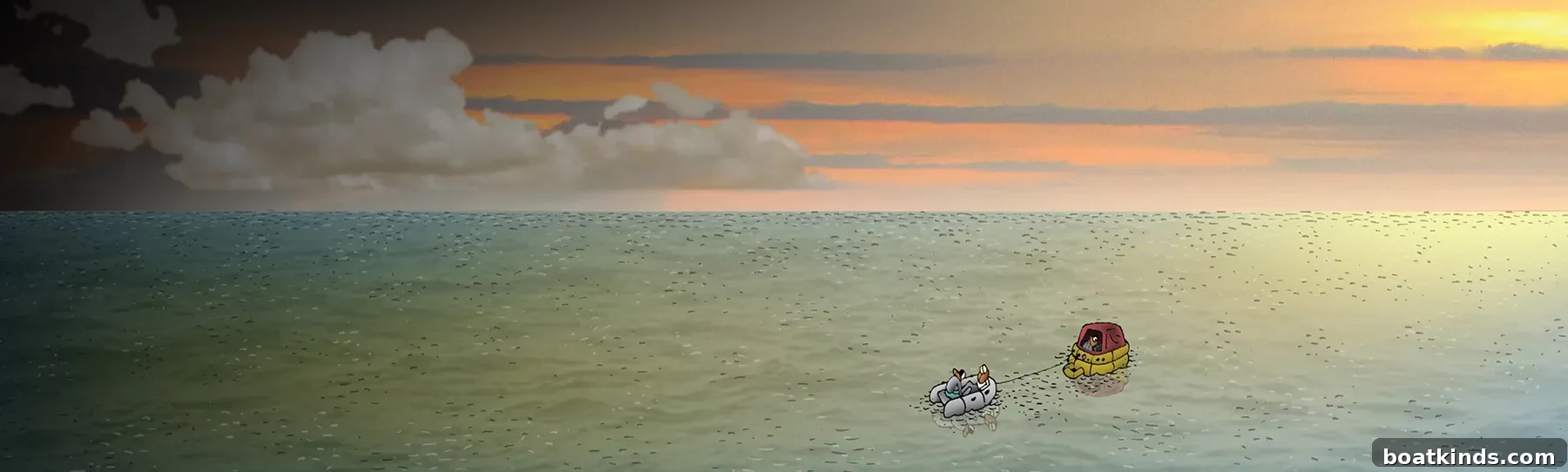
The whale swam away, bleeding, and Raindancer was critically damaged. Rodriguez reported that within about five seconds a bilge alarm sounded as water poured into the stern. The crew deployed emergency gear and tried to plug the breaches, but the flooding was too fast. They prepared the liferaft, activated an EPIRB, called a Mayday on VHF, and launched their 10.5-foot dinghy with the liferaft attached.
Hoping against hope, Rodriguez donned a mask and fins and inspected the hull. The damage was extensive—multiple holes and cracks—and within minutes the boat was roughly two-thirds flooded. The crew transferred to the dinghy and liferaft and watched as the last 10 feet of the mast sank with alarming speed.
By sunset they were adrift, calling Mayday on a handheld VHF every hour and using a Globalstar SPOT tracker to transmit frequent positions. Supplies included about a week of fresh water, means to collect rain, a few weeks of food, a fishing pole, and limited battery charge on their Iridium Go! and phone. Rodriguez messaged people ashore and at sea, including a friend, Tommy Joyce, who was about 180 miles away and began mobilizing help.
‘We Were the Closest Boat’
The following morning aboard Rolling Stones, Stone was checking in with friends when a buddy sent a screenshot from the Boat Watch Facebook group showing Raindancer’s distress information. The last known position was about 65 miles southwest of Stone’s location. Knowing several World ARC rally boats were in the area, Stone coordinated with them; they established a “Rescue Raindancer” WhatsApp group to share positions and communications.
World ARC’s managing director, Paul Tetlow, confirmed the rally fleet had received the Mayday and Iridium messages and alerted maritime rescue coordination centers. Stone shared his coordinates and speed, and he soon realized Rolling Stones was the closest available vessel. Although neither he nor his crew had formal rescue experience, Stone felt compelled to help: “In these communities, as you get out here, it becomes very apparent that everybody is here to help everybody else,” he said.
‘It’s a Big Ocean’
Stone headed straight for Raindancer’s last known coordinates. A cargo ship, Dong-A Maia, and several rally boats were also converging. Thanks to satellite communications like Starlink and Iridium, coordination among the vessels and with rescue authorities moved faster than relying on EPIRB relays alone.
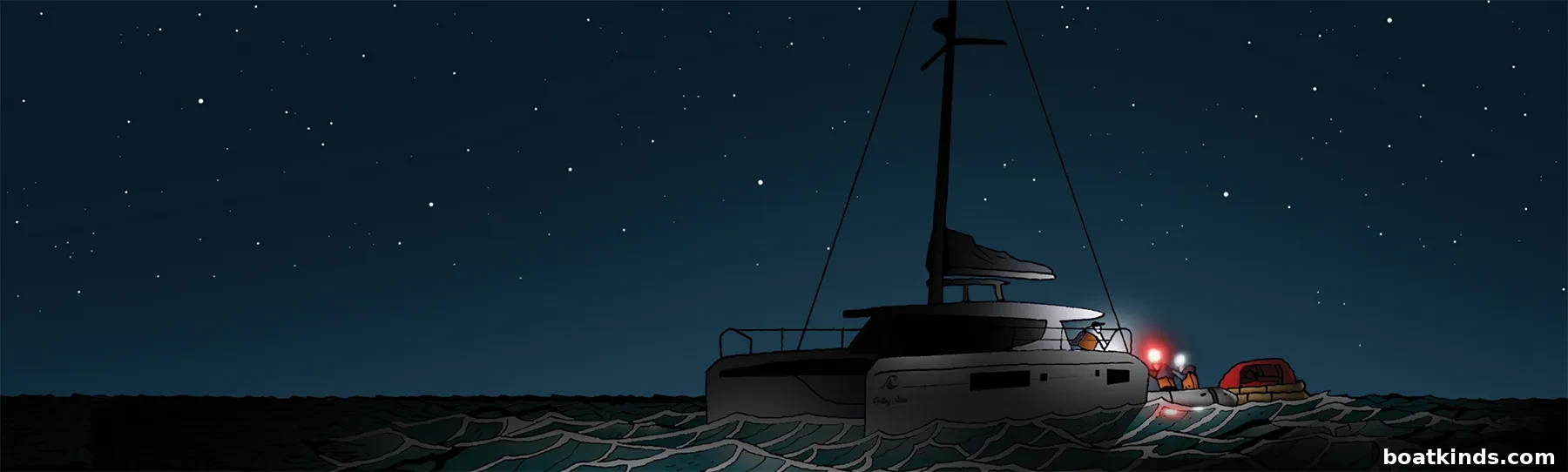
Nightfall made spotting the survivors easier. From about five miles out, lights on the liferaft and dinghy became visible. Stone’s crew added every available light, then dimmed them when excessive glare hampered their vision. They approached cautiously in 5-foot seas with roughly nine-second periods, keeping clear of drift lines and the life-raft sea anchor.
It took about an hour to close the final distance at roughly 5 knots. The Raindancer crew boarded the dinghy, then transferred to Rolling Stones, with owner Rodriguez the last to leave his sinking boat. Once aboard, they sheltered in the cockpit while Stone turned the catamaran downwind to regain a more comfortable ride and begin assessing the situation.
From the moment Stone realized they were the closest help to when the survivors were aboard, roughly nine hours had passed. The time adrift and the uncertainty of rescue were emotionally taxing, and Stone was particularly mindful of his guests’ psychological state.
‘They Were Calm and Collected’
Remarkably, the Raindancer crew remained composed. Stone praised their preparedness: multiple communication devices, emergency training, and practiced liferaft drills had paid off. They had conserved battery power and focused on essential tasks, avoiding unnecessary exertion and panic.
Stone admitted one regret: his own crew hadn’t prepared warm food during the nine-hour transit. At rescue they had only a fresh-baked loaf of bread handy. He also wished they had transferred more personal gear from the dinghy; in the chaos the priority was lives, not possessions.
With four rescued people aboard, Rolling Stones now carried eight people and faced some logistical challenges for the roughly 1,200 miles left to the Marquesas. Stone and Meghan tracked provisions and rearranged storage; within a day or two it was clear they had sufficient food, toiletries and spare clothing to keep everyone comfortable. For nine days both crews sailed together, sharing staterooms, settee spaces and forward benches, and cooperating quietly to make the voyage workable.
The ordeal reinforced for Stone the value of redundant communications and reliable charging options. He already owned an EPIRB, Iridium Go! and Starlink, and he planned to add a third satellite beacon like Globalstar SPOT to his safety gear. He also recommended hand-crank or solar chargers to preserve device power in an emergency.
When last reported, the Raindancer crew had reached Tahiti and were taking care of paperwork and logistics ashore. Stone reunited with his wife and three sons on Rolling Stones, and the family resumed island-hopping through French Polynesia. Stone said the rescue only deepened his commitment to cruising and the sailor-to-sailor support network that defines the community. “Raindancer didn’t lose the dream either,” he added. “They’re actively searching for a way to continue.”
This article was originally published in the June 2023 issue.