
In the early 1980s, after a 25-year career as a production engineer at Grand Banks, Tony Fleming set out to design and build his own motoryacht. The British-born, U.S.-based designer knew precisely what he wanted: a low-profile boat with a fine forward entry, a dedicated pilothouse and a twin-engine semi-displacement hull that could cruise efficiently yet achieve high-teen speeds when required.
Decades later that vision endures. The Fleming 55 has been produced at the same Taiwanese yard to the same demanding standards Fleming established in 1985, and it remains central to the marque’s identity.
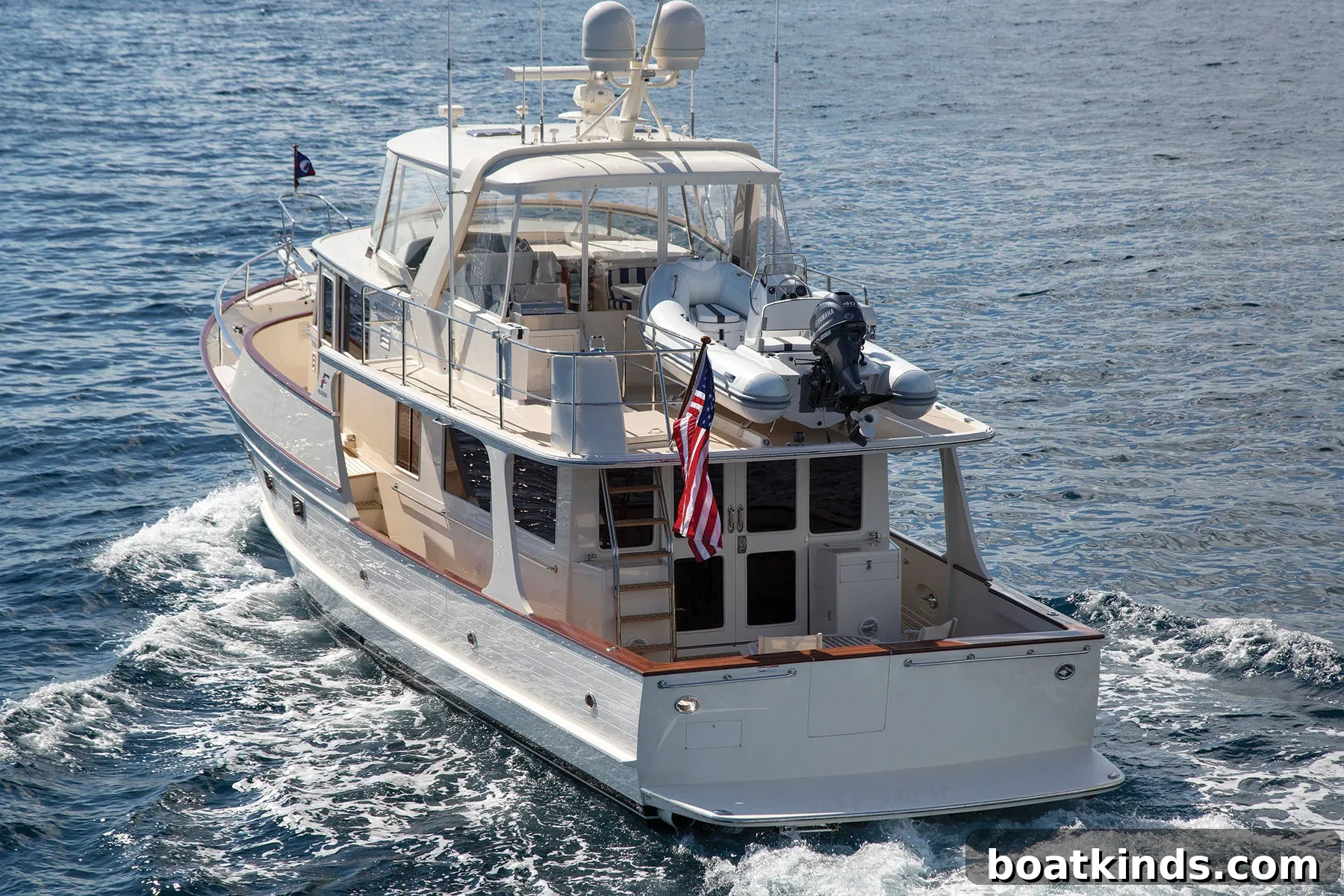
Few models can match the Fleming 55 for longevity on an unchanged hull platform. While other notable designs—like the Grand Banks 42 and the Holland 32 lobster hull—enjoyed long runs, the Fleming 55 stands out among larger cruising yachts for its sustained production life and enduring appeal.
By 2020, 258 Fleming 55s had been built. Although the Fleming line expanded to include 58-, 65- and 78-foot models, the 55 remains the most popular model. In the early years, shorter versions were produced by modifying the 55 mold, but once it became clear that the 55 could be handled by a couple, those shortened builds were discontinued in favor of the original layout.
Structurally, the 55’s hull has changed little in form since 1985. However, Fleming applies continuous incremental improvements—typically eight to ten upgrades per boat—so the cumulative refinements to systems, equipment and fit-and-finish now number in the thousands. The yard’s obsessive attention to quieter operation, greater comfort, improved efficiency and enhanced safety keeps the design current without wholesale redesigns.
Even after starting to hand operational control to his nephew Adi Shard and longtime engineer Duncan Cowie more than a decade ago, Tony Fleming remains an active presence, testing ideas on his own boat and offering feedback. Product improvements also come from dealers, mechanics, owners and yard staff; if a change demonstrably improves the boat, it is integrated into the next 55. That iterative process motivates many owners to trade up to newer 55s as upgrades accumulate.
Burr Yacht Sales, with locations in Edgewater, Maryland and Stuart, Florida, is the world’s largest Fleming dealer and has sold 124 of the 258 new Fleming 55s built through 2020. Burr also specializes in reselling well-maintained, pre-owned 55s.
Kevin Althoff of Burr, who’s been with the company since 2007, attributes the model’s longevity to its original layout and balance. “There’s nothing fundamental that needs changing,” he says. “If it were a poor design they’d have had to replace it. Instead Fleming refines it steadily—like the Porsche 911—keeping what works and improving what can be better.”
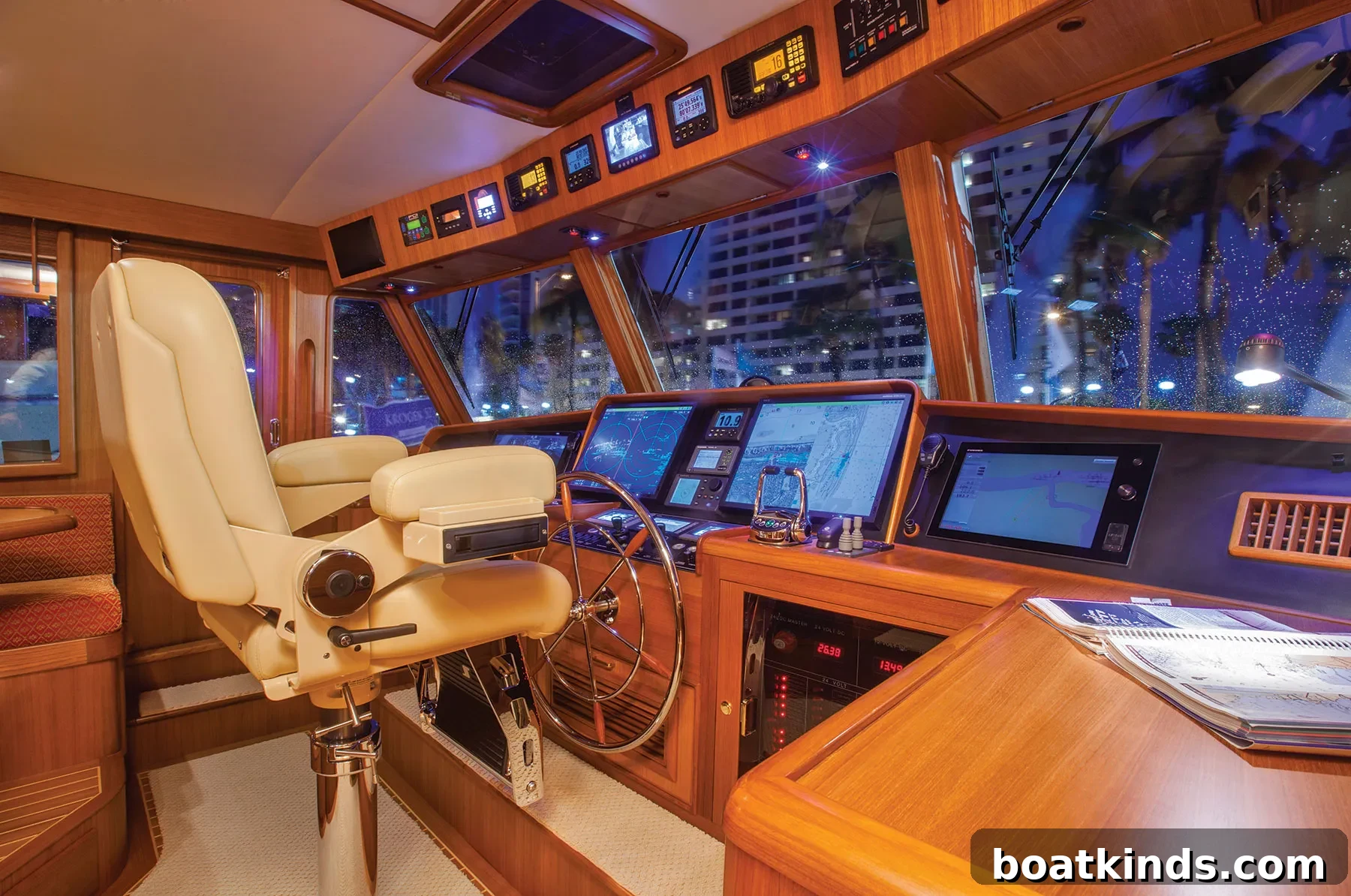
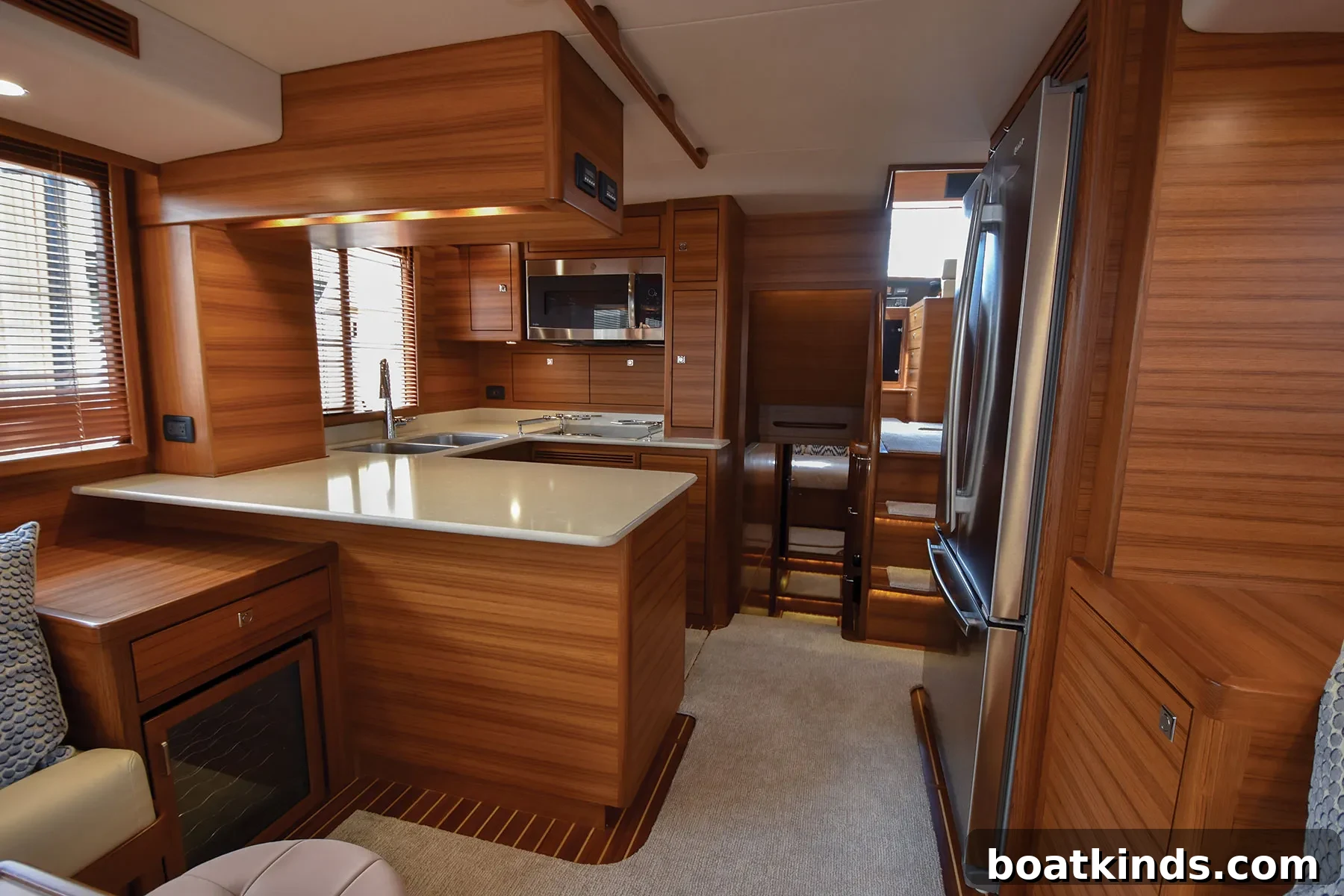
The 55 was designed with a low center of gravity. The cockpit, salon floor and sidedecks sit only 18 inches above the waterline, producing notable stability both underway and at anchor. That low profile also increases safety and ease of use—stepping aboard from a dock through the side gate requires no climb, and the hull form avoids the volume-by-height approach many builders use to gain interior space.
This compact vertical profile contributes to the Fleming 55’s seaworthiness and ability to tackle challenging northern passages.
Martha Comfort, Fleming’s West Coast representative at Chuck Hovey Yachts in Seattle, notes about 50 Fleming 55s operating in the Pacific Northwest and Western Canada. She points to the covered walkaround decks, Portuguese bridge, inside access to the flybridge, redundant systems and long range—900-plus miles at 10 knots from Seattle to Juneau—as why owners choose the model for extended coastal cruising. “For many boaters that cruise up to British Columbia and Alaska, the Fleming is ideal,” she says.
East Coast owners make similar passages, Althoff notes. Fleets of 55s routinely voyage to Maine, the Canadian Maritimes, the Bahamas and the Caribbean. The dedicated pilothouse is a major selling point for these northerly trips: a dry, protected helm that lets crews remain comfortable and in control in bad weather without constant heavy weather gear.
The pilothouse also functions well as a separate living space. Althoff points out that it provides privacy and workflow separation—someone can take a call in the pilothouse while others relax in the salon—and it offers practical access to the flybridge and side doors. Fleming has resisted tempting design changes that would enlarge the table or remove doors in favor of keeping a practical cruising layout that suits a couple.
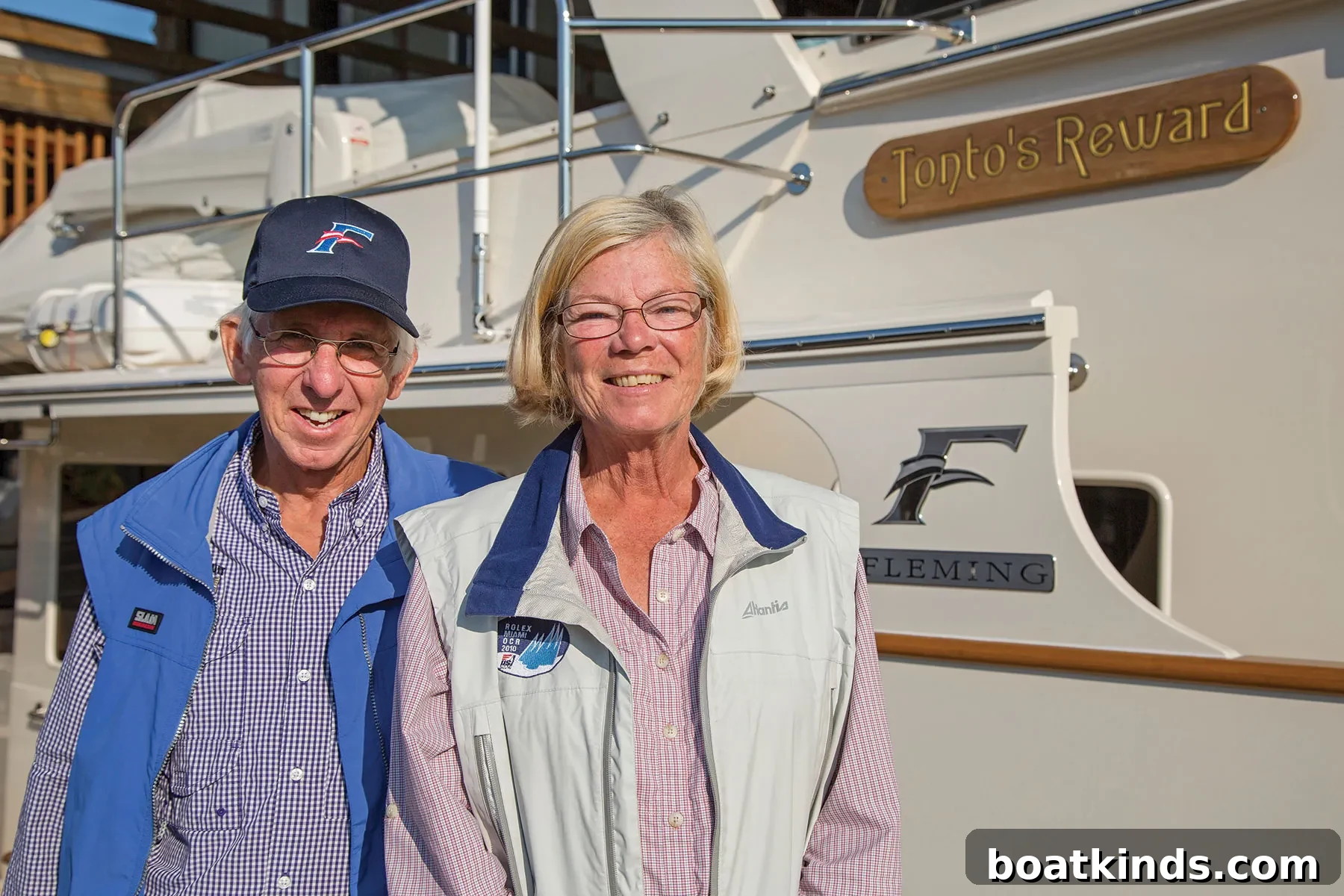
Owners like Gail and David Bernstein of Fort Myers, Florida, confirm the 55’s strengths in everyday use. Lifelong sailors who transitioned to powerboats, they moved through several models before buying a used 2008 Fleming 55 in 2013 and, later, a new 2016 55 configured to their preferences. The Bernsteins appreciated the third stateroom—adapted as an office—and the boat’s strong reputation for seaworthiness.
Gail admits early nervousness handling a 55-footer, but steady practice made her a confident helmswoman; today she routinely docks the boat while David handles lines. Their cruising ranges typically fall between 8 and 10 knots, where the twin Cummins QSC 500 diesels consume roughly 10 gallons per hour—about a gallon per mile—a notably efficient burn for a 55-foot motor yacht.
Top speed is listed at 19 knots; owners report practical top speeds around 17 to 18 knots in favorable conditions. The Bernsteins use full speed selectively—on passages where daylight and schedule demand it—and otherwise prefer comfortable cruising speeds for range and fuel economy. Sea conditions influence their routing: the Fleming will handle 4- to 5-foot beam or stern seas comfortably, but owners often avoid big head-on slamming for comfort rather than capability.
When they upgraded to a new Fleming in 2016, the Bernsteins appreciated a number of factory changes implemented over the prior eight years—switching from Naiad stabilizers to ABT-TRACs, upgrading air conditioning venting, replacing prop shaft couplers with Seatorques and improving the fuel polishing system—which added convenience and, in their experience, measurable efficiency benefits.
Strictly daylight cruisers by preference, the Bernsteins still exploit the 55’s speed when a stretch of open water calls for covering ground quickly. Their cruising history includes extended trips through the ICW, the Chesapeake Bay and the Bahamas. In late 2020 they took delivery of a Fleming 58 and sold their 2016 55, passing it on to another owner and keeping the Fleming 55 legacy active.
Specifications
LOA: 60’9”
Beam: 16’0”
Draft: 5’0”
Weight: 67,801 lbs.
Fuel: 1,000 gals.
Water: 300 gals.
Power: (2) 500-hp Cummins QSC diesels
Price: $2.5 million
This article was originally published in the March 2021 issue.