
Catboats on the Sound — Peter Arguimbau
Two catboats glide before a gentle afternoon zephyr, heading home at the close of a day’s sail. In Peter Arguimbau’s 20-by-30 oil painting, there is a delicate luminosity: a soft, diffused light and a subtle sense of motion that unifies sea, sky and craft. The composition is deceptively simple, yet the painting’s origins and technique reach deeply into a long art-historical tradition.
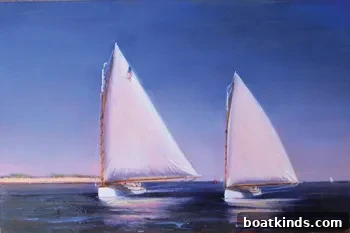
Arguimbau describes himself as a luminist, a term that links his work to the second generation of the Hudson River School, a 19th-century American movement. Painters in that circle sought to capture the effects of light on landscape with careful observation, fine detail and a contemplative approach to nature. Artists often referenced alongside this style include Frederic Edwin Church, John Frederick Kensett and Sanford Robinson Gifford, who emphasized atmosphere, clarity and the interplay of light and shadow.
Beyond the stylistic reference, Arguimbau’s methods are rooted in technical training and historical practice. He studied under Piero Mannoni, an Italian master restorer, where he learned the exacting craft of matching paints to the originals they restored. That apprenticeship left him committed to making his own pigments and preparing traditional panels. He still grinds pigments by hand, mixes them with oil, and prepares panels with a classic white-lead ground. To achieve the luminous depth he seeks, he has developed oil-resinous mediums and employs multiple translucent glazes — a practice that recalls techniques used by Flemish masters of the 15th and 16th centuries.
“They used the relationship between opacity, transparency, detail, object and abstraction to create a reality by itself, a virtual reality, using only paint,” Arguimbau explains from his studio in Greenwich, Connecticut. His glazing process builds up subtle layers, lending three-dimensionality and optical luminosity that he believes cannot be replicated by modern shortcuts. Through those layers, the surface of the painting seems to glow from within, producing a sense of depth and atmosphere that viewers experience almost as if it were a real place.
When asked about Catboats on the Sound, Arguimbau emphasizes its living quality. “It has a luster. It’s alive. It sparkles,” he says. “There’s luminosity, depth. It has its own reality, and that’s what the masters wanted to do.” The painting captures not only a scene but the sensation of light shifting over hulls, water and sky — an effect achieved through patient layering and careful control of transparency and opacity.
Arguimbau’s subject matter is closely tied to his life on the water. The boats depicted are modeled on his own 28-foot catboat, Molly Rose, built in 1935 by Erford Burt at Vineyard Haven Boat Yard in Martha’s Vineyard, Massachusetts. Molly Rose doubles as his summer studio: she has a roomy 10-by-12-foot cockpit where Arguimbau tests varnishes and painting mediums for permanence on brightwork exposed to sun and sea. Those trials inform the formulas he uses in the studio, ensuring the materials respond predictably over time and retain the desired sheen and translucency.
“I love painting boats,” he says. His affection for maritime subjects is evident in the careful attention to structure, rigging and the way light defines form. The boats function as both nostalgic objects and compositional anchors that convey movement, scale and the mood of a coastline afternoon.
To view this painting and other works by Peter Arguimbau, see exhibitions at the J. Russell Jinishian Gallery or visit the gallery in Fairfield, Connecticut, at 1899 Bronson Road. The painting Catboats on the Sound first appeared in print in the July 2017 issue of the publication where this article originally ran.
Arguimbau’s work bridges historical technique and contemporary observation. By combining traditional materials, painstaking craft and a modern eye for composition, he continues a luminous tradition that places light itself at the center of meaning in landscape and marine painting.