
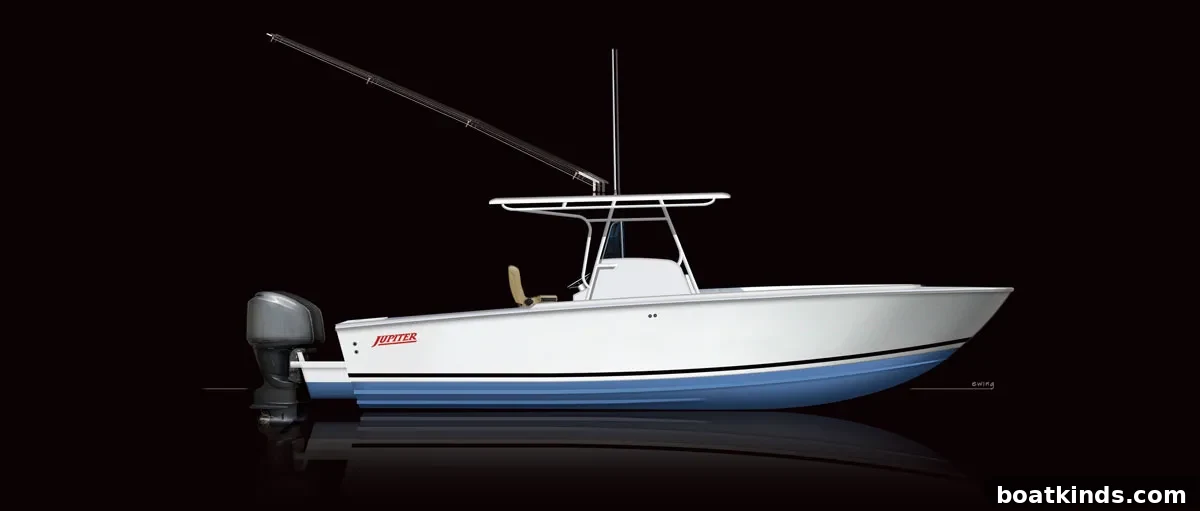
Jupiter 31: A 1989 Performance Center Console Built in Jupiter, Florida
When the Jupiter 31 debuted in 1989 it changed expectations for what a semi-custom center console could be. Conceived and produced in Jupiter, Florida, by Hall of Champions powerboat racer Nick Scafidi and master fiberglass craftsman Joe Moran, the design grew from a simple sketch on a napkin into a production boat known for its performance-first approach. With limited computer-aided design tools available at the time, the team relied on hands-on experience and traditional boatbuilding methods to develop the hull, molds and systems that defined the model.
From the start the Jupiter 31 emphasized modern composite construction and lightweight engineering. The builders avoided traditional wood structures, instead using synthetic cores such as Airex foam and Divinycell, hollow fiberglass stringers and bulkheads, isophthalic resin and knitted biaxial fiberglass cloth. The bottom was solid fiberglass where strength and impact resistance mattered most. These materials and methods produced a stiff, durable hull that resisted flex and maintained structural integrity under load—qualities important to anglers and sport boaters who run in varied sea conditions.
Hull design was a major contributor to the Jupiter 31’s reputation. Featuring a 24-degree deep-V entry with a razor-sharp 60-degree forefoot and three lifting strakes per side, the hull was engineered to cut through chop while providing lift and stability when on plane. A flat section that began narrowly at midships and widened toward the stern added lift where needed without creating the wandering or porpoising sometimes seen in deep-V designs. The result was quick planing, responsive acceleration and minimized bow rise—traits that helped the boat perform confidently in rough water, as many owners and drivers have reported.
At 31 feet overall with a 9-foot-6-inch beam, the Jupiter 31 offered a surprisingly roomy center console layout for its era. The console was walk-in, providing an enclosed head and shower plus more than six feet of headroom—comfortable accommodations for day trips and extended outings. Anglers benefited from a bait-prep center, a 30-gallon livewell and both raw- and freshwater washdowns. Buyers could also tailor the boat with options such as a hardtop, leaning post, helm enclosure, outriggers and other fishing-oriented accessories, reflecting the semi-custom nature of the build.
Performance was configured to suit owner preferences. Early models commonly used an aluminum bracket to support twin 200-horsepower outboards, which produced top speeds in excess of 40 knots in many cases. Later boats were built to accept more powerful twin 300-horsepower engines, offering higher top-end speeds and faster hole-shot for operators who wanted more performance.
The original builders produced the Jupiter 31 in limited numbers—roughly a dozen boats per year—until financial pressures led to a change in ownership. In 1997 Carl Herndon, founder of Blackfin Yacht Corporation, acquired the brand and sustained production. A significant set of refinements in 2002 refreshed the design and helped renew buyer interest. The Jupiter 31 remained in production until 2008, leaving a legacy as a well-regarded performance center console of its time.
Owners and enthusiasts remember the boat for its combination of race-derived hull traits and high-quality boatbuilding, the kind of craftsmanship that comes from people who both race and build boats. The Jupiter 31 stands as an example of how focused design, careful material selection and hands-on construction can produce a center console that performs well in a variety of sea states while offering practical, fishable features.
This article was originally published in the April 2022 issue.