
The smaller the boat, the bigger the adventure. It’s a simple truth that never gets old. Recently I felt the urge to satisfy that grain-of-sand itch—to get back in something compact and grin like a child again.
My latest small-boat fantasy started with the PT Eleven, a “nesting” dinghy kit from Port Townsend Watercraft. I didn’t build one myself—my epoxy skills and Zen level aren’t quite up to that—but I did manage to sail and row a finished example. It looked immaculate and handled beautifully under both oars and sail. Cruising around the Point Hudson beach, it felt like a burst of pure, uncomplicated fun.
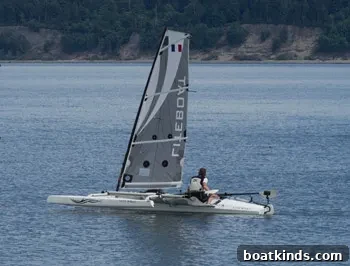
Then a very different craft slid into view—three hulls, a raked mast and a square-top mainsail that carried the French Tricolore and the word “Liteboat” along the leech. One person sat in the cockpit with oversized oars. He was no Captain America, but he cut an intriguing figure—an ocean-rower masquerading as a singlehanded coastal sailor.
“Salut, comment ça va? What is a Liteboat?” I asked, and that question started a conversation with Mathieu Bonnier. Bonnier, 59, runs Liteboat, a small boatbuilding shop in Pontcharra near Grenoble in the French Alps. He and a small team make high-performance rowing boats that sit between delicate racing shells and robust sea-rowing craft—designed to be fast yet stable enough for rough, real-world water.
Bonnier is better known in ocean-rowing circles than in sailing ones. He placed second in the Bouvet Rames Guyane, a solo trans-Atlantic rowing event from Senegal to French Guiana, and he rowed solo from Qaanaaq, Greenland, to Nome, Alaska, via the Northwest Passage to raise awareness about Arctic warming. He’s also skied across Alaska in winter and brings his dog Tico on expeditions. Measured, soft-spoken and fit, he pushes personal limits in ways that can be difficult to believe until you hear about the specifics.
He came to Port Townsend to test a new Liteboat prototype and to take part in the Race to Alaska (R2AK), a wild, mostly human-and-wind-powered race that sends entrants 750 miles from Port Townsend to Ketchikan through the Inside Passage, with a stop in Victoria, British Columbia. The race allows almost any craft powered solely by muscle and sail, turning the course into a laboratory for creative small-boat design and rugged seamanship.
“It is my first time, so I am here to learn,” Bonnier said, demonstrating the humility of someone who respects the ocean. “I’m not a sailor, so I had to take lessons from my brother who’d done the Mini Transat three times.” That Mini Transat connection also brought Bonnier to the designer he selected for his boat—Sam Manuard, a French designer known for fast Class 40s and Mini Transat 6.50s, and for work with Seascape sailboats.
Right Tools for the Trade
“This is a prototype built from an existing mold,” Bonnier explained. The hull is narrow, so instead of a cabin he plans to sleep in a cockpit tent at night and stop in ports that offer enough infrastructure to recharge the batteries that power his electronics. He deliberately chose a conservative sail plan: a 5.3-square-meter main (roughly the size of a Laser Radial) and an 8-square-meter gennaker—enough canvas to make good progress without inviting trouble.
For Bonnier, the R2AK is less about racing glory and more about testing a concept in real conditions. He approaches the race with caution: not overbuilding in the workshop but spending time on the water to find problems before the ocean does. “The danger is spending too much time in your workshop building things and not enough time on the water testing them,” he said.
Colin Angus, another competitor and a veteran of human-powered adventures, echoed that philosophy. Angus has circled the globe using muscle power—rowing, paddling, hiking and biking. He’s authored books and produced programs for National Geographic, and he knows these waters intimately, having rowed around Vancouver Island in 15 days—covering a distance comparable to much of the R2AK route through the Inside Passage.

The two men displayed mutual respect in a short dockside video: Bonnier smiling at Angus’s local knowledge, Angus replying that Bonnier will enjoy the new scenery. Angus, who has a sailing background, arrived with a self-built stitch-and-glue plywood trimaran of his own design. His boat is a practical study in singlehanded coastal cruising: a small cuddy for sleeping, a sliding rowing seat and outriggers for stable rowing, and a padded hiking board that doubles as a recliner and provides righting moment while sailing.
Angus paid special attention to versatile sail handling. He fashioned a ketch rig from two take-apart O’pen Bic spars and custom-cut sails. The unstayed masts allow him to ease or feather sail before conditions turn nasty—useful in places like Johnstone Strait, where strong winds and steep chop can make life difficult. He can also adjust spars and sail sizes or swap mizzen and main positions to tune balance and helm feel for a range of conditions.
Switching Modes Without Effort
Angus has logged something on the order of 15,000 nautical miles under oars. “This time the new component is performance sailing,” he said, and he augmented his setup with a small solar panel and a lightweight 14-pound tiller pilot. That autopilot is invaluable for giving his legs and arms a rest while the boat sails on a balanced helm.
Both sailors favor simplicity and reliability. Beaching a heavy singlehanded boat to sleep ashore is often impractical—what looks like sand at high tide can be rocks at low water—so they prefer hulls and systems that allow them to keep going. At the windy prologue start in Port Townsend, both used sail power to conserve energy and then switched to oars when the breeze died, maintaining speed by rowing on sliding seats. They repeatedly planted blades, pushed with their legs and pulled on the oars—thousands of strokes combined with intermittent canvas-driving, a literal form of motorsailing powered by muscle and sail.
“An oar is hard to break,” Angus noted. “You can row in nearly all conditions, so you stay in control.” That hardiness, combined with simple systems, often outperforms clever but fragile mechanical schemes when the wind dies and the course demands progress under human power.
Success and Survival
Both Angus and Bonnier admit luck plays a role in any long coastal passage or race. Going fast requires light gear and therefore slimmer safety margins. Still, they reduce risk with deliberate preparation. Bonnier sums up his approach in four steps: pick the right boat for the job, prepare yourself physically (run, bike, row), spend substantial time on the water to discover weaknesses, and plan the route and logistics carefully. It sounds straightforward, but it depends on honest self-assessment and disciplined execution.
My time among these small, multidexterous boats and the people who build and sail them reinforced a simple lesson: bold adventures don’t require recklessness. The right boat, steady preparation and sensible choices produce memorable voyages—and enormous pleasure. Messing about in compact craft can be profoundly rewarding, delivering wide smiles, clear thinking and a practical appreciation for common sense at sea.
This article originally appeared in the September 2016 issue.