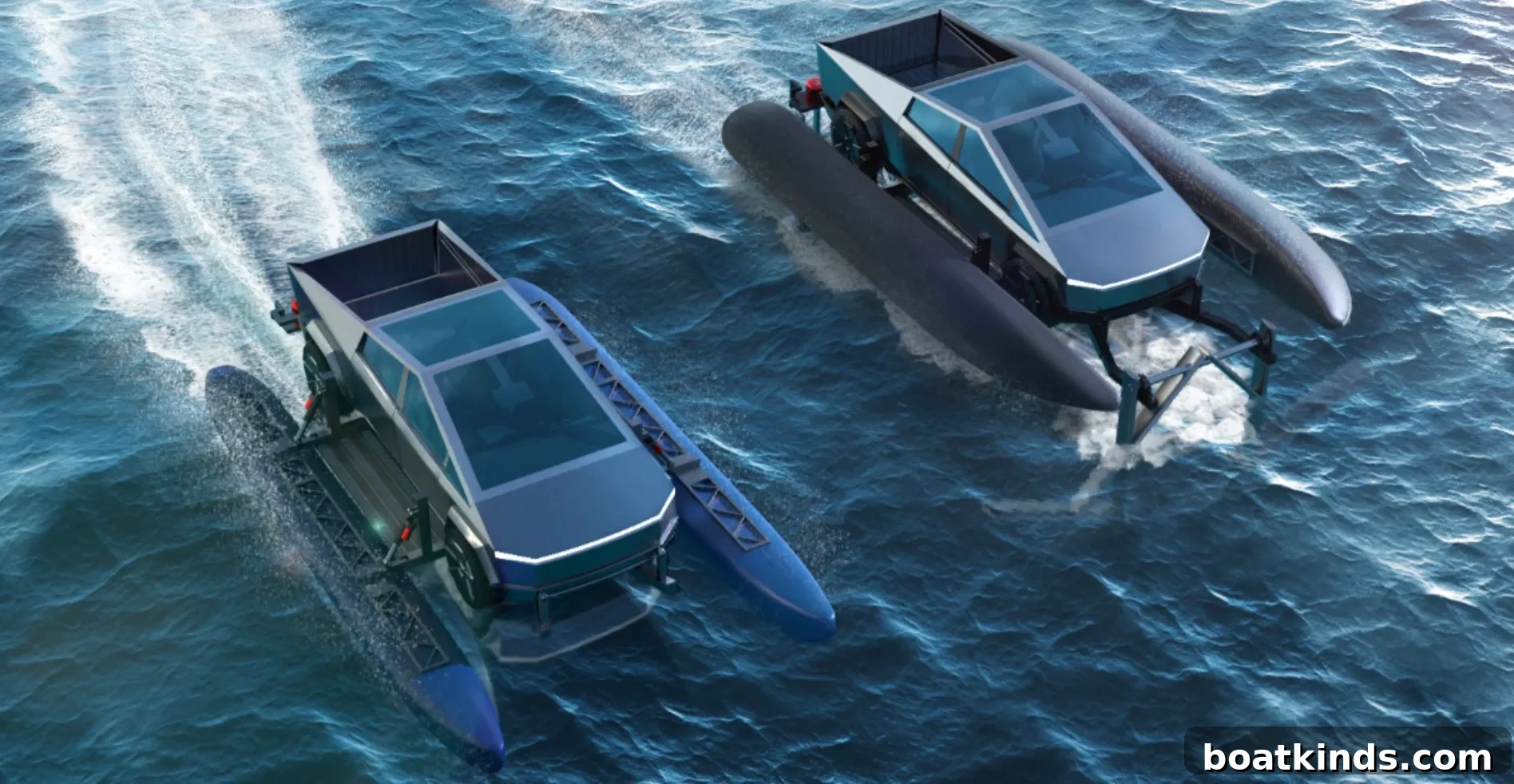
Cybercat: A Modular Electric Catamaran Concept Built for the Tesla Cybertruck
The Tesla Cybertruck has generated enormous interest even before it reaches widespread use, and that excitement has spurred a growing market for third-party accessories. Among the most ambitious ideas to emerge is the Cybercat catamaran concept — a modular, inflatable-hulled boat designed to be powered by the Cybertruck. Conceived as an easy-to-assemble kit, the Cybercat aims to blend automotive and marine electric propulsion in a way that could appeal to owners seeking weekend watercraft, amphibious capability, or simply a novel way to extend the Cybertruck’s utility.
The Cybercat concept is the brainchild of Anthony Diamond, an entrepreneur with a PhD in material science from UC Berkeley. Diamond’s proposal centers on lightweight, folding inflatable pontoons paired with between one and five 50-kW electric outboards. Those outboards would draw power from the Cybertruck’s battery pack, creating an integrated electric catamaran system that relies on the truck as its energy source. The kit format is intended to simplify transport and storage, enabling owners to assemble the vessel when they reach the water and stow it compactly when not in use.
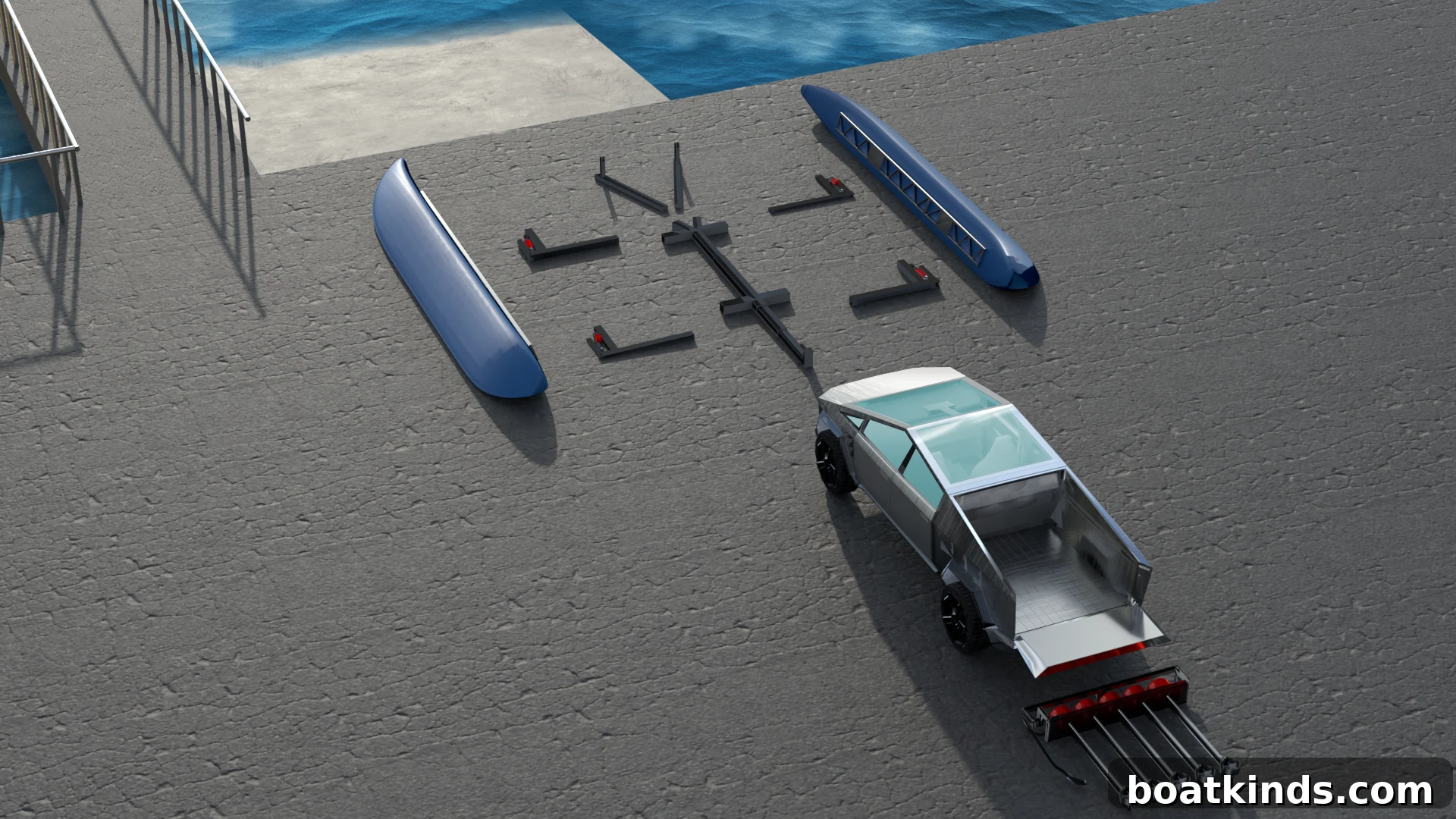
Performance estimates provided with the concept suggest the Cybercat could reach top speeds of 22+ knots, with an expected range between roughly 50 and 115 miles depending on configuration and operating conditions. Those figures will depend heavily on the number of outboards fitted, the Cybertruck battery capacity available at the time of use, load, weather, and sea state. The modular nature of the kit — from a single outboard setup up to a five-outboard configuration — allows buyers to prioritize efficiency, range, or speed based on their intended use.
One of the most intriguing possibilities is that, when combined with the Cybertruck’s adaptive air suspension, the boat could offer limited amphibious functionality. In practice, that would rely on the suspension raising and lowering the truck to act as a connection and power source for the inflatable catamaran sections. While the idea is promising, it remains conceptual and would require careful engineering, safety validation, and likely regulatory clearance before any true amphibious operation could be certified or recommended.
Price estimates for the Cybercat kit fall in the range of approximately $22,900 to $32,900, with the final cost tied to the number of outboards and optional equipment. The concept also includes the potential for a hydrofoil variant, which would trade some simplicity for greater speed and improved hydrodynamic efficiency. A hydrofoil version could deliver higher top speeds and reduced drag, but would also introduce additional design complexity and likely higher cost.
Beyond raw numbers, the Cybercat concept highlights a broader trend: growing cross-pollination between electric automotive technology and marine design. Electric outboards and inflatable catamarans offer appealing combinations of portability, lower noise, and reduced local emissions compared with traditional petrol-powered boats. For Cybertruck owners who already value all-electric operation, the concept presents an attractive, all-electric approach to boating that leverages an existing vehicle platform.
That said, the Cybercat remains in the early stages of development. Practical deployment would require rigorous testing of electrical integration, marine safety systems, and structural durability of the inflatable pontoons. Owners and builders would also need to navigate boating regulations, registration, and safety standards that apply to powered vessels. If those technical and regulatory hurdles can be addressed, the Cybercat could become a distinctive accessory for electric vehicle owners who want a versatile, packable boat solution.
In summary, the Cybercat catamaran concept offers an innovative, kit-based electric boat that pairs inflatable pontoons with 50-kW outboards drawing power from a Tesla Cybertruck. With estimated speeds above 22 knots and a projected range of 50 to 115 miles, the design aims to provide configurable performance, potential amphibious capability when used with adaptive suspension, and the option of a hydrofoil variant for greater efficiency. As development continues, the concept stands as an intriguing example of how automotive battery technology could be adapted to marine applications.