Tad Roberts: Designing Efficient, Purposeful Boats for Coastal Cruising
Tad Roberts grew up on the British Columbia coast in a family of boatbuilders, artists and sailors, so drawing boats as a child came naturally. His early years included a decade working on tugs and fishing vessels and spending time cruising and racing sailboats. In 1982 he opened his own design practice in Victoria, British Columbia, but wanting to broaden his technical background, he moved to Castine, Maine, in 1986 to attend Maine Maritime Academy’s Yacht Design Institute.
Within a year Roberts was employed by Bruce King Yacht Design in Newcastle, Maine. Over the next 14 years he rose to principal designer and contributed to a wide variety of projects. His work at King included large custom sailing yachts such as the 124-foot centerboard sloop Antonisa, the 134-foot aluminum ketch Alejandra, and the 154-foot cold-molded ketch Scheherazade.
While Bruce King was best known for sailing yachts, Roberts expanded the studio’s offerings to include powerboats. Under his direction the office produced the 80-foot high-speed commuter Liberty, the Hinckley Talaria 40 and 44 motor cruisers, and the jet-powered Hinckley Picnic Boat. “I did everything (at King’s office),” Roberts says. “Hull design, inboard and outboard profiles, interior arrangements. Everything.”
Although he enjoyed his years in Maine, Roberts wanted to return to the West Coast to be closer to family. In 2001 he left King’s office—having completed preliminary work for the Hinckley Talaria 29 and 53—and established his studio on Gabriola Island near Nanaimo, Vancouver Island. There he directed the Silva Bay Shipyard School for eight years and continued designing both power and sail vessels.
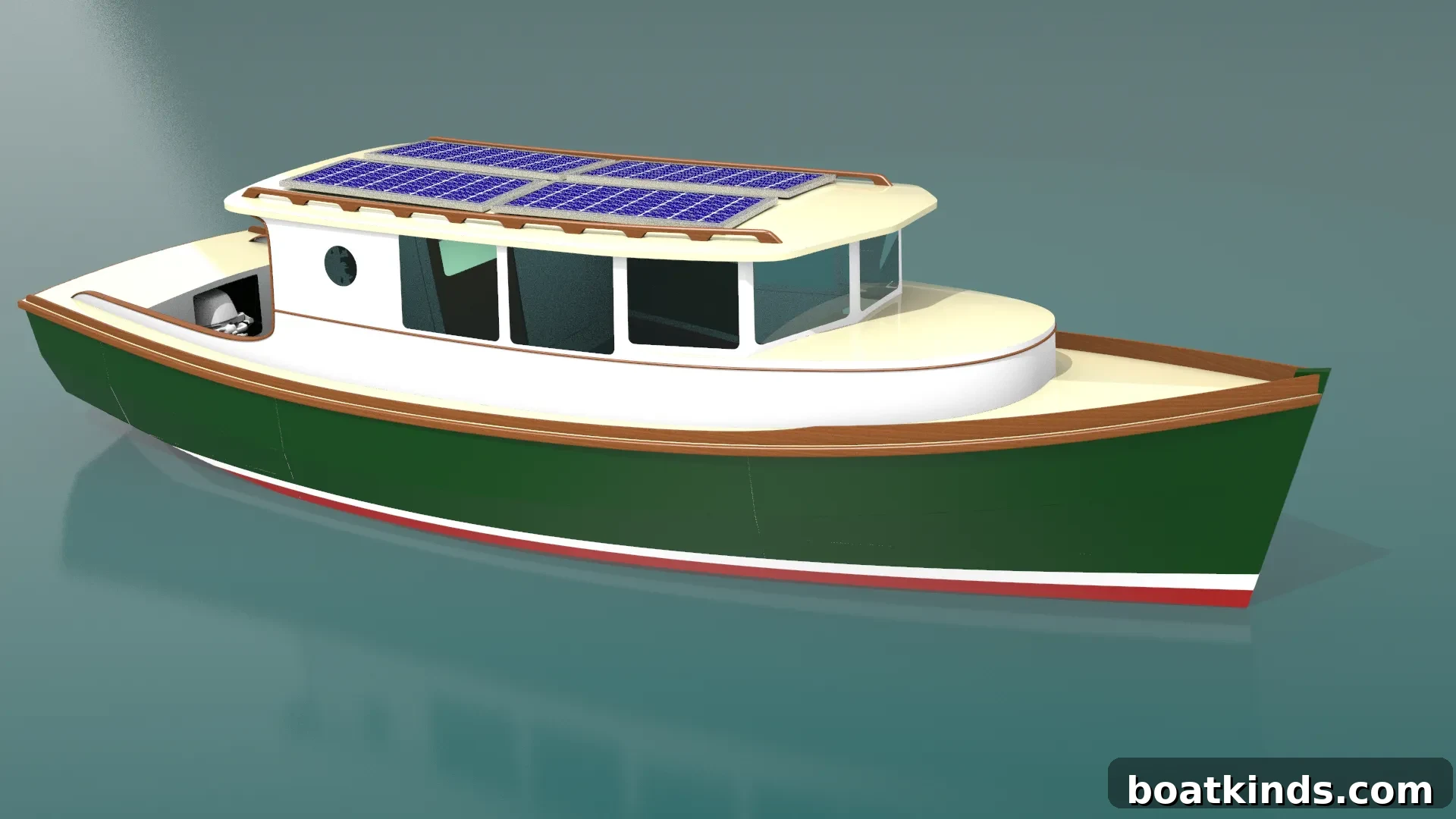
Back in Canada he developed a diverse portfolio: retro-styled commuters, classic motor yachts, halibut schooners, lobsterboats built for Maine’s John’s Bay Boat Company, and the Passagemaker Lites—a line of 39- to 80-foot lightweight, fuel-efficient oceangoing cruisers intended to be built, maintained and handled by a couple. These designs emphasize long-range capability while minimizing fuel use and crew requirements.
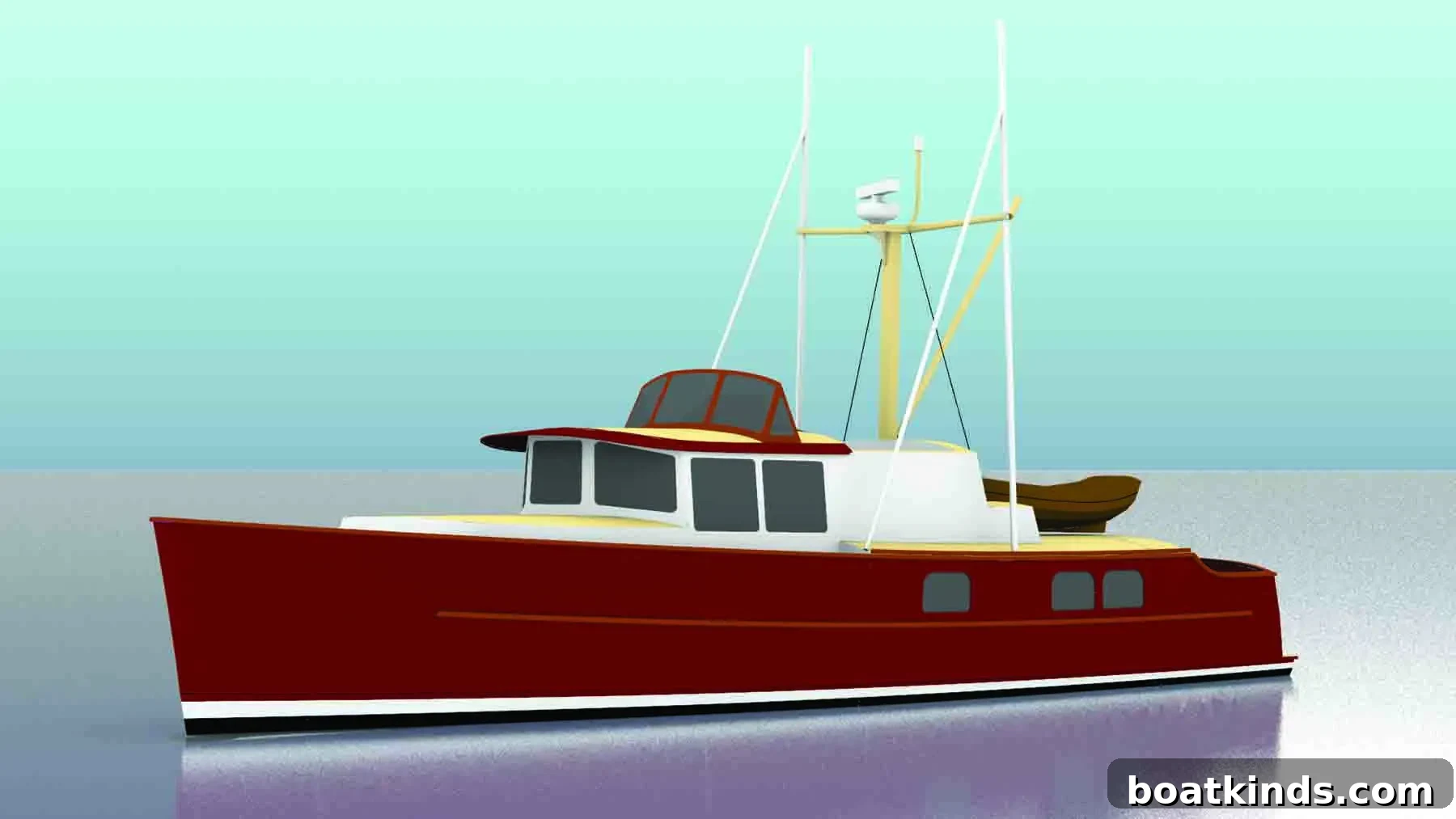
One Passagemaker Lite 46 was later stretched to 48 feet by a South African couple and sold to a New Zealand owner who outfitted her with twin 65-hp Beta diesels, stabilizer poles and a full A-frame sailing rig. He made extended voyages in the Indian Ocean and, when COVID restrictions blocked his return to New Zealand, sailed to the Caribbean. “Even a limited amount of sail can make a big difference in fuel consumption,” Roberts notes.
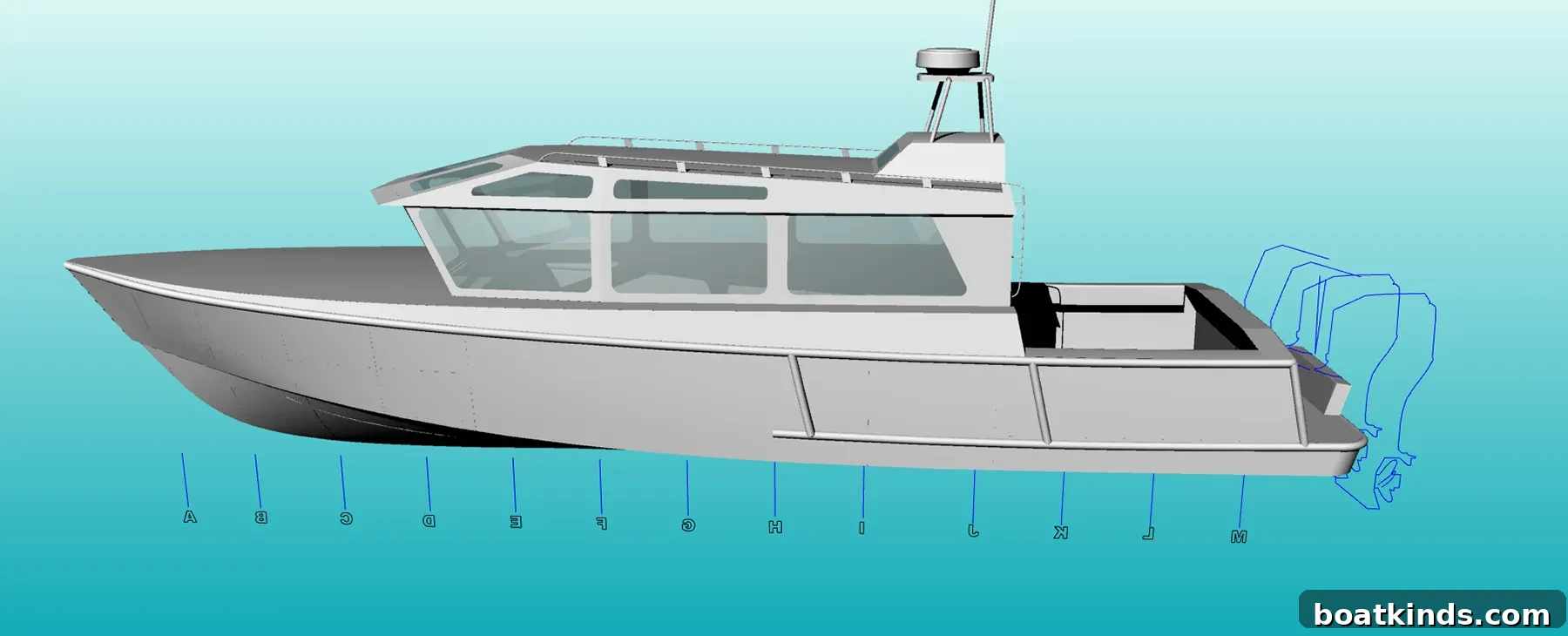
Today much of Roberts’s work involves commercial certification and stability analysis, but he continues to produce fresh designs. A new long-distance aluminum cruiser, the Grayson 32 Mollymawk, is about to launch. This 32-foot, 5-inch design borrows styling cues from commercial pilot boats and will be fitted with twin 135-hp outboards for an experienced Australian couple planning voyages as far as the Bering Sea.
Roberts also completed a two-and-a-half-year project converting a 1958 wooden 42-foot fishboat. The restoration involved stripping the hull to its frames, installing a new deck, and adding a modern deckhouse and interior to transform the workboat into a reliable cruiser.
After designing many fast, high-powered boats early in his career, Roberts now prefers vessels that use far less power. “Growing up and growing older, I’ve had a change of philosophy,” the 67-year-old designer says. “I didn’t really think about it 20 to 30 years ago, but I have totally changed my ideas about what is appropriate. People that are still producing designs for triple 350-hp engines, as far as I’m concerned, they’re still stuck in the last century. It’s outdated thinking. It’s irresponsible thinking.”
Roberts advocates for lighter, more efficient cruising boats that require modest power to be enjoyable and safe. “We need to use less of everything, including fuel,” he says. “Cruising boats with 250 to 350 horsepower are overpowered. That’s not necessary to get out on the water, have a good time and explore nearby places. A lot of the time people are more focused on getting from one place to another, and that’s an accomplishment, but there are many cruising opportunities an hour away even if you’re only traveling at 5.5 knots.”
Last November he began designing a low-power, 26-foot cruiser intended to run on a maximum of 9.9 horsepower. The one-off, minimum-power cruiser is aimed at two or three people and is best suited to protected waters—from Puget Sound up to Alaska, the East Coast, or the Great Loop—rather than long ocean crossings. Construction is deliberately simple for a homebuilder, using plywood and fiberglass with multiple chines and plywood bulkheads.
The hull features a flat center panel for an exceptionally shallow draft—about 10 inches—allowing beaching without a dinghy. High freeboard makes the design safe, while a superfine stern lifts the transom clear of the water to reduce drag. “There aren’t any other hulls like that in production today,” Roberts says, “except for sailboats.”
There are trade-offs to a shallow-draft hull: accommodations sit low in the hull, but with no machinery beneath the sole, headroom reaches at least 6 feet 6 inches when standing. The beam is 8 feet 6 inches, making the 26-footer trailerable, and the designed waterline displacement is 5,200 pounds—meaning a half-ton pickup is likely required for towing.
Roberts envisions propulsion options such as a 6-kW electric outboard, twin 3-kW outboards, or a 9.9-hp gas outboard with two portable 30-liter tanks. At an estimated consumption of about 0.25 gallons per hour, a small fuel supply still yields significant range. Freshwater capacity might be limited to 20–30 gallons—enough for overnight cruising—which keeps the boat light and maintains performance. “The weight of the boat is the key to the whole thing,” he says. “Everyone wants to build boats heavy, but that’s a mistake. Once you start overloading it, that just degrades performance.”
Comfortable with simple cruising, Roberts favors minimal gear and practical solutions learned from his upbringing: “I’m happy with camping out on a boat. That’s how I grew up. We didn’t have a whole lot of stuff on the boat. It was the basics. I just see people adding all this extraneous equipment, which makes it very convenient to use, but long term, the cost is really, really high. I see it as something we can change and something that is worth changing.”
This article was originally published in the September 2022 issue.