Anyone who has spent time around yachts and small craft over the past several decades will recognize the work of Mark Ellis. Born and raised in Upstate New York, Ellis developed a love of the water as a child while spending summers on the St. Lawrence River. That early fascination led to a long, respected career in yacht design. He apprenticed and worked with some of the leading firms and designers in the United States before founding his own studio in Canada at 30. Over the years he produced a wide variety of projects, from bespoke custom builds to production sail and powerboats. Now retired and living in Connecticut, Ellis recently learned that Mystic Seaport Museum will add his portfolio to the Ships Plans Library. We spoke with him about that honor and about his long life in boats.
SOUNDINGS: The Ships Plans Library at Mystic Seaport Museum is an impressive archive with plans from many of the most influential yacht designers. What does it mean to you to have your work preserved there?
MARK ELLIS: I’m very pleased that the museum will house my designs. I’ve been fortunate to have a long career, and while I don’t compare myself to the true legends like Philip Rhodes or Ray Hunt, it’s gratifying to be included in the company of great designers. At 77, having my work archived by Mystic Seaport feels like a meaningful recognition of a lifetime in yacht design.
SO: If someone wanted to see your work at the library, which design would you recommend they look for?
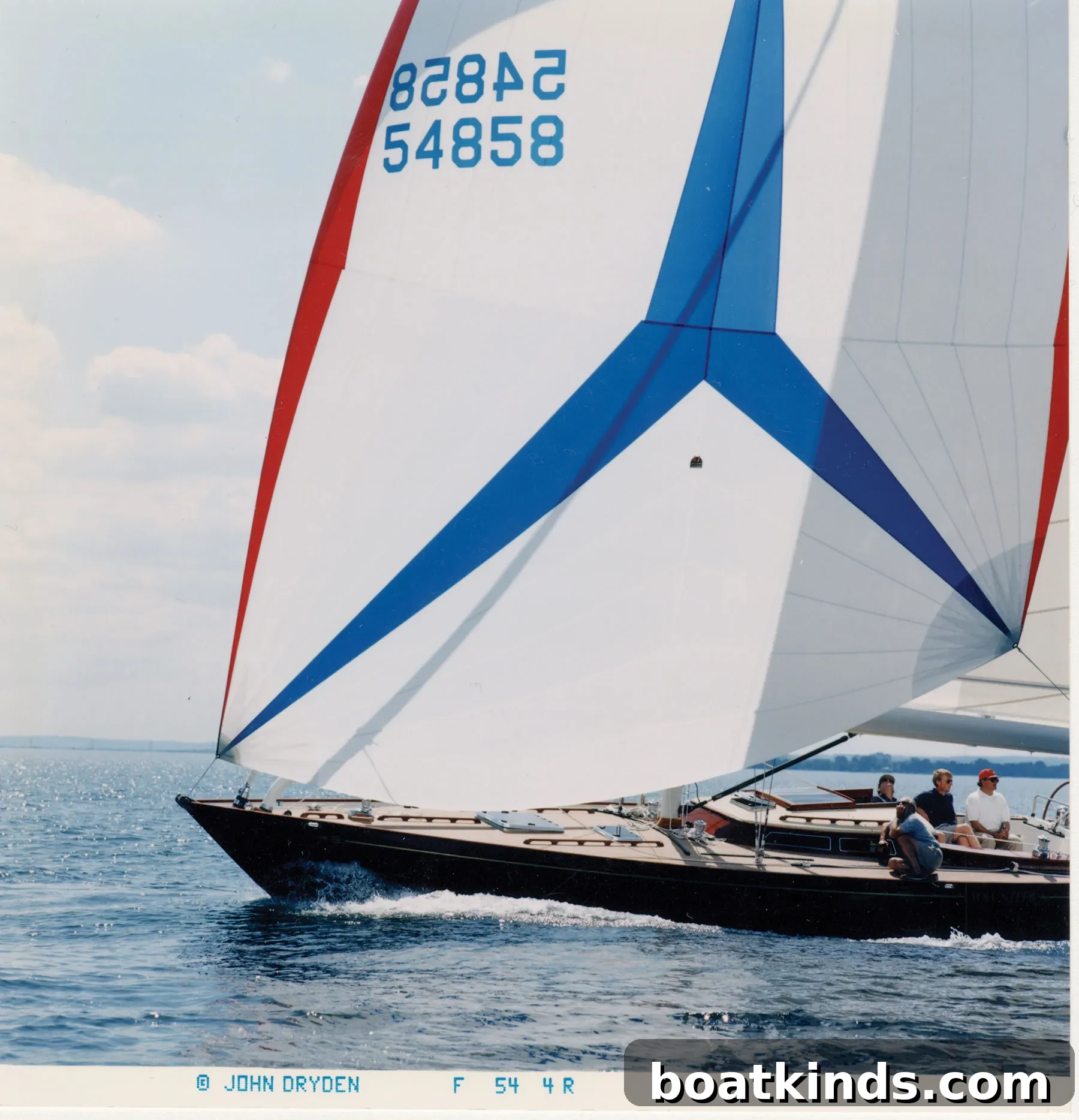
ME: My favorite is Volunteer. She’s a 47-foot day sloop from 1996, commissioned by Fred Eaton, whom I met through the Royal Canadian Yacht Club. Eaton’s family had deep roots in Canada, and he wanted a boat with the long, elegant proportions of an earlier era paired with a modern underbody. Volunteer represents what many now call the Spirit of Tradition: classic, graceful lines with contemporary performance.
SO: Where is Volunteer now?
ME: She’s in Southern California and still sailing.
SO: You grew up in Upstate New York and spent summers in the Thousand Islands. How did that environment shape your approach to design?
ME: I grew up in a time when wooden boats and traditional styles were still common. In the 1950s and ’60s the production boat industry was smaller, and names like Sparkman & Stephens, Chris-Craft, Gar Wood and Century dominated the scene. Being surrounded by wooden boats and classic designs left a lasting impression on me. My interest in yacht design deepened when the 12 Metre class appeared at the America’s Cup in the late 1950s. Around that time my father died when I was 13, and focusing on boats became a way to channel my energy and grief.
SO: You were comfortable with both sail and powerboats as a young man, correct?
ME: Yes. Our family had a Chris-Craft, some Peterborough canoes, a Lightning, and my father owned an Atkin-designed yawl. Sailing became my primary identity, but I always appreciated powerboats as well. In fact, I recently donated a Frostbite I sailed when I was 11—a classic from the 1930s—to the Connecticut River Museum.
SO: How did you get started professionally as a designer?
ME: I spent countless hours teaching myself to draw boats. In high school I chose Elements of Yacht Design by Norman Skene as my career book. Rather than attend a naval architecture school that emphasized large-ship design, I earned a business degree at Boston University. That background turned out to be an advantage—understanding business complemented my design work. While still an undergraduate I worked as a draftsman at C. Raymond Hunt Associates in New Bedford. John Deknatel hired me, and that office became my introduction to a talented circle of designers who guided and challenged me early on.
SO: What came after college?
ME: I worked for Philip Rhodes in New York, supervising construction of large ketches, and then joined Ted Hood at Little Harbor Yachts in Marblehead as a draftsman and designer, developing centerboard designs built by the Frans Maas yard in the Netherlands. I raced on Sundays as navigator aboard Ted’s 52-foot Robin, which taught me a great deal. In 1970 I moved to Canada to work for C&C, focusing on custom ocean racers.
SO: You launched Mark Ellis Design Ltd. in 1975. Early projects included the Aurora 40 and the Niagara 35, but the Nonsuch 30 really became a signature design for you. Tell us how that came about.
ME: The Nonsuch 30 grew out of a conversation with Gordon Fisher, a Canadian yachtsman and friend who had co-skippered Manitou in her Canada Cup victory. He wanted a simple, easily handled boat—a fin-keel, spade-rudder catboat that could be raced singlehanded or with two people, and he didn’t want a conventional boom. He suggested a wishbone rig and offered to fund the tooling, guaranteeing the first few hulls. That commitment made it possible to work with George Hinterhoeller to bring the design into production.
SO: Would you call the Nonsuch 30 your most commercially successful design?
ME: Yes. About 550 Nonsuch 30s were built, and the model launched a series that ultimately exceeded 1,000 boats. It resonated with sailors and became a recognizable line in production sailing yachts.
SO: Some of your early designs are still in production or have been revived. Limestone Boats, for example, recently reappeared. How did that original concept start?
ME: The Limestone began with a conversation with Fred Eaton. After selling his Bertram 25, he wanted a smaller utility boat to ferry him to his cottage on Georgian Bay—something sturdy with a safe hull. I designed a 24-foot utility that felt smart and practical, and in 1985 the first Limestone was built. I named it for the limestone that’s common around Georgian Bay—Mrs. Eaton didn’t care for the name at first, but it fit.
SO: If you were to design one more boat today, what would it be?
ME: I’d love to design another Spirit of Tradition sailboat, or something in the style of the Bruckmann 50. I’m drawn to classic proportions and timeless lines—boats that remain attractive and avoid the trendy ugliness you sometimes see. There’s no reason a boat can’t be both beautiful and functional.
SO: Are there contemporary designers whose work you admire?
ME: Doug Zurn and Bob Perry do excellent work. I also think the visibility of designers has changed—when Bruce Farr and others were at their peak, designers were talked about more. Today, advanced computer tools for shape development mean more people can produce good designs, and individual personalities don’t always stand out as much.
SO: If you were starting in the marine industry now, what would you focus on?
ME: I’d still focus on sailboats. Designing them is what I love.
SO: Do you have a favorite sailing partner?
ME: Jim Eastland, whom I met in the 1970s. We saw things similarly and sailed well together. He was a knowledgeable, intuitive sailor.
SO: Where is your favorite place to sail?
ME: There are many beautiful harbors, though some are crowded these days. Buzzards Bay remains my favorite—when a smoky southwester builds in the afternoon, it’s hard to beat.
This article was originally published in the January 2023 issue.