
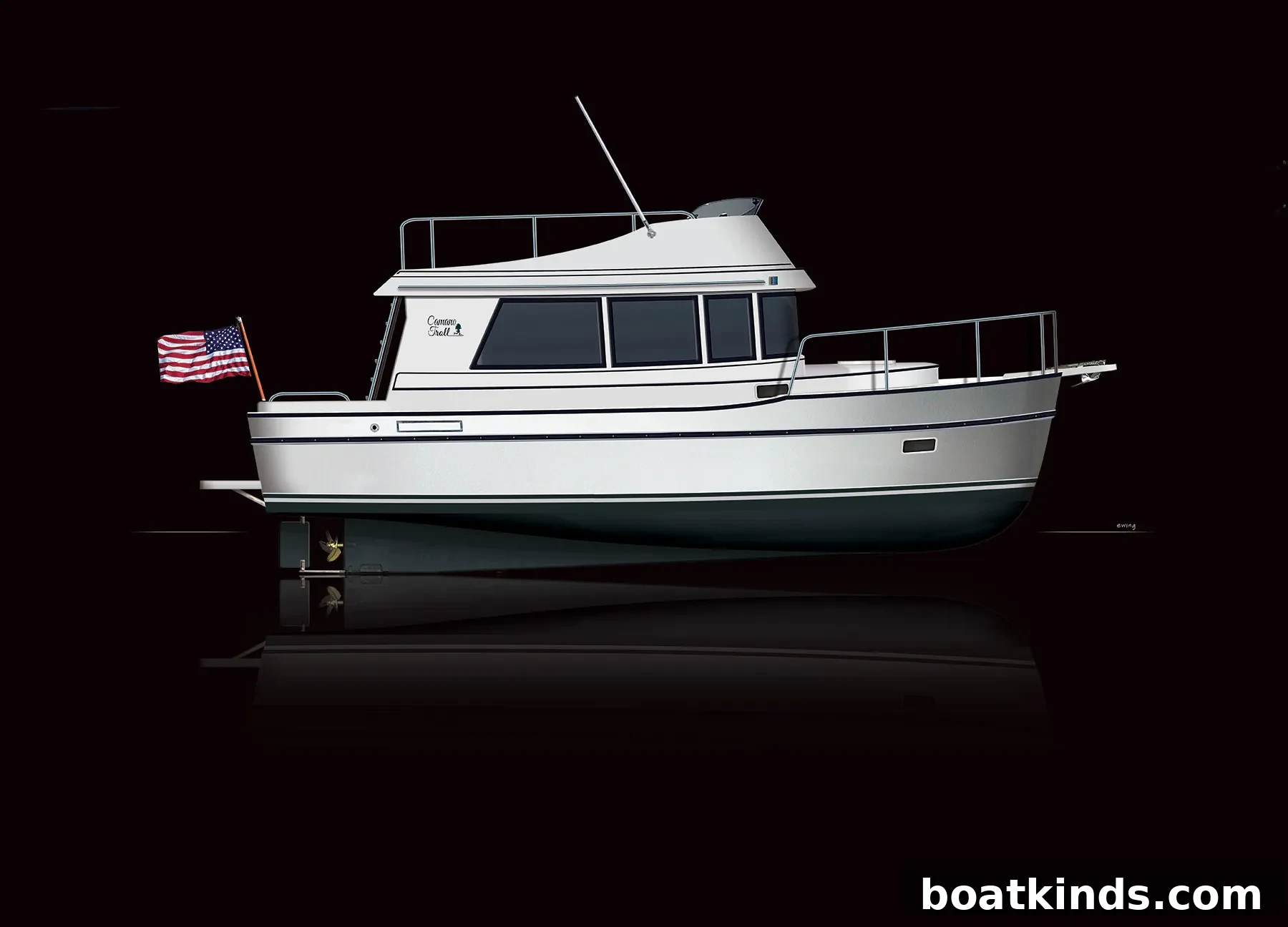
Camano 31: A Practical Coastal Cruiser by Bob Warman
The Camano 31, designed by Vancouver naval architect Bob Warman, is a compact coastal cruiser that blends the robust, practical qualities of regional working boats with comfortable cruising accommodations. Originally referred to as the 28 when Warman built, launched and sold the first hull, the design immediately attracted attention for its purposeful lines and seaworthy form. Over roughly nine years, Warman produced more than 125 of these versatile boats, which remain appreciated for their straightforward engineering and capable semi-displacement hull.
Hull and Performance Characteristics
The Camano 31’s hull is unmistakably influenced by working-boat geometry, beginning with a well-flared bow and a near-plumb stem. Those features help the hull part waves cleanly and throw spray aside, which contributes to a drier ride in chop and better control in coastal conditions. Moving aft, the hull widens rapidly before the sections disappear below the waterline, providing reserve buoyancy and a stable platform when heeled or in following seas.
Key underwater features include a pair of lifting strakes and full-length soft chines. These elements work together to add lift and improve directional stability as the semi-displacement hull accelerates. A full-length keel runs beneath the hull, broadening significantly just abaft amidships into a hollow, wedge-like shape that enhances buoyancy and offers effective propeller protection. The keel shape also allows installation of a single Volvo Penta diesel—typically a 150- or 200-horsepower unit—positioned lower in the hull. That lower placement contributes to a reduced center of gravity and yields a more favorable prop shaft angle, helping the engine deliver usable torque efficiently. In practice the Camano 31 cruises comfortably at about 12 knots, with a top speed near 16 knots depending on load and conditions.
Deckhouse and Deck Layout
Warman designed a deckhouse that occupies nearly the full beam of the boat, maximizing interior space while retaining practical side decks for access. The side decks are not protected by high bulwarks, so while they are serviceable for moving forward and working lines, they reflect the tradeoffs inherent in a design that prioritizes interior volume and social onboard spaces. The pilothouse arrangement centers on functionality: a convertible bench seat to port, space for two single seats to starboard, and a dedicated helm seat provide clear sightlines and easy movement for handling the vessel.
Interior Accommodation and Finish
Below the pilothouse, three companionway steps lead to a compact but well-laid-out interior. The galley sits to port, and forward of that is the cabin featuring a V-berth. The head is enclosed and located conveniently near the berth. With a beam of 10 feet 6 inches and a draft of 3 feet 3 inches, the Camano 31 offers more interior volume than many boats in its class, making it practical for short cruises and weekend living. Interior joinery varies by year, often finished in teak or mahogany, giving different boats a slightly different feel depending on when they were built.
Production History and Upgrades
After Warman sold the Camano tooling in the late 1990s, the molds and tooling passed through several owners. In total, roughly 270 examples were built before the tooling was acquired by Scott and Lisa Helker of Seattle-based Helmsman Trawlers. The Helkers updated the design and continued to develop the model while maintaining the essential qualities that made the original Camano 31 successful: a seaworthy hull, efficient single-engine layout, and a practical, comfortable interior for coastal cruising.
Today the Camano 31 is understood as a pragmatic choice for boaters who value seaworthiness, simplicity, and space efficiency. Its semi-displacement hull and conservative engineering make it well suited to tend the waters it was inspired by—coastal passages, islands and sound cruising—where reliable performance, protection for the propeller and comfortable accommodations matter most.
—John Wooldridge
This article was originally published in the February 2023 issue.