Life Aboard Sundance: Trading Tires, Lobsters, and a Loyal Poodle
While sailing south on the Intracoastal Waterway, I tuned into a Carolina swap show on AM radio and heard someone trying to trade three steel-belted radial tires for a dog. It was an oddly tempting proposition. We didn’t need tires, but for a moment I fantasized about trading away our dog, Bill. He’s more of an albatross than a typical pet—one that complicates life on our liveaboard.
Bill is an 11-year-old blue standard poodle and rules the cockpit from his favored spot under the dodger on the leeward side, propped on a pillow. Everyone knows that’s the best seat on the boat, and Bill takes it with absolute authority. He is, in every sense, the captain of the ship.
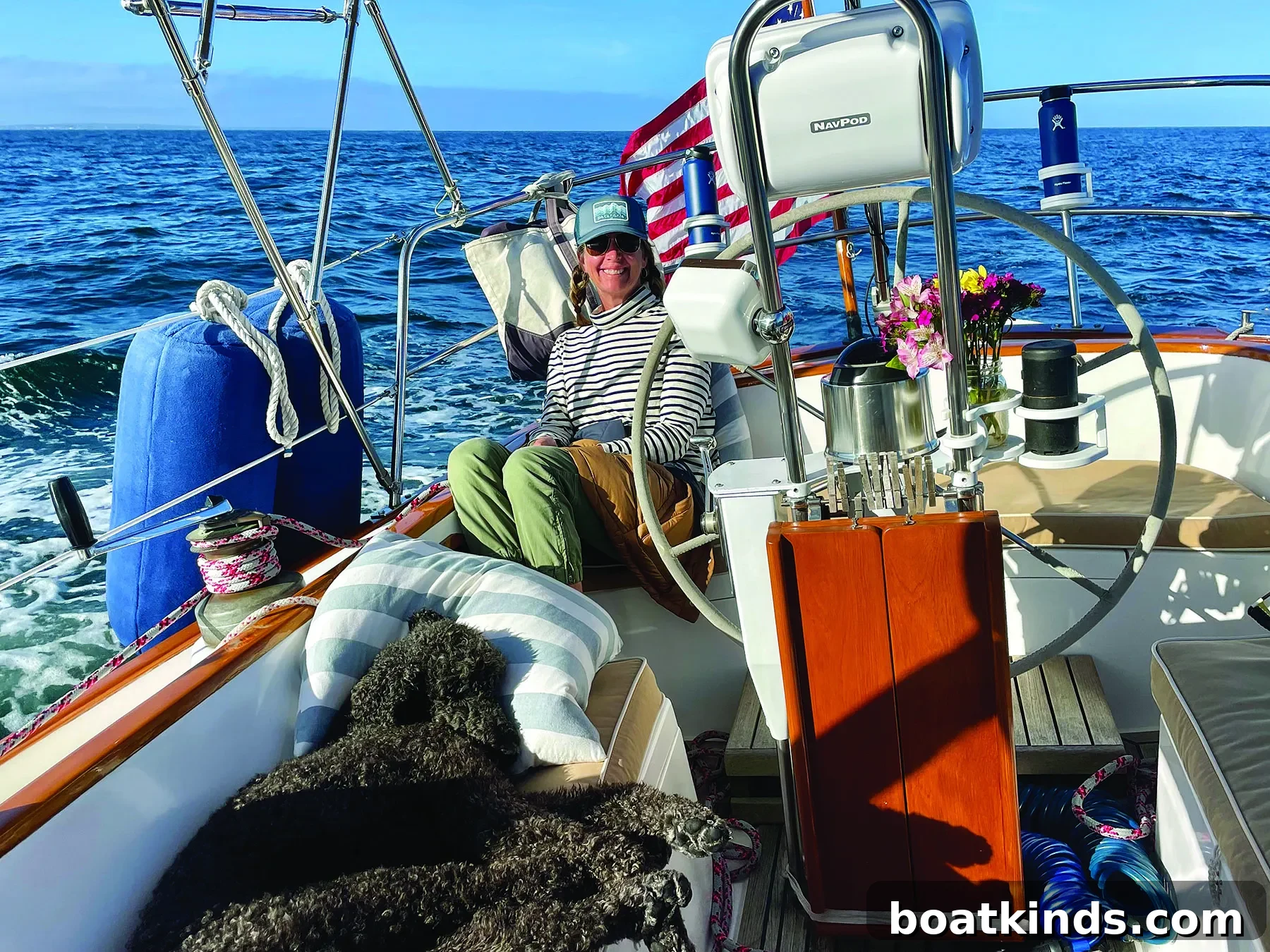
In the nine years we’ve owned our 36-foot Morris Justine, Sundance, we’ve never sailed without Bill. When he was younger he handled the motion well and moved around the boat easily—once even scrambling up the companionway ladder like a circus dog to join us for bacon at breakfast. Now, in his elder years, his legs are weaker and moving about when the boat is moving is a struggle.
We have, however, been trained by him. A paw, a nudge, or a pointed stare is all it takes for us to fetch fresh water, move his pillow into shade, or reef a sail when he deems it necessary. When underway, roles are clear: I steer and trim, and my wife, Alex, manages Bill. At every tack or gybe she shifts him from one leeward corner to the next. It takes coordination to avoid tangled legs, flailing sheets, and cross-purpose movement.
Feeding Bill is a project—one that would be solved forever by that tire-for-dog swap. I’ve hiked miles on risky roads to buy heavy bags of pricey dog food. Once in Chatham, Massachusetts, a woman pulled over to tell me I was a danger walking a road not meant for pedestrians; she was right. I almost asked if she had jib sheets to trade for a dog, but she drove off before I could finish the thought.
Bill still has moments of surprising energy. One afternoon he froze on the rail at full attention, locked in a staring contest with a seal ten yards away. After an hour of waiting and a few grapes passed between us—one for me, one for the dog—the seal returned. Bill answered with a full-throated howl that sounded more like a cello than a bark. That music made me reconsider the tires and reassess his worth.
Family paddle trips combine dinghy rowing and stand-up paddling with shoreline walks. Bill will ride either craft but prefers the SUP. We never taught him to do his business on fake grass on deck, so regular shore excursions remain part of our routine. The sequence of paddle, walk, and swim is my favorite triathlon, even if it means bringing half the beach back aboard in his curly coat.
Sand is relentless. We rinse him when docks or dog-wash stations are available, and when they’re not I wade waist-deep, cradle Bill, spin to agitate the sand out of his coat, then lift him into the dinghy. It’s never perfect—sand clings like Velcro and reappears once he dries and shakes on board.
At night, Bill prefers human beds. Alex and I sleep amidships on narrow settees, and sooner or later a wet, sandy nose nudges us apart. One of us gives in and ends up with a sandy, damp poodle hogging the berth. He’s not tidy—front legs wet from poor toileting habits—and I’ve spent many nights hoping the damp is sea spray rather than urine. Either way, it’s part of life with him.
On the coast of Maine, a lobster boat momentarily inspired another swap idea: one poodle for two lobsters. I never got the chance to bargain—the lobstermen were busy—but the thought highlights the trade-offs. One foggy evening in Downeast Maine, we dug clams on a shell beach while Bill supervised and occasionally demonstrated his own digging technique. Steamers, melted butter, and a shared rhythm of feeding—one for me, one for the dog—kept mutiny plans at bay.
Bill requires regular haircuts. We keep his coat short to help him stay cool and to reduce how much sand he carries aboard. Our onboard grooming ritual is a study in improvisation: on a breezy day we stern-anchor and bring all the grooming gear forward, using a 3,000-watt inverter to power the clippers. With the wind blowing aft, the clipped hair drifts overboard instead of into the cabin. Bill tolerates the process for the result, though he nips at the clippers and his groomers in protest.
After hours of clipping and fussing, we rinse the foredeck with the anchor washdown and move the snubber from stern to bow. Bill, newly shaved and in a life jacket, gets hauled down and back up the ladder like luggage for a celebratory family swim.
Finding dog-friendly anchorages is essential. Once we accepted a marshy beach in coastal Georgia—popular with alligators, snakes, and wild boar—as a place to walk Bill. There’s no romance in wrestling with wildlife after grooming; had a swap with a varnish brush been feasible back in Thunderbolt, I might have avoided the boar-scouting that evening. Still, I enjoy rowing and the steady rhythm of pulling an oar at sunrise and sunset has become a daily tonic.
We’ve given up a lot for Bill—cleaner decks and longer cruising range among them—but life without him would be dull. He lives entirely in the present and models a slower way of being that we sought when we left land for a life aboard Sundance. His contentment shapes our onboard conversations, and his small pleasures—pistachios shelled by hand, clams dipped in butter, an evening row followed by a sundowner—remind us why he belongs here.
This story was originally published in the March 2023 issue of SAIL magazine and is published in the April 2023 issue of Soundings.