John Stobart and “New York Maiden Lane”: Mastery of Maritime Memory
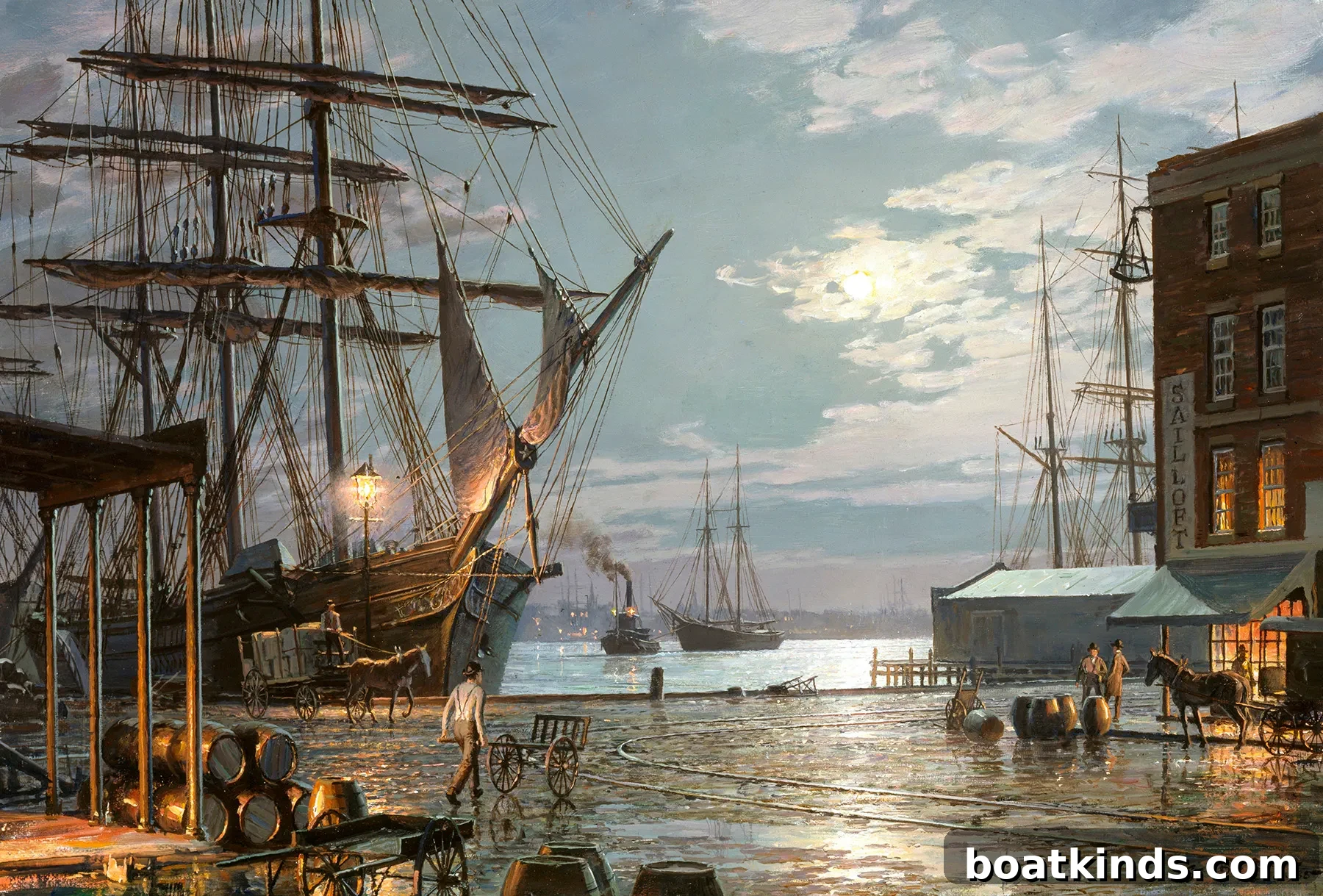
In the oil painting New York Maiden Lane, John Stobart conjures a nineteenth-century waterfront scene that feels both photographic and entirely imaginative. Men push carts, horse-drawn carriages idly wait, and dockworkers exchange words in the shadow of a triple-masted schooner. A solitary lamp post and the warm glow from a sail loft window reflect on the wet cobblestone, while schooners and tugboats crowd the East River, and the city rises beyond. The composition captures not only the physical details of the harbor but also the atmosphere of a vanished urban world.
Stobart, a British-born maritime artist long admired for his painstakingly researched depictions of 19th-century harbors and tall ships, died in March at the age of 93. For decades his oil paintings have been prized for their combination of historical accuracy, atmospheric lighting, and narrative clarity. Russel Jinishian, a gallery owner in Stonington, Connecticut who knew Stobart for forty years, recalled how the artist could imagine a historic scene with uncanny plausibility.
“We look out on New York Harbor today and see it with speedboats and all, and Stobart looked out and saw it as it was in the 19th century,” Jinishian said. He emphasized Stobart’s precision: “The architecture has to be right. The ships, the people, the perspectives and the light have to be right. He was able to do all those things and that gave his paintings a quality that nobody else really could match.”
Accuracy was a hallmark of Stobart’s maritime art. Although he often reconstructed scenes that never existed exactly as painted, each work was rooted in research into period architecture, ship rigging, dock equipment, period clothing, and urban perspective. This meticulous approach allowed him to blend imagination with documentary detail so convincingly that viewers often assumed his scenes were literal historical records.
Born on December 29, 1929, in Leicester, England, Stobart grew up in Derbyshire, a landlocked county, yet he developed an early passion for ships during visits to his grandmother’s home in Liverpool. There, the bustling docks and a steady stream of vessels captivated him and left a lasting impression that would shape his artistic focus. He trained at the Derby School of Art and later attended the Royal Academy School in London before his studies were interrupted by National Service.
Travel further deepened Stobart’s fascination with maritime subjects. A voyage to visit his father in Bulawayo, Southern Rhodesia, exposed him to a variety of ports and ships and reinforced his decision to devote his career to harbor scenes and tall ships. Over the years he became known for oils that combined vivid storytelling with technical knowledge of ship construction and period detail.
Stobart spent his later years in Fort Lauderdale, Florida, where he continued to paint well into old age, reportedly working up to two weeks before his death. His determination to remain productive and commercially successful was summed up in his own wry remark, recalled by Jinishian: “I don’t want to be a starving artist, you know?” That blend of ambition and craft helped him build a devoted audience among collectors, galleries, and enthusiasts of maritime art.
Beyond their market value, Stobart’s paintings serve as visual histories—careful recreations that invite viewers to imagine life along historic waterfronts. Paintings like New York Maiden Lane function as both artistic compositions and interpretive reconstructions. They demonstrate how an artist with a deep understanding of ship forms, architecture, light, and social detail can revive a long-vanished moment in time.
Stobart’s legacy endures in the many works that continue to circulate among collectors and in the influence his method has had on other maritime painters who seek to balance authenticity with atmosphere. His career shows how disciplined research, technical skill, and an eye for narrative can combine to produce paintings that feel historically plausible while remaining the creative products of a single artist’s imagination.
This article was originally published in the August 2023 issue.