
Few marine advances in recent years have reshaped boating as dramatically as Volvo Penta’s IPS propulsion. The pod drive’s efficiency and exceptional maneuverability—especially when combined with a joystick—have made docking feel intuitive and almost game-like. IPS helped attract a younger generation of boaters and enabled many owners to move up to larger craft than they might have managed with conventional drives.
That success wasn’t immediate. When Volvo Penta introduced the Inboard Propulsion System, the industry greeted it with healthy skepticism. Boaters and dealers asked whether pods would be difficult to service, whether forward-facing props could deliver the promised performance, and how vulnerable the pods might be to damage if someone ran aground. For a time it felt like Volvo Penta had placed a bold bet on an idea many thought too radical.
But good ideas spread fast in the boating community. As IPS proved its worth—making close-quarters handling and docking accessible to novices and experts alike—the technology gained momentum across the market.
Nearly 20 years after IPS debuted, I visited Volvo Penta’s test center on Krossholmen, near Gothenburg, Sweden. Johan Inden, President of Volvo Penta Marine, recalled early development work with a laugh. “The first crash tests for IPS were done out here. They built a concrete platform and hit it at 25 knots to make sure that they broke the way they were supposed to,” he said, pointing toward a long history of rigorous testing and refinement.
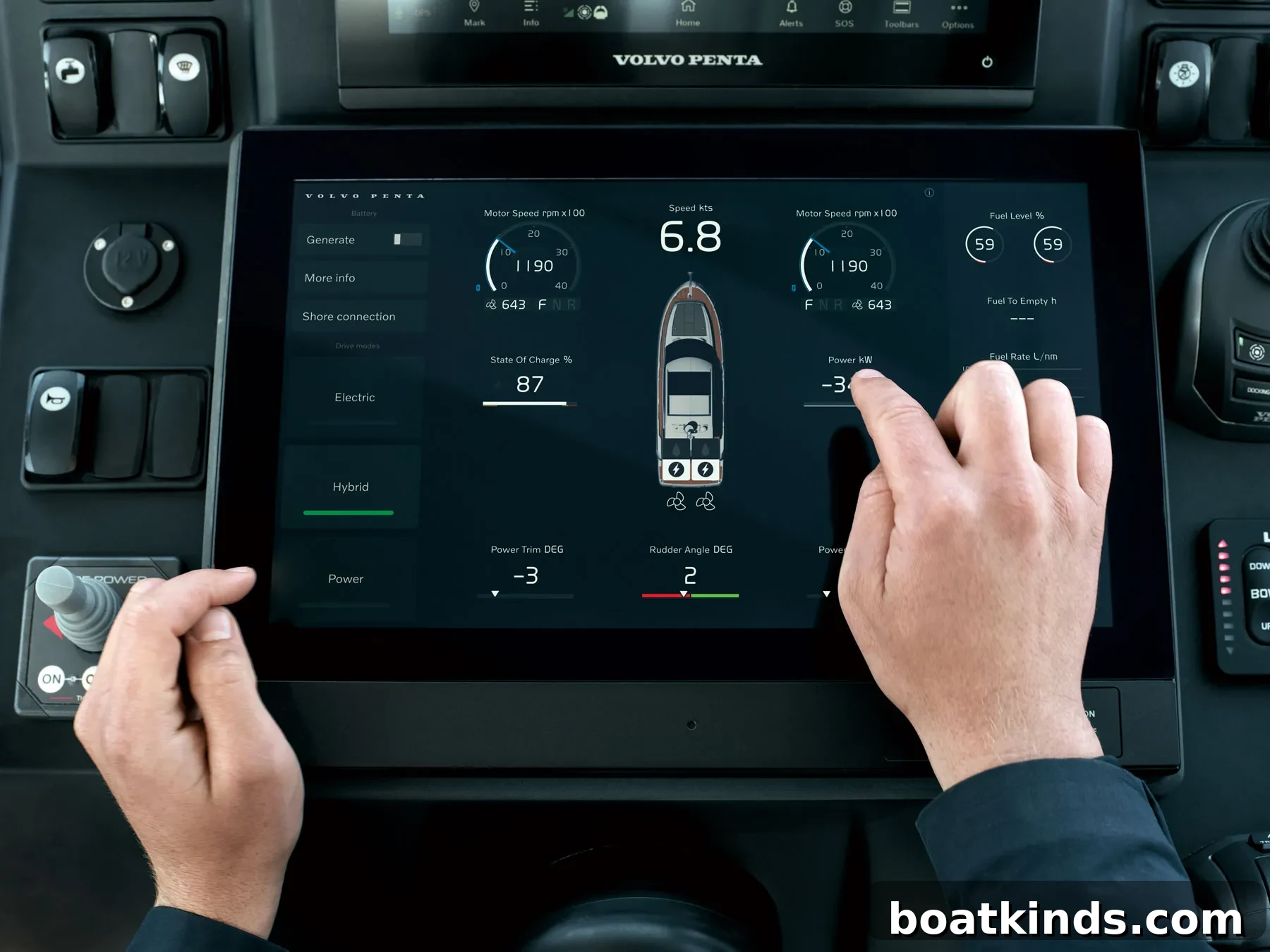
On site I was invited to try what Volvo Penta described as another step forward: their first fully integrated hybrid-electric propulsion system. Developed in partnership with Groupe Beneteau and installed on a Jeanneau NC37, the system was presented in a soft launch aimed at collecting feedback from press and dealers as Volvo Penta moved toward serial production.
The NC37 test boat combined twin 60-kW electric motors with a pair of 320-hp D4 diesels and Aquamatic sterndrives. The boat slid silently from its slip through the rock-strewn archipelago. Beyond the quiet and low vibration, the joystick control felt even more responsive than typical IPS setups; the instantaneous torque of electric motors sharpened maneuvering and made low-speed handling exceptionally precise.
The hybrid installation uses an MB battery bank with eight lithium-ion subpacks (total weight 1,322 pounds) providing 67 kWh of usable capacity. Volvo Penta has not yet manufactured this battery pack itself. According to the company, that capacity delivers roughly three hours—or about 15 nautical miles—at 5 knots, with a top electric speed near 10 knots.
Operating the NC37 in hybrid mode was straightforward. Pushing the throttles to 1500 rpm automatically brought the D4 diesels online and produced a top speed of about 37 knots. Pulling back to 1200 rpm returned the boat to quiet, electric-assisted cruising. An “electric boost” mode blends diesel and electric power to reach planing speed more quickly; on the test boat it shaved a few seconds off the acceleration time compared with diesel-only propulsion.
One valuable feature in electric mode is DPS—Dynamic Positioning—which lets the boat hold a fixed position silently. This is ideal for activities such as jigging or waiting for bridge openings without running a generator at anchor.
Charging flexibility is another strong selling point for this hybrid-electric package. Batteries can be replenished from shore power or while underway, and the system can recover up to 80 percent of capacity while motoring. The fastest approach is to charge from the boat’s diesel engines while stationary on the hook or in a slip: Volvo Penta says this method can restore a nearly depleted battery to full within about an hour, after which the battery can support onboard systems—including air conditioning—for extended periods.
Volvo Penta has not announced pricing or a firm availability date, but the hybrid NC37 is expected to appear on the boat-show circuit in the United States this fall as Volvo Penta and Groupe Beneteau ready the product for market.
Joystick Driving
While the hybrid system was the headline, another Volvo Penta innovation that stood out was the evolution of joystick driving. I’ve used joystick docking on several IPS boats and assumed the system had reached its peak. Volvo Penta’s continuous refinement disproved that idea: their latest joystick integration feels noticeably more intuitive and capable.
On a Prestige-built boat, the captain engaged docking assist to prevent accidental contact with the dock. In open water I used the joystick in traditional mode, then engaged a new “joystick driving” function by pressing a button on the joystick housed in the helm armrest. That mode lets you shift from neutral into gear, advance the throttle and steer simply by leaning the joystick to port or starboard. Small heading corrections are possible via the autopilot with a gentle twist of the wrist. The control felt natural almost immediately—the craft responded as if it were an extension of my hand.
The input logic is designed with safety and simplicity in mind. Pulling the joystick back reduces speed to neutral; continuing the same motion shifts into reverse. Releasing the joystick from reverse returns it to neutral automatically, a smart fail-safe that reduces the risk of unintended backing. On the test boat the traditional wheel and throttles became largely redundant.
Given this level of functionality, it’s not hard to imagine radically different helm layouts. I’ve already seen a Fountaine Pajot 67 with a lower helm that relied solely on a joystick and multifunction displays—no wheel in sight.
Culture of Innovation
Between trials I spoke with Inden about what comes next. “We’re always trying to think 20 years ahead,” he said, referencing Volvo Penta’s “boating for everyone” vision introduced at CES. The presentation outlined future ideas from fleet charging and docking infrastructure to new ways people might use boats.
One concept that drew enthusiastic responses was a floating island or village: a mooring hub where boaters could dock, charge, walk the perimeter and get a meal. “The reaction was fantastic,” Inden said. Builders called to ask when Volvo Penta planned to build the prototype, and boaters wanted the first test island placed nearby so they could try it for themselves.
Standing on the Krossholmen dock, watching the archipelago and reflecting on the hybrid NC37, the question was whether this hybrid-electric approach represents a meaningful step forward. Will owners value the ability to sit quietly at anchor without a generator? Will transient range at speed keep some buyers hesitant? Those answers will depend on individual use cases, but history suggests that what once seemed radical can quickly become mainstream.
After all, many of the most influential innovators were once labeled “crazy.” Volvo Penta’s path from skeptics to standard-bearer in pod propulsion is a reminder that persistence, testing and incremental improvement can reshape an entire industry.
This article was originally published in the September 2023 issue.