Before Prestige invited me to sea-trial its new flagship and tour the Italian factory, I knew almost nothing about Trieste or the nearby shipbuilding town of Monfalcone. Trieste, however, proved unforgettable: a historic port city perched on forested limestone bluffs overlooking the clear Adriatic, and the cultural crossroads of the Gulf of Trieste.
With over 2,000 years of history, Trieste sits a few miles from Slovenia, 15 miles from northern Croatia and about 50 miles from southern Austria. The waterfront hums with a mix of languages—Slavic, Germanic and Romance tongues—reflecting centuries of cross-border exchange. At Pizzeria Calo I sampled one of the best margherita pies I’ve had, then asked the manager where the waterfront crowds came from.
“Everywhere,” he said—naming countries from Croatia to Switzerland—and then added with a laugh, “And Russia too,” referencing the 460-foot vessel recently seized from Andrey Melnichenko. That cosmopolitan flavor sets the scene for Prestige’s reveal of the M8, a new 65-foot power catamaran launched by Prestige’s parent, Groupe Beneteau.
The M8, tied off at Portopiccolo—a former quarry transformed into a marina and resort—was introduced by key Prestige staff, including Brand Director Erwin Bamps, North American Director Sam Dubois and Product Manager Rosalie Le Gall. As Prestige’s most expensive model at about $5.5 million, the M8 is intended to deliver expansive, yachtlike living spaces uncommon on a 65-foot platform.
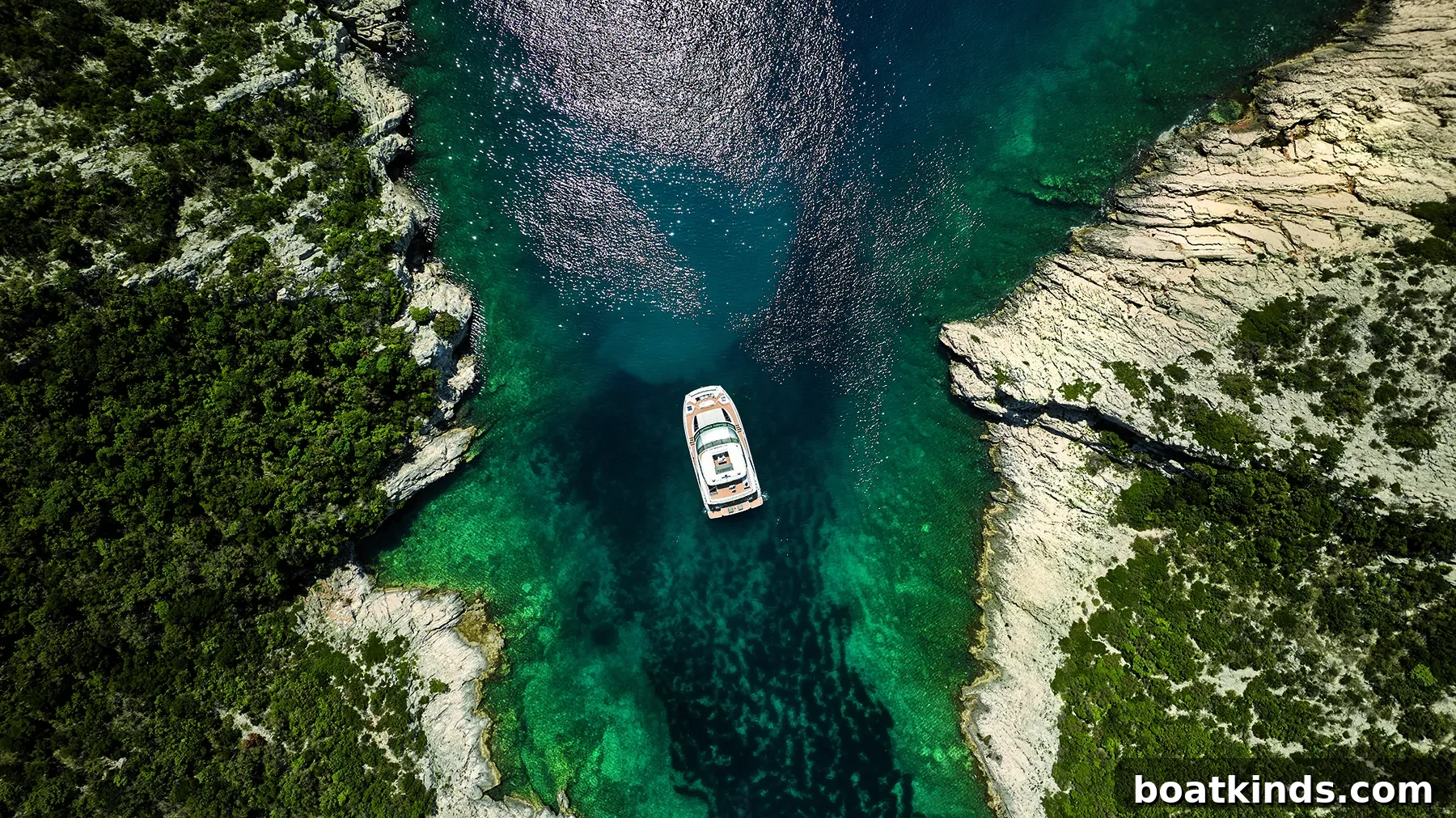
The model name M8 is a tongue-in-cheek reference to size: Prestige claims the 65-foot M8 provides more than 3,000 square feet of living area—space that would normally require an 80-foot monohull. Exterior lines are angular with curved hull windows and bright white finishes, while interior design plays on modern, Miami-inspired aesthetics.
I toured the M8’s birthplace at Groupe Beneteau’s 500,000-square-foot Italian headquarters and factory in Monfalcone. The facility, staffed by roughly 250 skilled craftsmen, continues a shipbuilding tradition dating back to the late 19th century. It’s a highly automated yet artisanal operation that turns out a Jeanneau 65 sailboat roughly every 23 days and an M8 every 27 days.
At the hull infusion area, a massive crane rotates the complete hull mold. The joinery shop, staffed by experienced cabinetmakers, handles much of the M8’s bespoke woodwork—Prestige determined in-house production was more efficient and more controllable than outsourcing. Because the complex sits on the water, the factory also handles refits and other service work for varied vessels.
Starting at the stern, the M8 boasts an exceptionally broad aft deck and main cabin that together create more than 1,180 square feet of uninterrupted, flat living space. The decking uses resilient faux teak, chosen for its light weight and ease of repair. A 14-foot-wide, step-equipped Opacmare swim and beach platform—dubbed “The Transformer”—extends the aft deck functionality: raised it becomes part of the deck, mid-level it aligns with a stern garage for paddleboards and gear, and lowered it becomes a bathing platform or tender launch.
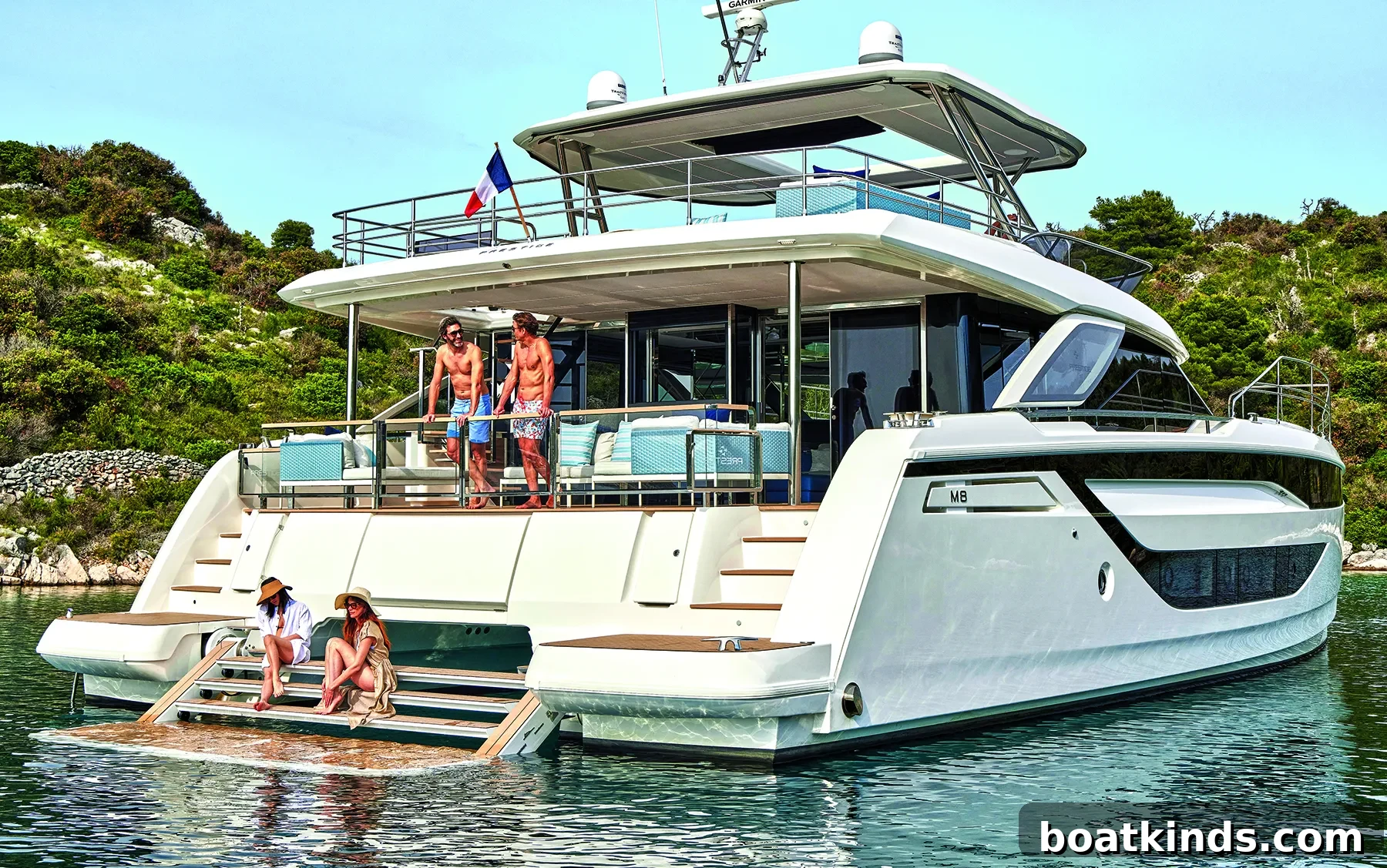
The main salon opens through five glass doors—two to port, two aft and one to starboard—combined with a raked windshield and wraparound floor-to-ceiling windows. When these doors are open the transition between indoors and outdoors nearly disappears; a handsome bar visually separates the salon and cockpit while still supporting large gatherings and sociable entertaining.
Camillo Garoni designed the exterior while Valentina Militerno de Romedis led interior design. The M8’s layouts emphasize luxury and practicality. Hull number one featured a salon-level galley with Miele appliances, though buyers can specify the galley belowdecks to suit different owner preferences. The lower control station replaces the traditional wheel with joystick control and three large multifunction displays, and Garmin’s Surround View provides a drone-like aerial perspective that simplifies docking. There is also a docking joystick on the aft deck.
Interior comforts include multiple climate zones, abundant USB charging ports, recessed lighting and handhold railings throughout. Furniture, including pieces from the famed Italian design house Pininfarina, is arranged to feel modern yet timeless—a “jet-age” luxury that favors social cruising rather than long blue-water passages.
Belowdecks the M8’s full-beam, single-level master suite occupies the forward section and feels more like an apartment than a traditional stateroom, with expansive windows and light wood paneling. Product Manager Rosalie Le Gall noted the space would normally require a monohull exceeding 100 feet to match, and the impression is justified: the master is an exceptional offering for a 65-foot catamaran.
Guest accommodations are generous as well. The demonstrator was fitted as a four-cabin yacht; options include a five-cabin layout that trades some VIP space for additional berths. The port-side VIP in the four-cabin version is almost suite-like, with a walk-in closet and a small lounge that could double as an office.
The foredeck offers broad walkways, sunpads and a recessed forward lounge that feels like the best seat on the boat—perfect for relaxation on passage. The M8 also features an internal stainless-steel spiral staircase to a 500-square-foot flybridge with dining for eight, lounging areas and provision for a grill and fridge. The demonstrator’s flybridge roof had a retractable canvas sunroof, though owners can specify a solid solar panel roof and a lithium battery bank that may allow overnight house power without the generator.
On the water, the demonstrator was powered by twin Volvo Penta D8-600 shaft-drive engines producing 1,200 total horsepower. The catamaran’s twin-hull efficiency, combined with a V-shaped center bow and the reduced wetted surface of each hull, delivers performance and fuel efficiency that outperforms a similarly sized monohull. In testing on a calm morning, the M8 handled sharp turns and three-foot wakes with authority, staying remarkably flat and stable while accelerating and turning.
Joystick controls—including twin bow thrusters—make close-quarters maneuvering intuitive; according to North American Director Sam Dubois, joysticks are enabling more owner-operators to step up to larger yachts because they significantly reduce the difficulty of docking.
Fuel capacity totals 978 gallons split between twin 489-gallon tanks. At full throttle the M8 can reach about 20.8 knots, consuming around 64 gallons per hour. A comfortable cruise near 15 knots returned roughly 49.5 gph and an estimated 350-nautical-mile range, while an economical 8-knot cruise reduced burn to about 5.3 gph and extended range to roughly 1,400 nautical miles.
On the return to Trieste I paused to photograph a towering limestone cliff—a reminder of how much this region offers beyond boatbuilding: dramatic scenery, rich history, excellent food and the high-caliber facilities of Groupe Beneteau. The Prestige M8 represents a notable step in power catamaran design, blending spacious, yachtlike accommodations with modern systems and practical, owner-friendly controls.
Prestige M8
LOA: 65’0”
Beam: 29’0”
Draft: 5’5”
Fuel: 978 gals.
Water: 224 gals.
Power: (2) 600-hp Volvo D8-600s
This article originally appeared in the October 2023 issue of Power & Motoryacht magazine and was published in the November 2023 issue of Soundings.