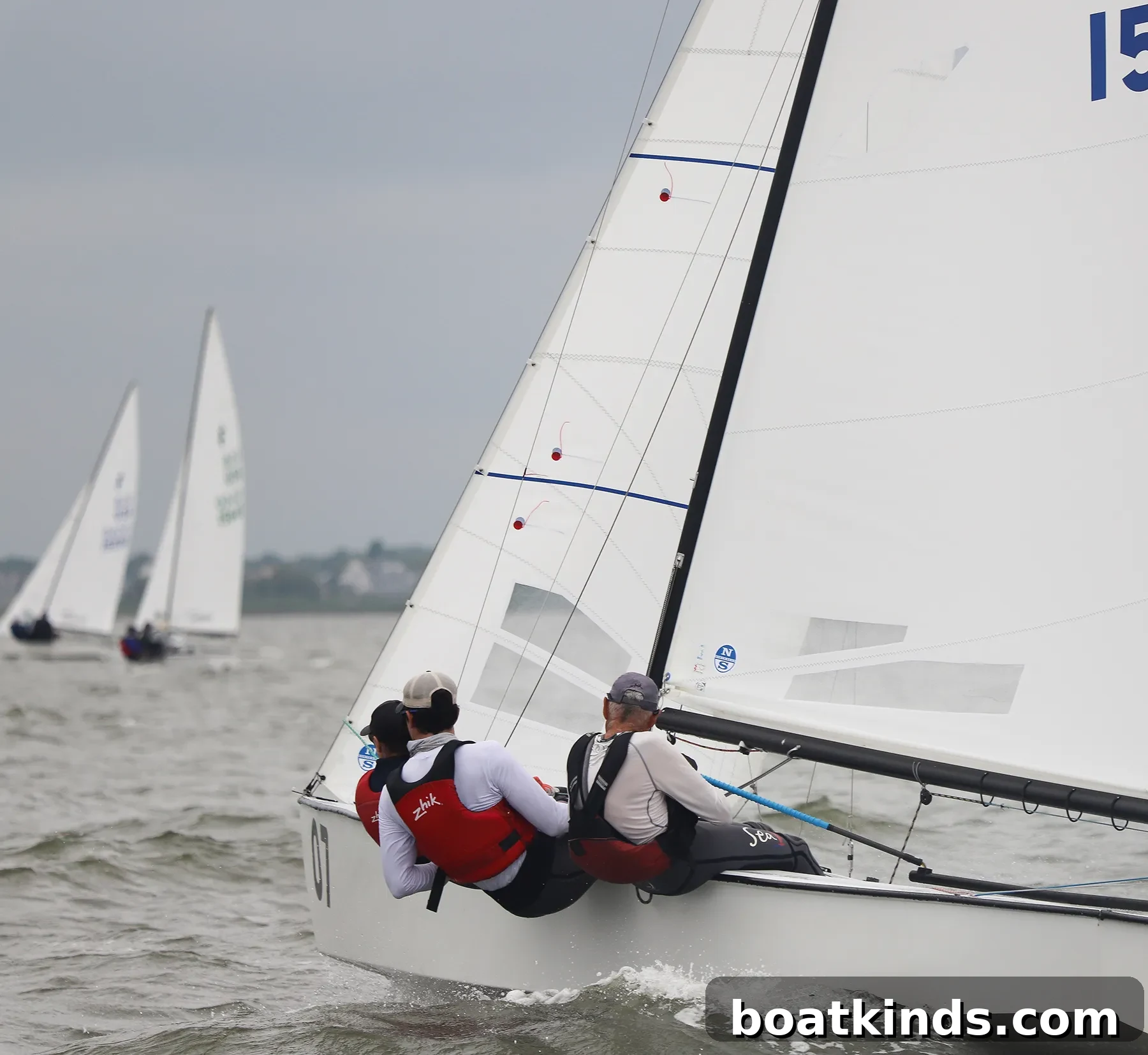
“Haul hard! Cleat that halyard and watch the luff.” Those commands were the soundtrack of my youth, shouted across spray and sunburned forearms. By twenty-one I was not a child anymore, and my mandatory crewing on the family Lightning had been theoretically retired. But on Labor Day weekend, back at the family cottage on Wellesley Island in the Thousand Islands region, I’d come home from a demanding newspaper job in Manhattan for rest—and found myself dragged back into service for one last race.
Dad had other plans. On race day he put me on the rail again and ordered, “Pay attention.” I said I was, but my attention drifted as I waved to friends on shore while the Committee boat’s hand-held horn signaled the midday start of the final race for the Thousand Island Park Regatta Cup.
Chaos took over at the imaginary start line in the St. Lawrence River, a broad waterway that marks part of the border between the United States and Canada. Fifteen Lightnings fought for position, jibing and tacking within arm’s reach of one another. Generations of our family had summers here; my father, his father before him, and now me. With Dad at the tiller we crossed the line first, but there was no time to celebrate. “Watch the luff,” he reminded me for what felt like the thousandth time.
I craned my neck to watch the upper edge of the jib for any sign of a backwind. My father—now in his mid-fifties, with a sunburned patch on a bald head and one hearing aid from an old injury—was as precise and competitive as ever. He ran a newspaper chain and ruled our household of women with the same strategic intensity he brought to sailing. He expected the same focus on deck.
He taught me to treat every Sunday race as if it were the America’s Cup of dinghies. Everything mattered: sail trim, weight distribution, and the small, sudden changes in wind. Unlike some of the other skippers—who kept coolers full of dark Canadian beer and wore baseball caps backward to drink—Dad’s crew was drilled and serious. I’d crewed on other Lightnings and noticed they didn’t monitor the luff the way we did; still, I watched it on any boat I sailed. Years of sailing with Dad had made that reflex mine.
On the second leg of the race he caught me fiddling with a bowline knot on the jib sheet. “Wake up! We’re in a race,” he snapped.
“Aye aye, Moby Dick,” I muttered, which made Tim—the third member of our crew—laugh. Tim and I had been Dad’s regular crew through our teens: Tim on mainsail and centerboard, me on the jib, Dad at the helm. Tim was almost a brother to me and the son my father never had; both of us carried complicated relationships with our fathers.
Downwind, as Tim hoisted the spinnaker, a lull let me find a warm can of Dr Pepper rolling beneath the cockpit floorboards. Between sips and out of earshot of Dad, Tim confided that the Commodore—Dad’s local nickname—taught him to keep his face to the wind at the start so he’d always sense his bearing. Dad had never told me that.
Tim added with a grin that when becalmed he’d once been told to light a cigarette and watch which way the smoke drifted. I shot Dad an accusing look, but he was busy tweaking the main. Tim—shirtless, hair long and tangled—looked back and said, “You’re as competitive as your father. You’re just like him.”
“Stop talking,” Dad cut in. “Watch the curl.” The spinnaker’s lower corner had curled; I trimmed until it filled and pushed us forward.
We rounded the final buoy amid the usual clambering. Tim dropped the spinnaker and we wrestled it into the cockpit, stuffing canvas under the bow at top speed. Dad rounded the mark a little too close; I reached to fend the hull off the buoy. “Touching the mark could be a penalty,” he said. “Hitting it is definitely a penalty,” I replied.
The last leg demanded three long tacks. The wind strengthened as the afternoon sun pulsed, and the Lightning heeled smartly. Tim and I scrambled to the windward gunwale to keep her flat. Timbers groaned, telltales fluttered, and halyards slapped the mast as we pushed for every advantage. When we crossed the finish the other boats were distant, no immediate threat—yet every detail had been contested and earned.
Back at the main dock, Dad orchestrated a neat landing. I eased the jib as we swept into the basin on a broad reach. Tim jumped onto the bow with lines in hand, bracing against the forestay. Dad shoved the tiller left and the Lightning swung in fast toward the dock. With a practiced move, I let the jib fly and Dad eased the main, slowing the boat. The sails snapped and flailed in the gusts, and momentum carried us a couple more feet before we stopped inches short of a bumping collision.
Tim jumped ashore and tied bow, stern, and spring lines in tight figure-eights. Dad and I furled the sails while the rest of the fleet finished in a relaxed procession. I watched them come in and felt the familiar mixture of triumph and affection for the ritual: the family lessons shouted across the wind, the small humiliations and the shared victories that come with every race on the St. Lawrence.
This article was originally published in the November 2023 issue.