
Surfhunter 25: The Deep-V Breakthrough That Shaped Small Powerboat Design
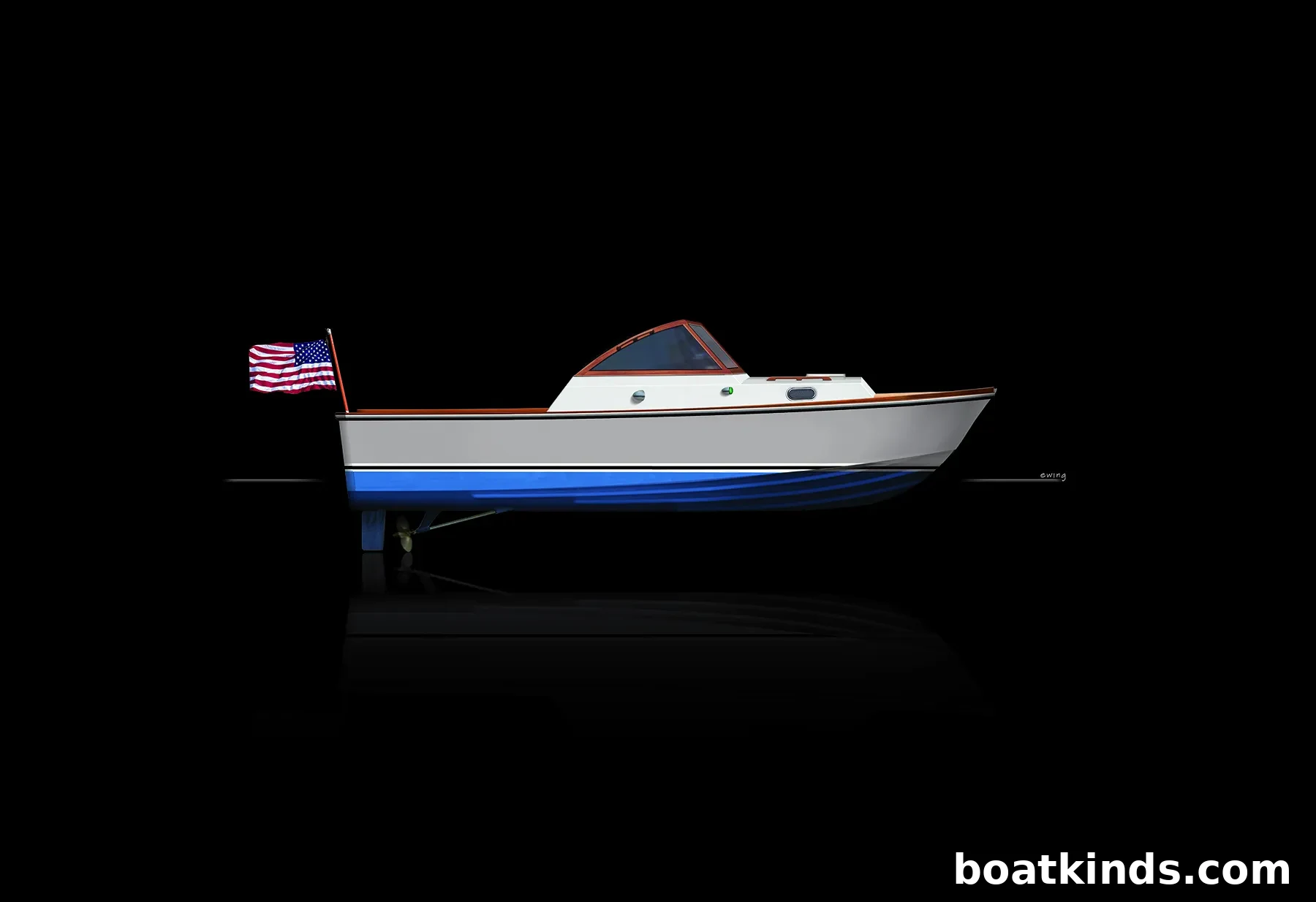
When I moved to Annapolis in 1982 to take the editorship of Rudder Magazine, one of my first assignments was to test a new Surfhunter 25 on Buzzards Bay. The weather delivered a harsh lesson: the bay was a washboard of three-foot, wind-driven seas. I expected the worst, but the Surfhunter 25, built on the deep-V hull concept developed by C. Raymond Hunt, proved surprisingly composed. That same hull form had already shown its seaworthiness in the storm-raked 1960 Miami to Nassau Powerboat Race, and on Buzzards Bay the Surfhunter felt steady on every heading, turned with authority, and delivered a notably dry ride without tripping over its bow.
The Surfhunter’s lineage reflects a transition in small powerboat construction and production. In the early days the 25 was offered with either a single inboard engine or a sterndrive, and initial examples were cold-molded mahogany built by a Mattapoisett boatbuilder. At a later stage, Jarvis Newman of Maine used one of those wooden hulls as a plug to produce the first fiberglass versions, marking a shift from craft-built wood construction to molded fiberglass production.
Early owners often specified wooden decks, tailored to individual tastes, but as the design gained popularity fiberglass deck molds were developed that reflected the era’s classic bass-boat styling. Those molds eventually passed to Tommy Johnson in Rhode Island, who supplied hulls and decks to subcontractors and allowed a variety of customizations. When Hunt Yachts acquired the molds in the early 2000s, the Surfhunter 25 became part of its lineup, and the company introduced center-console and runabout variants while making modest refinements to the hull.
The hull form itself reveals why the Surfhunter performs so well in rough water. It begins with a moderately raked stem and a gently curved forefoot, with spray-catching strakes that start above the waterline and extend aft until they meld into broad, flat chines at the transom. In practice the chines ride relatively shallow in the water, a design choice common in the 1960s and 1970s when designers prioritized staying up on plane to reduce drag and increase speed.
Winn Willard, longtime president of C. Raymond Hunt Associates in New Bedford, Massachusetts, explained the thinking behind the running strakes: “On the hull itself, there are three strakes per side, plus the primary chine at the topsides/bottom intersection. The strakes, or lift strips as we call them, are staggered. Only the outer one runs all the way to the transom. The idea on the early deep‑Vs was the boat was to run on the primary chine until it climbed far enough to clear the water. Then the boat would run on the first lift strip down, maintaining good dynamic stability.”
Complementing that strake arrangement, the hull features considerable forward flare to deflect waves and keep the cockpit drier, while a gradually radiused keel from stem to stern allows a controlled degree of slip during turns to reduce the risk of tripping. Together these elements produce a hull that is forgiving, predictable, and comfortable when the sea is unkind.
In both its ride and its construction history, the Surfhunter 25 stands as a defining small powerboat. Like Hunt’s Bertram 31, the Surfhunter has been an influential design, inspiring builders and designers for nearly six decades. Its evolution from cold‑molded wood to fiberglass molded production, and from custom deck layouts to standardized molds and varied configurations, mirrors broader trends in powerboat manufacturing while preserving the core performance traits of the original deep‑V concept.
Testing the Surfhunter on Buzzards Bay more than forty years ago left a lasting impression: a modestly sized boat, rooted in a well‑proven hull form, can offer big‑boat manners in rough conditions. That combination of seaworthiness, adaptability, and historic importance keeps the Surfhunter 25 relevant to sailors, powerboaters, and designers who study how effective hull form and thoughtful detailing produce dependable performance.
This article was originally published in the January 2024 issue.