John Whorf’s “Brooklyn Navy Yard” (1950): An Industrial Seascape in Watercolor and Gouache
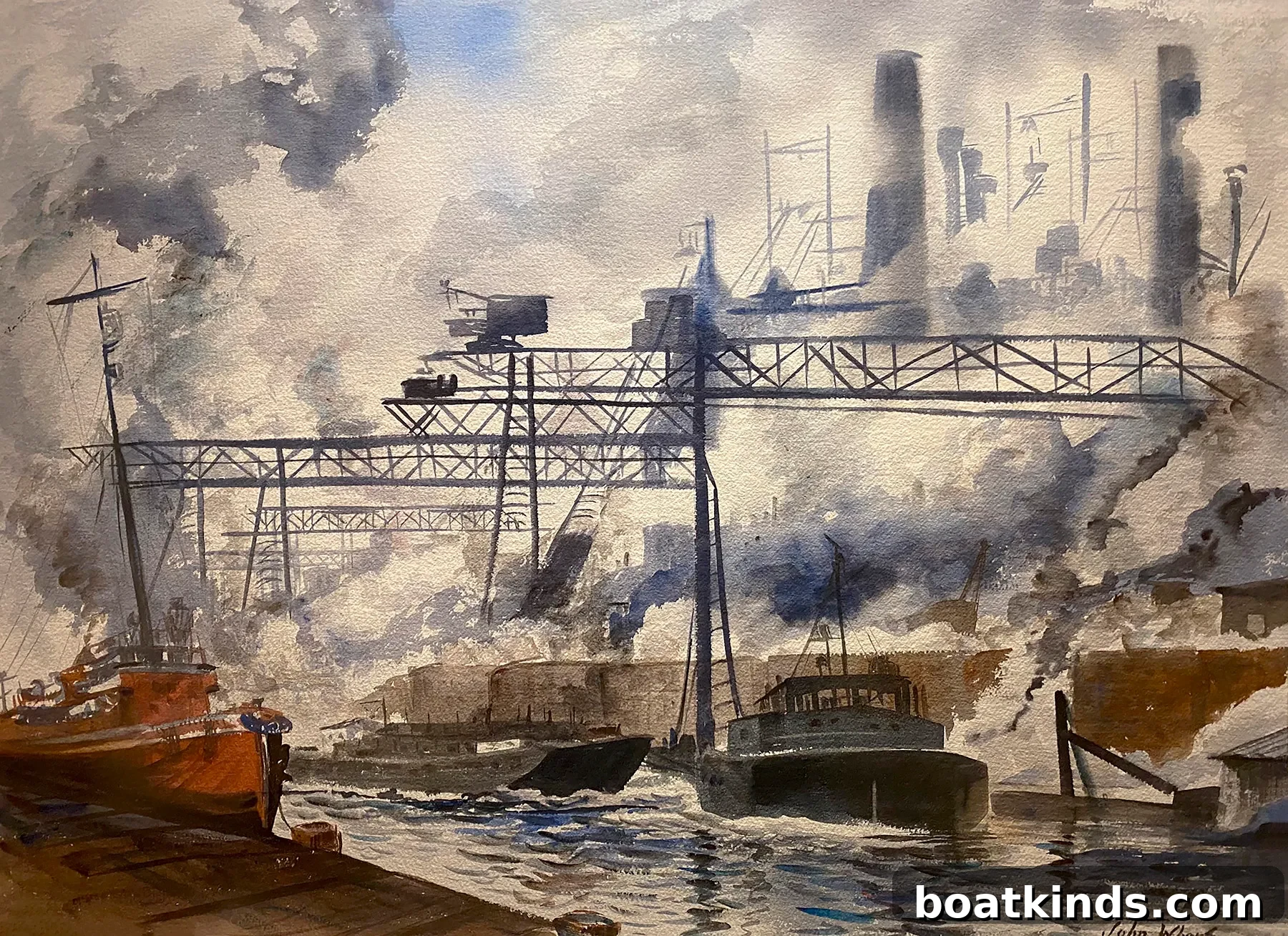
John Whorf’s 1950 work Brooklyn Navy Yard presents a compressed, atmospheric view of a vital industrial waterfront. Executed in gouache and watercolor on paper, the painting emphasizes the busy, smokey character of the shipyard with a restrained palette and confident brushwork. Thick clouds of smoke and haze dominate the composition, partially obscuring cranes, scaffolding, and vessels so that the scene reads as much as a study of light and air as it does a documentary record. Whorf’s dark, economical strokes suggest the scale and complexity of the yard without spelling out every detail, while the billowing plumes recall the tonal influences of earlier American painters such as Winslow Homer.
The Brooklyn Navy Yard itself has a long, consequential history in American shipbuilding. Established in 1801 to build and fit both commercial and naval vessels, the yard expanded significantly through the 19th century. During the War of 1812 the facility took on major refit work; the first wholly new ship constructed there was the USS Ohio. Over the following decades the yard continued to produce warships and other vessels, including four sloops of war and the USS Somers, contributing to the nation’s growing maritime capacity.
The Civil War era marked a particularly intense period of activity. At that time roughly 6,000 workers were employed at the yard, which produced 16 new warships and converted 416 commercial vessels for Union service. Those efforts reflect the yard’s strategic importance and its role in supporting large-scale naval operations. Production continued into the 20th century, and the shipyard’s output expanded dramatically during World War II.
World War II was the yard’s most active chapter. Nicknamed the “Can-Do Shipyard” for its prodigious output, the Brooklyn Navy Yard employed tens of thousands of civilians—71,000 at its peak—including 4,657 women who contributed to wartime production efforts. The battleship Missouri was built there and later became the site where Japan formally surrendered on September 2, 1945. In the postwar years the yard continued to construct aircraft carriers and other naval vessels, sustaining its reputation as a major center of American shipbuilding. It was during this era of intense activity that Whorf turned his attention to preserving the visual memory of the yard through his paintings.
Born in Boston in 1903 to parents who encouraged artistic study, John Whorf preferred hands-on learning to formal academy training. At fifteen he relocated to Provincetown, Massachusetts, where he immersed himself in the coastal environment and developed a working practice rooted in observation. Influenced by American realist and watercolor traditions—artists such as Edward Hopper and John Singer Sargent—Whorf adapted watercolor and gouache techniques to convey both atmosphere and the structural rhythms of maritime scenes. His works are notable for their clarity of light, economical drawing, and an ability to evoke the mood of a place without overwrought detail.
Whorf’s Brooklyn Navy Yard captures the industrial tempo and visual density of a shipbuilding complex at the height of its production. The painting functions on several levels: as a historical record, as an exploration of light and atmosphere, and as an expressive depiction of labor and infrastructure. Even though the yard was sold to the city of New York in 1996 and later repurposed for a range of commercial and industrial uses, Whorf’s representation remains a compelling visual testament to one of the nation’s most important naval facilities.
Viewed today, the painting invites modern observers to imagine the sights, sounds, and smells of the yard in its busiest decades. Its smoky skies and obscured structures offer a reminder that industrial landscapes are, in many ways, environments of both creation and concealment—places where massive machinery and human effort combine to produce objects and histories of national significance.
This article was originally published in the February 2024 issue.