
Natural Ranges (Transits): A Simple, Reliable Navigation Tool
Among the many techniques in a navigator’s toolbox, few are as reliable and straightforward as the natural range, also known as a transit. A natural range exists when two charted objects — one near and one farther away — visually align and appear to meet. That alignment establishes a line of position (LOP): when the two features line up, you are on that line and nowhere else.
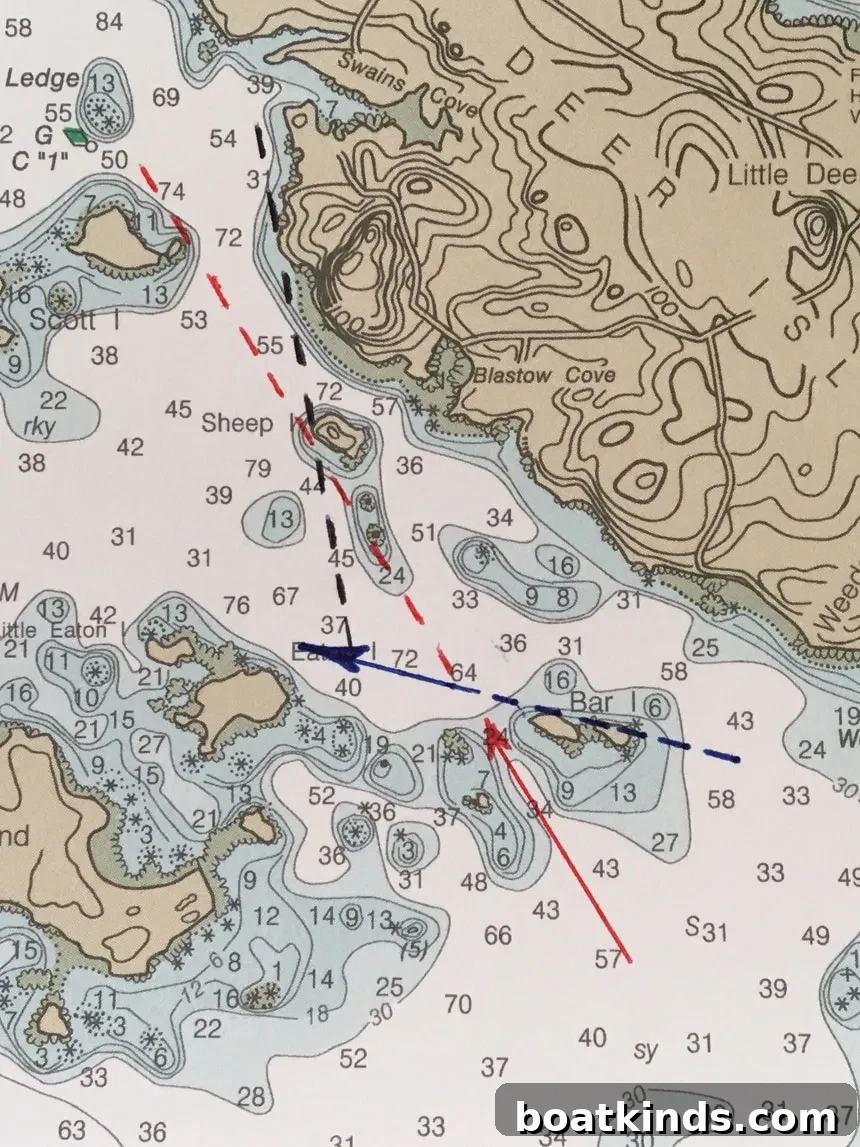
Unlike a compass bearing, which depends on accurate headings and steady hands, a natural range is indisputable when you can see it. This reliability is why harbor authorities around the world have long built artificial ranges — pairs of lights or structures, one higher and farther aft, one lower and nearer — so mariners can steer the channel simply by keeping the two aids aligned.
Natural ranges occur everywhere: the edges of two islands that line up form a range, as does an isolated rock aligned with a headland. Ranges can include manmade, charted features too — a jetty tip aligned with a water tank, a church spire and a lighthouse, or a radio tower and a distinct point on the shore. So long as the features are identifiable on the chart and visible from your vessel, they make excellent cross-checks of position.
Recreational boaters frequently use local, informal ranges that don’t appear on charts — for example, a flagpole lining up with a particular tree or a chimney. That practical approach is useful but depends on local knowledge and should be treated as a supplement rather than a primary source of navigation information.

One of the best uses of a natural range is setting a waypoint on your chart or chartplotter. Rather than placing the waypoint arbitrarily in a general vicinity, place it on the line formed by a reliable range. That way you can verify your approach visually as you close with the waypoint, combining electronic navigation with an immediate, hands-free visual confirmation. This is not “eyeball navigation” in a casual sense; it is a systematic, reproducible cross-reference between what your chart says and what you can see.
It’s important to remember that a single LOP formed by a range is not a full fix. A range tells you the line on which you lie, but not your exact position along that line without an additional crossing or measurement. Still, knowing where you are not — and seeing that you are on a particular track — can be enough to make safe navigational decisions.
When a natural range is dead ahead, you can also use the relative motion of the two features to judge whether you are being set off track. If the nearer and farther objects begin to separate or one starts to overtake the other visually, you are being pushed off your intended line and should alter course or correct for set and drift.
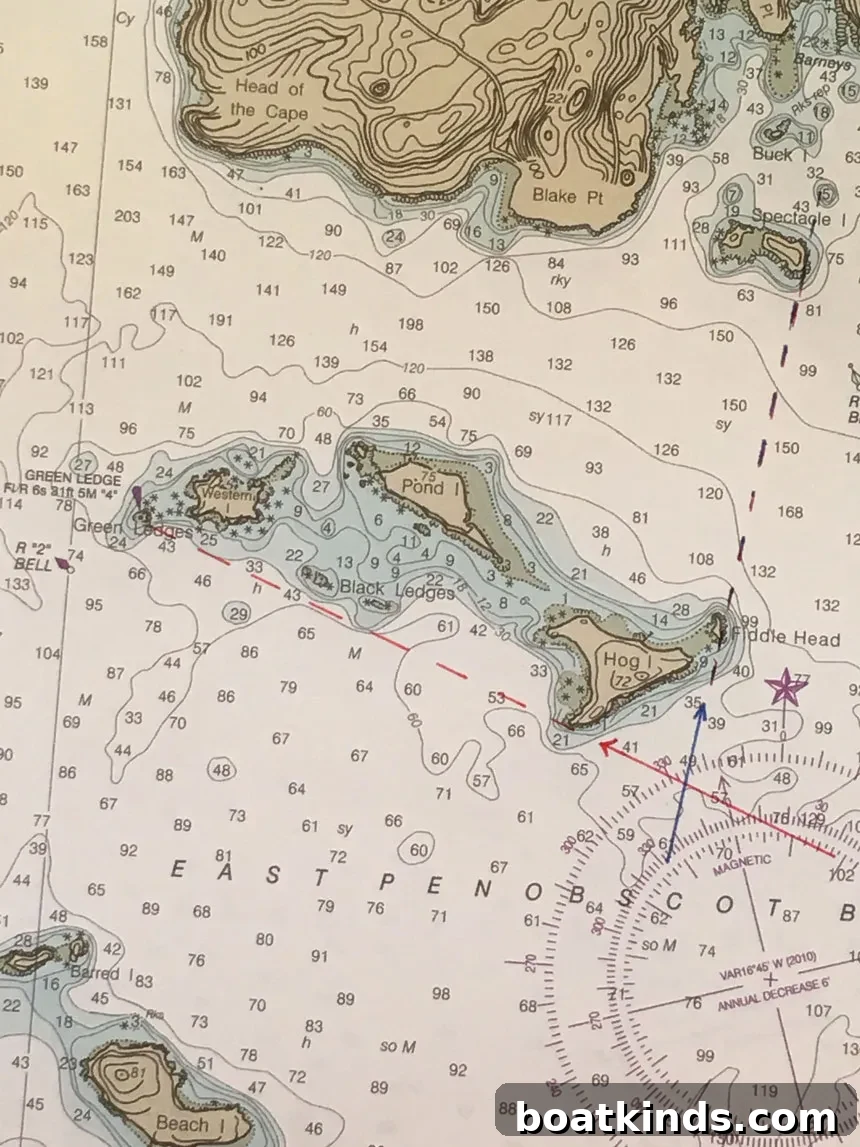
All navigational tools have limits, and natural ranges are no exception. In darkness or fog many visual references will be unavailable, so do not base an entire passage plan on ranges if poor visibility is possible. On the other hand, some natural ranges can show up on radar, providing an additional means of detection in low-visibility conditions.
Tidal variation and shoreline slope can affect the visible shoreline; at different tides the apparent edge of land may shift from the charted shoreline. Where navigation is constrained by shallow water or narrow channels, that discrepancy can matter. Ranges also lose precision over long distances — features several miles apart aligned in the distance won’t be as definitive as two nearby objects. Likewise, very featureless coasts offer few reliable ranges, while cluttered shores risk misidentifying the wrong feature as part of a range.
Buoys can be tempting to include as range components, but use them cautiously. Buoys may be off-station, and tidal currents can move them away from their charted positions. Any charted feature with questionable positioning will reduce the reliability of a natural range.
Despite these caveats, natural ranges are a powerful, high-quality navigational aid when used wisely. They are especially valuable as a way to check and augment electronic systems: plan routes with ranges in mind, set waypoints on those lines, and use them to confirm approaches and detect being pushed off track. Natural ranges are predictable and simple — navigation that truly begins at the dock.
Next time you prepare a passage on a chart, look actively for natural ranges you can use. Note them on your route, visualize how they will appear on approach, and use them to sharpen situational awareness as you navigate.