
Dave Gerr — Director of the Westlawn Institute of Marine Technology
Naval architect, yacht designer, and educator known for diverse work ranging from ultralight racing sailboats to large aluminum motoryachts.
Dave Gerr is the director of the Westlawn Institute of Marine Technology and a respected naval architect and yacht designer. His career spans an unusually wide range of projects: from a 76-foot tunnel-drive aluminum motoryacht to a 60-foot ultralight racing sailboat and a 41-foot jet-drive express cruiser.
Raised in New York City among a household of boat books, Gerr built his first pleasure craft at 18 — a Phil Bolger-designed sharpie. A Westlawn graduate, he began work at MacLear & Harris in New York in 1979, designing megayachts and commercial vessels. He founded Gerr Marine Inc. in 1983 and has produced dozens of recreational boat designs since. In 2003 he became director of Westlawn, a not-for-profit school in Eastport, Maine, affiliated with the American Boat and Yacht Council that teaches yacht design. Because of his responsibilities at Westlawn, Gerr accepts only one outside design project per year.

Gerr is also an author of five books, including The Propeller Handbook and The Nature of Boats. He lives in New York City with his wife, Barbara Curialle, and divides his free time between boating and composing classical music. In this interview he explains why he believes hybrid propulsion is generally a poor choice for recreational boats, describes his most demanding design challenges, and discusses why he often prefers sailboats to powerboats.
Q: You design boats to achieve beauty, seakindliness, strength and efficiency. Can you explain those priorities?
A: Seakindliness is fundamental. Too many contemporary designs emphasize top speed, interior accommodations, or dock appeal at the expense of how a boat behaves at sea. A seakindly boat takes care of its crew: it is comfortable, predictable and safe. Strength ties into that — when vessels are built primarily to meet a price point or to look impressive at a boat show, structural integrity can be compromised. A strong boat protects its crew and inspires confidence.
Efficiency matters both for operating cost and performance. For powerboats it means getting good range per gallon of fuel; for sailboats it means achieving speed and handling that match the sail area. Ultimately, a well-balanced design that combines these four attributes makes boating safer and more enjoyable.
Q: Can you give examples of boats that combine those qualities well?
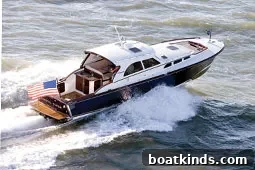
A: Two examples are Imagine, the Kanter 57 aluminum voyaging motor cruiser, and the 41-foot Santa Cruz Coastal Flyer jetboat. Both are seakindly and efficient; the Coastal Flyer is particularly noted for its fuel economy and practical jetboat design.
Q: When you talk about fuel efficiency, what counts as decent miles per gallon for a boat?
A: There’s no single number because fuel consumption varies widely with hull type, size and speed. What matters is achieving the best possible efficiency for a given design. In general, longer, more slender hulls are always more efficient and typically more seakindly when proportioned correctly. Operating at a slightly lower fraction of hull speed also improves economy.
For displacement and semidisplacement vessels, sizing a boat according to displacement is important. For example, a 30,000-pound hull stretched from 40 to 50 feet — keeping displacement the same but lengthening and narrowing the hull — will usually yield much better fuel economy and higher speeds at the same speed-to-length ratio.
For technical discussion on efficiency I’ve written in the Westlawn journal The Masthead. One key point I make there is that hybrid propulsion, despite its appeal, is rarely an efficiency win for boats.
Q: Why aren’t hybrids a good fit for recreational boats?
A: Hybrids work well for cars because road vehicles benefit from regenerative braking and spend a lot of time idling or in stop-and-go traffic. Boats don’t. They don’t coast downhill, and most boating profiles don’t include long idle periods where electric drive alone yields meaningful savings. Every time you convert energy from one form to another you incur losses. In a marine hybrid you convert mechanical to electrical energy to charge batteries, then back to mechanical energy to turn the propeller — each conversion reduces efficiency.
Typical direct-drive diesel or gasoline installations deliver 95–96 percent efficiency at the shaft. A hybrid system, after generator, battery and motor inefficiencies, often yields around 80 percent at best. Claims of hybrid efficiency are frequently based on slower operating speeds used during tests. For true efficiency gains on most recreational boats, a properly proportioned direct drive and optimized hull and propeller package will outperform a hybrid arrangement.
Q: Besides a longer, narrower hull, what else improves efficiency?
A: Propulsion matters. For most moderate-speed boats, larger-diameter, slower-turning propellers are more efficient than small, high-RPM props. Optimizing the drivetrain and propeller can yield dramatic improvements. Practical barriers persist, though: dockage fees are commonly based on length rather than displacement, and market trends often favor flashy technologies over fundamentally efficient design choices.
Q: Which yacht was your most challenging design?
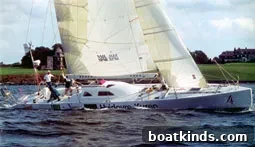
A: The 60-foot BOC racer Holger Danske was especially challenging due to its extreme light weight. It launched with a displacement/length ratio around 40, making it one of the lightest ocean-racing monohulls built and launched. That project required exhaustive structural and hydrostatic stability calculations, and it tested the full range of design and engineering methods.
Q: Which design did you enjoy most?
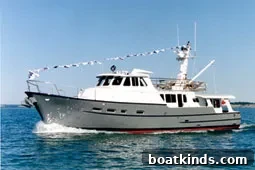
A: I enjoy whatever I’m working on, but I take special pleasure in boats I would like to own. Tunnel-drive motor cruisers such as the 42-foot Summer Kyle and the 47-foot Peregrine hold particular appeal to me — they’re practical, well-proportioned and fun to use.
Q: Walking a boat show dock, what pleases you and what offends you?
A: I’m drawn to classic lines and sensible design. Modern, high, bloated, overly white boats often leave me cold. That said, there are modern designs I admire — for instance, Rodger Martin’s Presto, an efficient 30-foot sharpie, and certain contemporary large motoryachts that achieve a clean, proportioned aesthetic. My preference remains for boats that emphasize seakindliness, strength and efficiency over mere visual flash.
Q: How did you first enter the marine industry?
A: I grew up surrounded by boats in New York. My father kept boat books, and we sailed and spent summers on the water. I studied physics at NYU, briefly transferred to Pratt Institute for industrial design, and eventually discovered Westlawn. Yacht design combined my interests in art, science and engineering perfectly, and I’ve been immersed in it for decades.
Q: Do you own a boat?
A: Yes. My personal boat is a custom design called Madrigal — a 20-foot canoe-stern, varnished lapstrake sloop. It’s currently stored in Connecticut. Although it has an outboard bracket, I rarely use the engine; I prefer sailing when time allows.
Q: Are you primarily a sailboat person?
A: I began as a sailboat enthusiast and remain fond of sails, but over the years I’ve come to appreciate powerboats as well. Sailing offers a purer, hands-on experience, but powerboats can be more comfortable and less physically demanding for cruising. I’ve designed far more powerboats than sailboats, yet if pressed I’d still say my preference leans toward sailboats.
Q: Who are notable Westlawn graduates and designers you admire?
A: Westlawn has produced many successful designers, including Tom Fexus, Bruce King, Jack Hargrave, Rodger Martin, David P. Martin, Bill Shaw, Rod Johnstone, Royal Lowell and Britton Chance, among others. Designers I admire include L. Francis Herreshoff for his elegant work, Bill Garden, William Atkin for his prolific small-boat legacy, Dick Newick for revolutionary multihulls, and Renato Levi for his refined powerboat designs from the 1960s.