
I clearly remember the first time I worked out my position using celestial navigation. That neat cross on the chart meant more than just a location on a map — it marked the moment I felt like a real navigator. Celestial navigation carries a lot of mystique; early reading made it seem like you had to be a mathematical prodigy to fix your position on the earth by observing stars with a sextant. In truth, with a little practice and patience, it becomes straightforward and empowering.
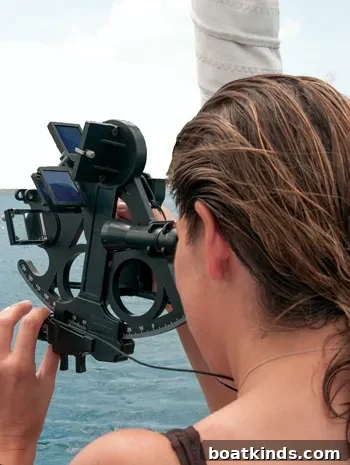
To determine a position at sea you need latitude and longitude. Modern GPS reduces that to pushing a button and watching an icon move across an electronic chart, but celestial navigation remains a valuable backup. Learning how to observe the sun, stars, and planets to establish position gives small-boat skippers and offshore sailors confidence when electronics fail. The military’s renewed interest in teaching celestial navigation speaks to the value of a reliable Plan B if satellite systems or electronic navigation are compromised. Beyond practicality, the skill itself is rewarding and impressive to master.
Start with the sun and focus on mastering the noon sight. A noon sight—measuring the sun’s altitude at local noon—provides a solid way to determine latitude. At local noon the sun reaches its highest point in the sky for your location; by accurately measuring the angle between the sun and the horizon at that moment and recording the time, you can calculate your latitude with useful precision.
The basic method is simple. Measure the sun’s altitude with a sextant at local noon, then subtract the sextant reading from 90 degrees to find the zenith distance (ZD). Consult the nautical almanac to find the sun’s declination for the nearest hour at your location; declination is the angular distance of the sun north or south of the equator. If you and the sun are in the same hemisphere, add the declination to ZD; if you are in opposite hemispheres, subtract it. The result gives your latitude.
Longitude requires knowing the exact moment of local noon. In the northern hemisphere local noon is when the sun is due south; in the southern hemisphere it is when the sun is due north. One common technique is to take repeated sights with the sextant as the sun rises in altitude, watch for the moment the altitude stops increasing and appears to “hang” at its maximum for a short time, then begins to fall. Another approach is to take a sight roughly ten minutes before expected local noon, record the time, continue taking sightings until the same sextant reading recurs as the sun descends, record that time, and average the two times. That average is local noon. With local noon known and by consulting the almanac for Greenwich hour angle (GHA) information, you can calculate longitude: the earth turns 360 degrees in 24 hours, so each hour of time corresponds to 15 degrees of longitude relative to Greenwich (0°).
Practical celestial navigation also requires small but important corrections. Index error compensates for any inherent bias in the sextant’s optics and should be checked regularly. Dip corrects for the height of the observer’s eye above the sea horizon — whether you are sitting on a small boat or standing on a tall ship’s bridge makes a difference. Time error accounts for whether your watch or chronometer runs fast or slow; using an accurate timepiece set to UTC (Coordinated Universal Time) or a reliable chronometer reduces this source of error. Sea motion and roll make sights more challenging, so practice on stable ground first to get comfortable handling the instrument and reading angles.
Start ashore to learn how a sextant feels and how to take steady sights before attempting observations on a pitching boat. Practice repeatedly: handling the instrument, applying index and dip corrections, consulting the nautical almanac, and timing local noon will build confidence. Small, careful steps will turn what seems complex into a repeatable routine.
When you first lose GPS offshore and can revert to celestial methods to find your position, the sense of competence is remarkable. Celestial navigation is not only a practical backup for electronics failures and cyber threats to satellite systems, it is a time-honored seamanship skill that adds resilience and confidence to any navigator’s toolkit.
Buying a sextant
For beginners, inexpensive plastic sextants can produce acceptable results if handled carefully, but they can be easily knocked out of adjustment. If you plan to use celestial navigation regularly, invest in a quality instrument. High-quality sextants range widely in price; many capable, durable models are available for a few hundred to a couple of thousand dollars. The Astra 111B, for example, is a popular, robust option that typically sells for several hundred dollars and offers reliable performance for most users. Buy the best sextant you can afford and maintain it properly — a well–cared-for instrument can last for generations.
This article originally appeared in the June 2016 issue.