
If you must transit the Somali coast or the Gulf of Aden, experts say you should travel with a trained, armed security team or avoid the passage entirely.
As piracy off Somalia grows more audacious, better armed and more organized, yachtsmen, commercial shippers and the international community face difficult decisions. For private yacht captains, cruising and security specialists are unequivocal: avoid the region if you can. If no alternative exists, obtain professional protection or transport your boat by sea.
“If it were up to me, I wouldn’t go there at all,” says Jeremy Wyatt, director of the World Cruising Club in Cowes, England. A.J. Anderson, managing director of Wright Maritime in Fort Lauderdale, which handles megayacht management and security, concurs. “It simply doesn’t make sense to take a yacht there now or in the foreseeable future.”
Three-time circumnavigator Jimmy Cornell also advises extreme caution about the Gulf of Aden–Red Sea route, suggesting yachts either sail around Africa’s west coast or transport their vessels to avoid passage through the Suez Canal area. Convoys, once seen as a mitigant, are no longer considered a reliable defense.
Rising attacks and limited naval protection
Despite coordinated patrols by NATO, the European Union, India and Russia, international naval forces have not been able to provide armed escorts for the more than 20,000 commercial vessels transiting the Gulf of Aden each year, and patrols have not deterred escalating pirate activity. The International Maritime Bureau reported roughly 109 pirate attacks in the Gulf of Aden and off Somalia through Dec. 19, 2008, with 42 of those incidents ending in hijackings. By late December, about 14 vessels and 268 crew remained in pirate hands.
High-profile ransom demands have underscored the threat: attackers reportedly sought $25 million for the supertanker Sirius Star, which was carrying roughly $100 million in crude oil, and $20 million for a Ukrainian ship reportedly transporting T-72 tanks and other heavy arms to Kenya. A light aircraft later parachuted an estimated $3 million ransom onto Sirius Star’s deck, securing the release of the Saudi vessel and its crew, but not without tragedy: one pirate skiff capsized during the escape, and reports said five of the men drowned.
A tougher international response
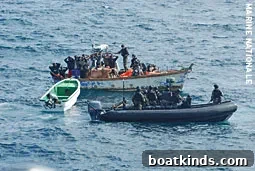
The international response has stepped up. In mid-December the United Nations adopted a resolution permitting naval forces to land ashore in Somalia, with Somali consent, to pursue pirates. European forces have increasingly intervened: in early January a French frigate stopped a pirate attack on a Panamanian cargo ship and detained eight suspects; days later another French warship captured 19 pirates while rescuing two cargo vessels. The U.S. Fifth Fleet announced the formation of a multinational Combined Task Force 151 to coordinate anti-piracy operations in the region.
Heavier pirate armaments and longer ranges
Security firms report the pirates’ weaponry and tactics have become more lethal. Attackers now commonly use Russian-made PKM 7.62 mm machine guns that can penetrate many hulls, and rocket-propelled grenades. They operate with mother ships, extending their range hundreds of miles offshore — the Sirius Star was taken some 450 miles south of Somalia. For many cruising yachts and smaller motor yachts not designed for long open-ocean passages, the prudent advice is to avoid Somali waters entirely or travel only with a professionally trained armed escort.
AffairAction, a long-established maritime security firm, places compact teams of two to four highly trained armed guards aboard yachts. These teams have reported successfully repelling multiple attacks over recent years. According to security managers, pirates generally seek easy, low-risk targets; when they encounter credible resistance they tend to disengage. That said, crews and owners must choose security providers carefully — inexperienced, trigger-happy contractors pose legal and safety risks. Any firearm use must follow strict rules of engagement and comply with applicable laws, because unjustified shootings can leave owners, captains and crew liable for criminal prosecution.
Using yacht transport as an alternative
Loading a yacht onto a semi-submersible transport shifts security responsibility to the transport operator and can be safer than an under-way transit. For example, Dockwise Yacht Transport planned voyages that would carry yachts from the Persian Gulf through the Suez Canal to the Mediterranean, with security teams aboard and routing that keeps vessels in protected corridors at higher transit speeds. Transport operators may travel at night and coordinate with naval patrols to reduce exposure.
Routing yachts westward around Africa avoids the Gulf of Aden but creates its own challenges: many West African ports are unsafe, forcing nonstop passages that require careful seasonal timing to avoid cyclone season in the south Indian Ocean. These longer routes also mean additional time and voyage planning for cruising schedules.
Industry positions and defensive measures
Some industry groups have urged stronger collective action. The International Association of Independent Tanker Owners called for an international air-and-sea blockade of the Somali coast to suppress piracy, arguing the costs of diverting tankers around Africa would be substantial. Cruise lines have varied in their approach: some have chosen to disembark passengers before transiting the Gulf of Aden and rejoin them after, while others rely on speed and onboard defenses to pass through.
Maritime legal and security experts debate the merits of arming merchant crews. Some argue well-trained and lawfully armed crew can deter pirate attempts; others emphasize the legal complexity and risks. Non-lethal technologies such as water cannons and high-decibel sound devices are also being incorporated into larger yachts and commercial vessels as part of layered defenses.
Copycat risks and wider regional crime
Security professionals warn that Somali piracy’s apparent success could inspire copycat attacks elsewhere, including more targeted threats against pleasure craft. In some Somali communities pirates have been portrayed as Robin Hood figures, a dynamic experts link to declining local fisheries and broader socioeconomic stress. Organized criminal groups on land increasingly manage intelligence, logistics and ransom negotiations, turning coastal raids into a coordinated criminal enterprise. Until underlying causes such as poverty, depleted resources and governance issues are addressed, experts expect maritime criminality to persist and potentially spread.
Other regional concerns: Venezuela
Beyond East Africa, cruising conditions are deteriorating in other regions. Jimmy Cornell’s cruising information site, www.noonsite.com, documents incidents worldwide and highlights increasing attacks in Venezuelan waters. More than 90 crimes against foreign yachtspeople have been reported in the last three years at the time of the original reporting, including shootings and murders near Puerto La Cruz. Specialists advise yachtsmen to avoid high-risk areas and to remain vigilant about local security conditions.
Given the changing threat environment, many experienced professionals now recommend a combination of strategies: avoid known pirate zones when possible; employ vetted, disciplined security teams if transit is unavoidable; consider yacht transport to eliminate exposure; and adopt layered defensive measures that follow the law and minimize escalation. Ultimately, reducing the regional piracy problem will require sustained international enforcement and concerted efforts to address the root causes ashore.
This article originally appeared in the March 2009 issue.