
Jurassic Ocean Predators: Thalattosuchians and Their Whale-Like Inner Ears
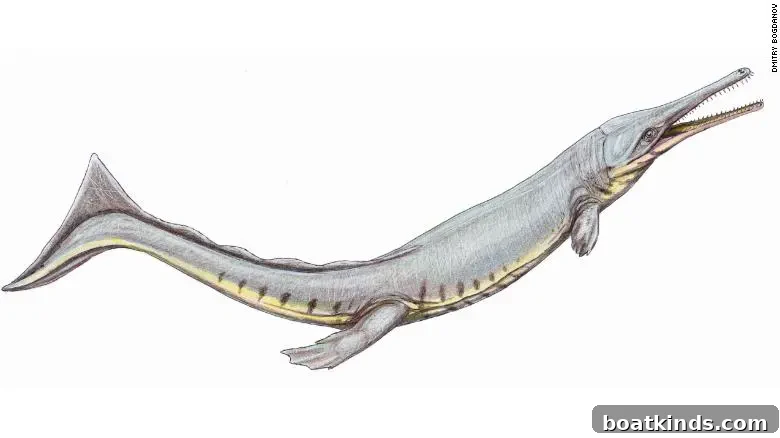
If you find great white sharks intimidating, consider the sea-going crocodiles that hunted the oceans around 170 million years ago. Known collectively as thalattosuchians, these ancient reptiles reached lengths of up to 33 feet and bore formidable teeth suited to a predatory lifestyle. Over millions of years they transformed from land-dwelling crocodile ancestors into highly specialized marine hunters.
From Land to Sea: Major Body Changes
The transition of thalattosuchians from terrestrial to marine environments involved dramatic anatomical shifts. Limbs once adapted for walking became paddle-like flippers, tails elongated and developed powerful flukes, and bodies grew more streamlined to reduce drag while swimming. These physical changes enabled greater speed and maneuverability in open water, turning thalattosuchians into efficient aquatic predators capable of pursuing prey in environments very different from those of their ancestors.
Inner Ear Evolution: A Surprising Parallel with Whales
Recent research focusing on the skull anatomy of thalattosuchians has revealed an unexpected adaptation: parts of their inner ear were modified in ways that parallel changes seen in whales and dolphins. This inner ear restructuring likely played a role in how these animals sensed their environment underwater—affecting balance, spatial orientation, and possibly the reception of low-frequency sounds.
“The ancient aquatic crocs developed unusual inner ears after modifying their skeletons to become better swimmers,” said Dr. Steve Brusatte, senior author on the study. “Whales also changed their ears in a similar way but did it soon after entering the water.”
Convergent but Distinct Evolutionary Routes
The resemblance between the inner ear structures of thalattosuchians and those of marine mammals is a classic example of convergent evolution: unrelated lineages evolving similar solutions to shared challenges. In this case, both groups adapted to living and moving in water, but they did so along different anatomical pathways and timelines. “It seems like the crocs and whales took similar, but different, evolutionary routes from land to water,” Dr. Brusatte added. That observation highlights how natural selection can produce comparable functional outcomes even when starting from different ancestral morphologies.
Why Inner Ear Changes Matter
Modifications to the inner ear are significant because that region of the skull houses structures responsible for balance and the detection of movement and sound. For animals shifting from a terrestrial to an aquatic lifestyle, changes in inner ear anatomy can improve stability during swimming, enhance the ability to detect prey or predators, and help coordinate rapid maneuvers. While the study focuses on anatomical evidence preserved in fossil skulls, those anatomical changes point to major behavioral and ecological shifts in thalattosuchian life.
What This Tells Us About Marine Adaptation
Studying thalattosuchians enriches our understanding of how vertebrates adapt to marine environments. These crocodile-line archosaurs represent one of several successful transitions from land to sea in Earth’s history. Comparing their adaptations with those of other marine groups—such as cetaceans—reveals both the constraints and creative solutions evolution employs when organisms face similar ecological pressures. The discovery of whale-like inner ear features in thalattosuchians underscores the value of examining fossil anatomy in detail to uncover convergent patterns across deep time.
Continuing Research and Paleontological Insights
Ongoing study of fossil skulls and other skeletal elements will refine our picture of thalattosuchian biology, behavior, and sensory capabilities. Each newly analyzed specimen contributes to a more complete understanding of their diversity and the timing of key adaptations. By integrating anatomical data with broader paleontological and geological evidence, researchers aim to map how these ancient crocodiles navigated shifting shorelines, prey availability, and oceanic ecosystems during the Jurassic.
Thalattosuchians remain a striking example of how powerful selective pressures in the marine realm can drive dramatic transformations—both visible in body shape and hidden within the skull—resulting in predators that were well suited to life in ancient seas.