
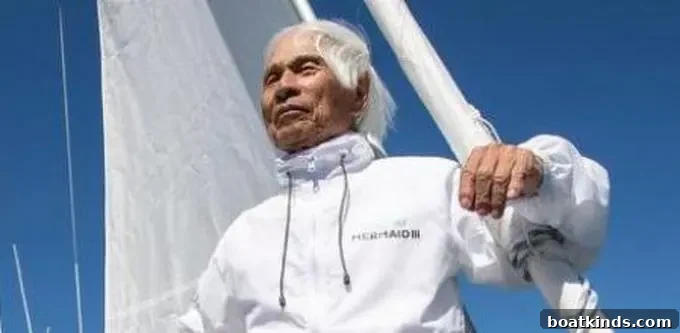
Kenichi Horie’s Latest Solo Pacific Crossing: A Short Aluminum Boat, Old-School Navigation, and a Long Legacy
Kenichi Horie has long been one of the most adventurous and unconventional figures in modern sailing. His seamanship and appetite for creative, low-tech projects have made him a living legend in Japan and beyond. Decades after making headlines for bold solo voyages, Horie has set out once again, this time aiming to sail solo from San Francisco back to Japan in a purpose-built 19-foot aluminum boat.
Early Milestone: The 1962 Pacific Crossing
Horie first attracted international attention in 1962 when he sailed non-stop from Osaka to San Francisco in a 19-foot plywood boat. The passage took 94 days. At the end of that crossing he faced unexpected trouble on arrival — detained and unable to explain himself because he had no passport, no money, and little ability to speak English. That daring voyage helped establish the foundation of a career defined by audacity, resilience and a willingness to challenge conventional limits.
A Life of Unconventional Voyages
Throughout the 1970s and 1980s Horie completed several circumnavigations and earned a reputation as one of Japan’s most prominent yachtsmen. He has also become known for experimental, environmentally-minded projects that demonstrate alternatives to conventional boatbuilding and propulsion. Among his most imaginative undertakings are crossings made with hulls fashioned from beer kegs and whiskey barrels, and vessels powered primarily by renewable or human energy sources such as solar panels, pedal power, and wave generators.
The Suntory Mermaid III: Small, Simple, Purposeful
For his current voyage Horie is sailing a custom-built, 19-foot aluminum sailboat named Suntory Mermaid III. The boat keeps things deliberately minimal: it has no engine, no radar and no GPS plotter. His approach to navigation emphasizes traditional seamanship, relying on nautical charts and a mobile application as an aid rather than a primary electronic navigation system. The simplicity of the setup underscores Horie’s focus on self-reliance, seamanship skills, and demonstration of low-impact travel.
Crossing Goals and Timeline
Horie departed San Francisco on March 26 with the expectation of arriving in Japan in June. One of the objectives of this passage is to set a record as the oldest person to complete a solo Pacific crossing. Beyond records, the voyage is also a statement about sustainability and the potential of minimalist design and renewable energy in small-vessel voyaging.
Environmental Intent and Public Profile
Over the years Horie has positioned many of his projects as environmentally conscious experiments, testing alternative materials and propulsion methods to highlight reduced ecological impact. Whether working with reclaimed barrels or designing boats that rely on human or solar power, his efforts blend practical seamanship with an activist sensibility aimed at drawing attention to ocean health and sustainable practices.
Legacy and Influence
Kenichi Horie’s long career has inspired sailors, boatbuilders, and advocates of small-boat exploration. His early trans-Pacific crossing and subsequent voyages challenged assumptions about what small craft and solo sailors can achieve. Equally important, his inventive experiments in hull design and propulsion have broadened the conversation about low-impact boating and alternative materials.
This current voyage in the Suntory Mermaid III is another chapter in a lifetime of striking, hands-on demonstrations that seamanship, creativity and resilience remain central to meaningful ocean travel. Observers and fans of adventurous sailing are watching with interest as Horie attempts once more to cross a vast ocean in a deliberately simple craft, relying on skill, experience and a deep familiarity with the sea.