
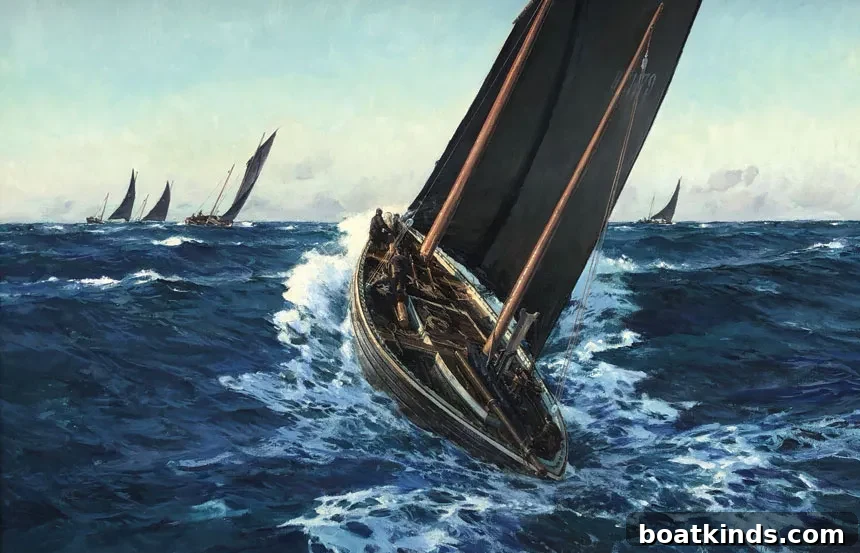
Drifters and Zulus: Christopher Blossom’s Sea-Washed Tribute to 19th-Century Fishing Boats
Wind and wave send a double-ended, lug-rigged fishing boat plunging through white-capped rollers off the coasts of northern England and Scotland. In the painting, the crew are moments away from setting a mile-long net and working the tide — resuming the age-old rhythm of fish and fishermen.
Marine artist Christopher Blossom transports the viewer back to the late 1800s, when this type of vessel — known as a zulu — was a dominant force in coastal fisheries. Typically about 40 feet long in its early form, the zulu carried a distinctive double lug-sail rig: a large mainsail set on a main mast often as long as the keel, and a smaller mizzen used mainly to steady the boat. The mainsail extended well aft, giving the boat power and drive while the mizzen helped balance and control in changing conditions.
Design Lineage and Practical Strength
Blossom explains that the zulu combined features from two older fishing-boat traditions. From the scaffi it inherited a short keel and a raked stern, and from the fifie it took a full bow and a deep forefoot for better upwind ability and a longer waterline for speed. As technology advanced, particularly with the introduction of steam-powered capstans, zulus were built longer — some reaching lengths up to about 70 feet — to increase capacity and efficiency for larger hauls.
These were boats made for hard work in demanding seas. At the turn of the tide, drifters would put out nets as long as a mile, then drift with the tidal flow while hauling in the catch slowly and methodically. The crew would clear the fish and flake the net in preparation for the next set. Managing such gear and manoeuvres required a high degree of seamanship; Blossom emphasizes that these vessels were sailed by men of extraordinary skill.
Capturing Motion and Atmosphere
In Blossom’s composition, the boats are shown heading into a fairly stiff evening breeze to set their nets. He suggests that, owing to the wind conditions, many would set downwind and that distant boats in the scene have already turned off the wind. The sense of movement — hulls cutting through swell, sails drawing, and the ever-present spray — creates a vivid narrative of labour and sea craft.
One of the most striking visual devices in the painting is the treatment of foam and spray. The bright bursts of white stand out against deep blue water, providing both contrast and compositional rhythm. Blossom uses foam not merely to depict surface texture but as a design element to define the planes of the sea and to lead the eye through the scene. The effect is bold rather than subtle, but it reinforces the painting’s energy and sense of place.
Historical Context and Local Fisheries
The drifters depicted in the work evoke the great fishing communities of Yarmouth and Lowestoft, ports with long histories of coastal fishing. Drifters from these ports made regular forays into the North Sea, relying on skillful sail handling and intimate knowledge of tides and weather to bring in their catches. Blossom’s depiction honors that tradition while offering a dynamic study of how boats, seamen, and the elements interact.
Viewing the Work
This painting is part of a body of marine work by Christopher Blossom that reflects both historical awareness and painterly craft. To see this and other works by Blossom, visit the J. Russell Jinishian Gallery in person at 1899 Bronson Road, Fairfield, Connecticut. If you plan a visit, it is advisable to call ahead for gallery hours: (203) 521-1099.
Originally published in the August 2018 issue.