
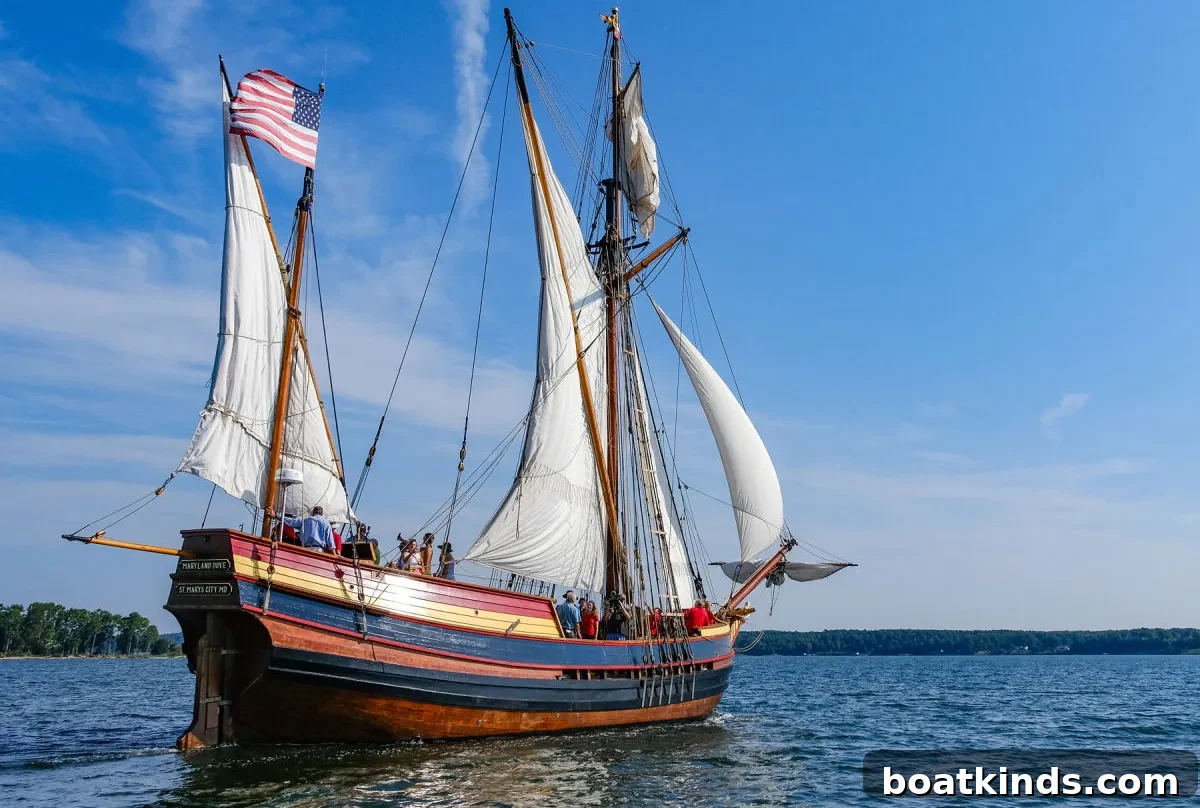
Maryland Dove Replica Arrives at Historic St. Mary’s City
After five years of planning and nearly three years of construction, the Chesapeake Bay Maritime Museum (CBMM) in St. Michaels, Maryland, has completed and delivered the new Maryland Dove to its permanent home in Historic St. Mary’s City. The reproduction arrived on August 27, 2022, escorted by a diverse fleet of recreational and commercial vessels. This new vessel replaces the first reproduction built in Cambridge, Maryland, in 1978, which is being retired due to age and condition.
The new Maryland Dove is a 40-ton vessel with an overall length of 84 feet, a length on deck of 57 feet, and a beam of 17 feet. These dimensions more closely match historical records for the original Dove that entered the Chesapeake Bay from England in 1633, accompanying the larger ship Ark. As a smaller, versatile 17th-century coastal craft, the Dove was suited to exploration and supply runs along the Atlantic seaboard and between the Chesapeake Bay and New England.
Shipbuilding and Historical Accuracy
CBMM won the contract to construct the new Dove after evaluating proposals from shipyards along the East Coast. The museum’s experience in maritime preservation and its well-equipped boatyard made it an appropriate choice. Regina Faden, executive director of Historic St. Mary’s City (HSMC), emphasized the natural partnership between the two institutions, noting that the project supports both organizations’ missions to interpret and tell the story of early Maryland.
To ensure historical authenticity, the museum’s shipbuilding team relied on close study of period construction techniques and visual sources. Members of the shipbuilding crew visited the Vasa Museum in Stockholm to inspect the remarkably well-preserved 17th-century warship, which shares many construction methods with British and Dutch ships of that era. For rigging details, the museum’s head rigger examined numerous 17th-century Dutch paintings to identify the nuanced rigging practices and hardware used at the time. These research steps helped the team reproduce the distinctive appearance and functionality of a 17th-century coastal vessel.
Craftsmanship and Apprenticeship
The boatyard team included experienced shipwrights alongside a rotating cohort of young men and women enrolled in CBMM’s two-year apprentice program. This blend of seasoned craftsmanship and hands-on training ensured both high-quality construction and transmission of traditional skills to a new generation of maritime artisans. The project exemplifies the museum’s broader role in preserving not only historic vessels but also the techniques required to build and maintain them.
Role as a Living Artifact and Ambassador
Owned by the state of Maryland and operated by the Historic St. Mary’s City Commission, the Maryland Dove will function as a living artifact and a floating ambassador for the historic city that served as Maryland’s first capital. The vessel is intended to draw visitors and provide an immersive connection to the early colonial era, illustrating maritime commerce, exploration, and daily life in the 17th century.
Throughout the project, CBMM demonstrated its longstanding commitment to Chesapeake Bay maritime heritage. The museum maintains one of the largest regional collections of historic Chesapeake Bay watercraft, including skipjacks, crab dredgers, buy-boats, log canoes, and traditional crabbing skiffs. The Dove project builds on that legacy by adding a carefully researched and constructed reproduction that complements the museum’s existing fleet and interpretive work.
With its arrival in St. Mary’s City, the new Maryland Dove stands ready to serve as a centerpiece for historical interpretation and cultural tourism, helping visitors better understand Maryland’s maritime origins and the role these modest yet capable vessels played in early colonial life.
—George Sass
This article was originally published in the November 2022 issue.