
Understanding Amp-Hours and Battery Capacity on Your Boat
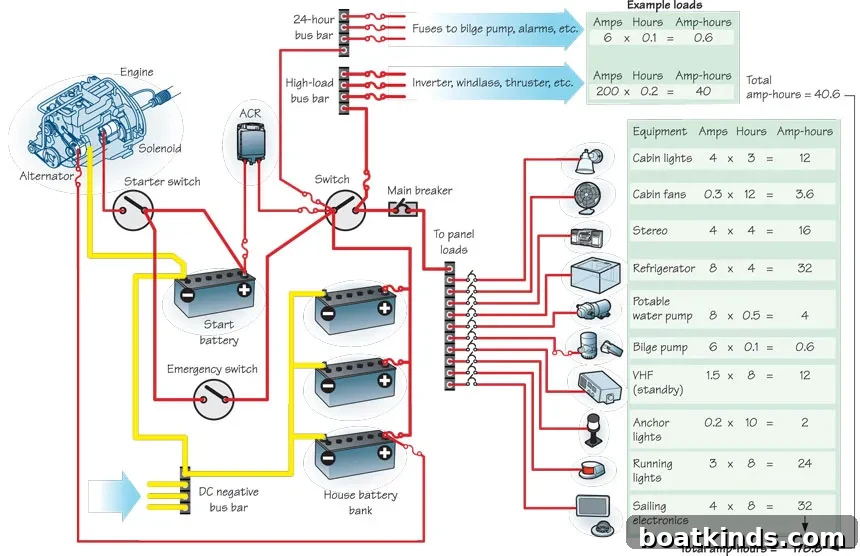
Amp-hours on board are the marine equivalent of kilowatt-hours in your home: they measure how much current you draw over time. When planning a boat’s electrical system, the two critical factors are the amount of current each device consumes and how long each device runs between charging opportunities. Accurate accounting of these variables determines the size of the house bank—the bank of batteries that powers lights, refrigeration, electronics and other onboard loads.
Why Starting Batteries Are Different
Starting batteries are straightforward to size because they must supply a large burst of current for a very short time to crank the engine. In contrast, house batteries support lower-current loads that run for extended periods—hours at a time—which has a much greater impact on total amp-hour consumption. Lighting, fans, navigation instruments and other continuous systems may draw modest current but their long runtime can rapidly deplete capacity if the battery bank is undersized.
Estimating Required Battery Capacity
A practical rule of thumb is to size the house battery bank so it never discharges below about 50 percent of its rated capacity. Keeping depth of discharge to 50 percent helps maintain voltage stability and extends battery life. In simple terms, this means batteries should be at least twice the amp-hour requirement for the time between charges. For example, if your daily usage totals X amp-hours, you need at least 2X amp-hours of battery capacity to avoid excessive discharge.
Planning for Extended Cruising
For longer cruises or when charging opportunities are limited, a more conservative approach is wise: plan for three times the expected consumption. A 3× factor provides a buffer when recharging moments are unpredictable or when batteries cannot reliably reach full charge between uses. If you regularly undertake extended passages, install multiple charging sources to reduce reliance on a single system and to give flexibility when the engine is off.
Supplementary Charging Sources
Many cruisers combine the engine alternator with renewable charging to keep the house bank healthy. Solar panels, wind generators and auxiliary water-driven generators can meaningfully reduce net consumption by adding amp-hours back into the bank. When estimating your net energy budget, deduct the realistic average production from these sources to arrive at the true shortfall that batteries must cover. Multiple charging options also increase redundancy and peace of mind when motoring is limited or impossible.
Monitoring and Balancing Consumption
Monitoring is essential to maintain a balanced electrical system. Battery voltage gives an immediate, rough indication of state of charge, while dedicated meters that log amperage over time provide precise amp-hour accounting. These meters show real-time amp-hours drawn and put back into the bank, helping you adjust usage patterns and charging behavior to keep batteries within safe limits.
Reducing Load Through Efficiency
If your amp-hour budget exceeds practical battery size or charging capability, reduce consumption with efficient equipment. Advances in LED lighting dramatically lower long-term amp draw compared with incandescent or halogen bulbs, making them one of the most effective energy-saving upgrades. Likewise, modern refrigeration compressors and insulated systems run more efficiently and can cut peak and total amp-hour demand.
Careful planning—accurate load calculations, conservative battery sizing, multiple charging sources and good monitoring—ensures a reliable, balanced onboard electrical system. These measures keep voltage within acceptable ranges, extend battery life and help guarantee that systems perform at the level you need for a safe and comfortable time on the water.
This article originally appeared in the December 2017 issue.