
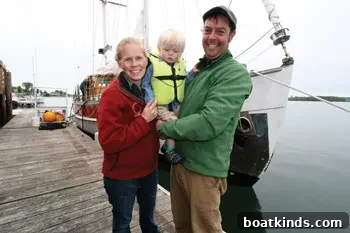
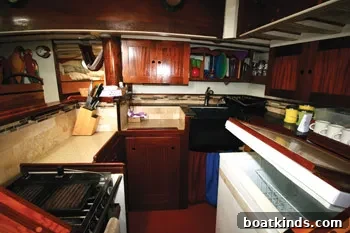
There are two deeply evocative moments aboard the classic William Hand–designed motorsailer Guildive. The first is when you crouch on the cabin sole to study the original teak planks: the smell of sea salt, the soft sheen worn by nearly 80 years at sea, every nick and hollow a small history of voyages and weather. The second arrives after leaving the dock in Castine, Maine, where Guildive now operates. Capt. Kate Kana steers while holding their 18-month-old son, Coe. Capt. Zander Parker stands on deck, hoisting the main and jib. Passengers talk in the sheltered cockpit above the steady hum of the engine, pointing out landmarks—the Maine Maritime Academy’s brick buildings and docks, the small red-roofed Our Lady of Holy Hope church, a protective seawall over an early Native American shell midden, and perfectly restored Georgian and Federal homes.
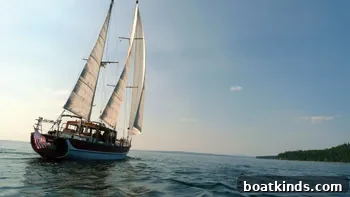
Then Kana cuts the engine. The sails fill with a gentle flap across some 1,600 square feet of canvas, and a hush falls over the boat. Conversations fade as people listen to lapping waves, the cry of gulls, and the soft sound of a wooden hull slipping through the water. That quiet moment—when sail and wood and wind come together—defines the Guildive experience.
For Parker and Kana, and now for little Coe, running this grand motorsailer as a tour boat in Castine is a dream realized. They cherish the layered history that Guildive represents: the story of William Hand’s motorsailers, the boat’s own decades-long life, and Castine’s maritime past. Close by at Maine Maritime, another Hand icon, the Arctic schooner Bowdoin, sits at the dock—an empowering reminder of a seafaring heritage they love to share with guests.
Sharing has been central to their work, turning many customers into friends. On the cruise described here, passengers relax in the cockpit as the couple points out seals and historical sites and explains Castine’s role during the War of 1812, when locals organized a blockade against the British. Picnics unfold—lobster rolls are common—and family-style camaraderie grows: Parker takes the helm, Kana steadies Coe, and the toddler delights in gently pushing fenders off the side decks while adults watch and smile.
“We’ve been having a blast,” Kana says after they return to the dock. Both captains move with practiced ease: steering, answering questions, watching for changing conditions, and keeping an eye on their energetic child. They switch duties almost wordlessly. “We thought we’d get people who have sailed before,” Kana adds, “but many passengers have never been on a boat. To share this experience with beginners and seasoned sailors alike has transformed us and them.”
#
William Hand’s motorsailers represent an important transition in small-boat design—the integration of internal combustion power into hull forms that had evolved for sail. After decades as one of the 20th century’s most productive naval architects, Hand focused in the late 1920s on creating vessels that performed well under both engine and sail. He drew inspiration from Maine sloops and Chesapeake Bay sharpies and bugeyes, and addressed the new challenge of pairing reliable powerplants with hulls that handled that power efficiently.
Hand’s solution was not merely to add an auxiliary engine to a sailboat. Instead, he rebalanced hull lines, refined forward sections, reduced displacement, and improved entry—producing boats that were primarily powered by engines but able to perform under sail when conditions allowed. These motorsailers quickly earned reputations for beauty, seaworthiness, and comfort.
Guildive began life as Restless, a private yacht built in 1934 for Stuyvesant Fish II. At 56 feet, she was the largest of the Wheeler shipyard’s Hand series; most others measured 30 to 40 feet. Early yachting publications praised Restless for her grace and seaworthiness. In 1942 she was requisitioned by the U.S. Coast Guard for coastal patrols during World War II. After the war, the motorsailer changed hands several times and sailed from Canada to the Caribbean. In the 1960s she operated as a Caribbean charter under owner John Mason.
Wooden boats demand constant care, and Guildive was no exception. In 1981 Richard “Dmitri” Bernhardt purchased the boat, renamed her Sixpence, and raised his daughter aboard while cruising between Canada and the Caribbean. Bernhardt restored the craft extensively in the 1980s, later home-porting her on Orr’s Island and running overnight charters in Casco Bay. After decades of stewardship, he was careful about the boat’s next owners.
#
Kana and Parker brought deep maritime experience when they acquired the boat in 2008. Both are U.S. Coast Guard–licensed and together have sailed more than 40,000 nautical miles across the North Atlantic, South Pacific, the West Indies, the California coast, the Great Lakes, and as far as Iceland. Kana grew up on Maryland’s Eastern Shore, racing small boats and winning collegiate championships. A Semester at Sea program led her into professional sail instruction and youth education aboard schooners such as Harvey Gamage and Lady Maryland and later at the Los Angeles Maritime Institute.
Parker is from Antigonish, Nova Scotia, and after sailing a Laser in his youth he trained aboard the barque Picton Castle before studying small vessel operations at Maine Maritime Academy, where he also worked on the Bowdoin. He and Kana met at the Los Angeles Maritime Institute and sailed together on a variety of ships. Their work took them to remote locations, including a stint supplying the Cook Islands aboard a converted trawler, where they carried everything from cement to canned goods and learned to manage cargo, community relations, and long stretches at sea under basic conditions.
#
They found Sixpence in the winter of 2008 listed by an Annapolis broker and fell in love. Bernhardt interviewed prospective buyers carefully—he wanted someone who would use and maintain the vessel rather than keep her as a dockside trophy. The couple’s vision matched his expectations: they planned to invite the public aboard, teach, and run comfortable charters in Maine. They renamed the boat Guildive—an Anglicized pronunciation, “gill-dive,” linked to the boat’s rum-trading heritage and their hope of voyaging to the Caribbean.
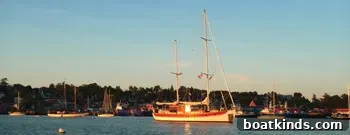
Their business launched the following summer from Castine, where the town’s historic charm, the presence of Maine Maritime Academy, and a steady seasonal population made the location ideal for sail tours and educational trips. The couple originally split time between summers in Castine and winters in the Chesapeake, inviting passengers to take an active role as crew on voyages. Today they live in Castine year-round, running day sails, educational cruises, and private charters that emphasize hands-on experience and connection to maritime history and nature.
They sometimes miss long offshore passages, but they appreciate their life ashore aboard a beloved classic and the community built around Guildive. “We’ve come away with so many friends,” Kana says. “People still send thank-you notes from trips years ago. It feels like real life, not work.”
This article originally appeared in the September 2016 issue.