
Tracy Edwards and the Remarkable Story of Maiden
Tracy Edwards, born in Pangbourne, England, emerged from a nonconformist youth to become one of the most influential figures in modern sailing. Expelled from school at 15, she left home to backpack across Europe and, at 17, took a job as a stewardess on the Greek yacht Piraeus. It was there that she first learned to sail. By 23 she had sailed in the 1985/86 Whitbread Round the World Race (now called The Ocean Race), serving as cook aboard Atlantic Privateer and becoming the first woman to compete in that class around the world.
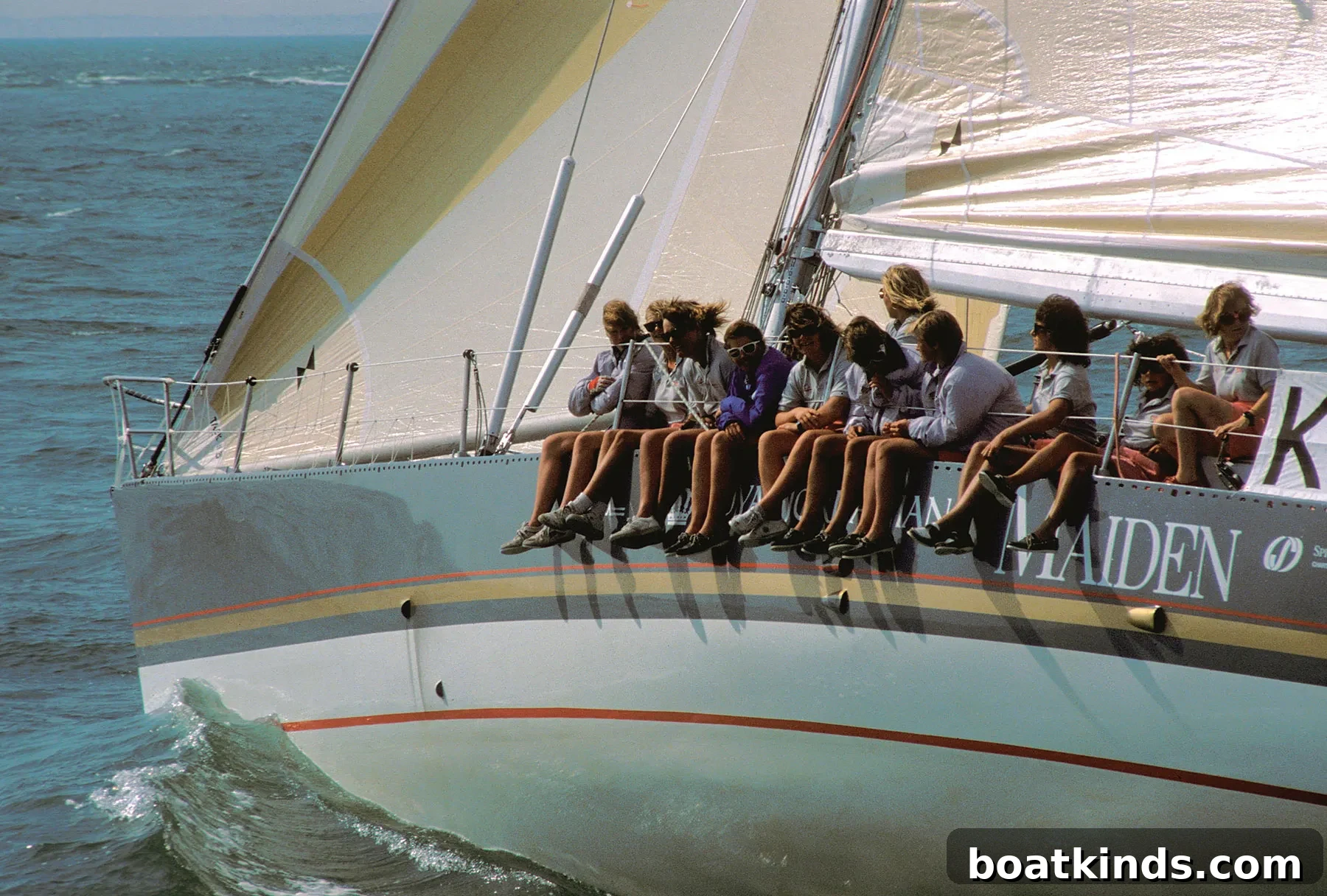
Determined to push far beyond the role she had been given, Edwards resolved to skip her own entry in the next Whitbread race. At a time when women were dramatically underrepresented—just a handful of women sailed for every 200 men—Edwards took the bold step of assembling an entirely female crew. She mortgaged her home to buy a 1979, 58-foot aluminum yacht designed by Bruce Farr, invested in its restoration, and renamed the vessel Maiden.
On September 2, 1989, Edwards and a 12-woman crew crossed the starting line aboard Maiden and set out on what would become a landmark campaign. Against long odds and deep skepticism from parts of the sailing community, the crew won two of the six individual legs of the race, including the famously challenging Uruguay-to-Fremantle passage, and finished second overall in their class. The achievement earned Edwards the MBE (Member of the Most Excellent Order of the British Empire) and made her the first woman to receive the Yachtsman of the Year Trophy—an historic moment that broadened perceptions of who could lead and compete at the highest level of offshore racing.
Edwards continued to pursue record-setting and barrier-breaking projects. In 1998 she led the first all-female crew to attempt the Jules Verne Trophy—the prize for the fastest non-stop circumnavigation of the globe by sail—aboard a 92-foot catamaran. That campaign set five world records before the vessel was dismasted some 2,000 miles off the coast of Chile. Undeterred, Edwards later helped set four major world records with a mixed-gender team racing the 110-foot maxi catamaran Maiden II, demonstrating both resilience and a relentless appetite for pushing the boundaries of offshore performance.
Years after making maritime history, Edwards learned in 2014 that Maiden had been left to deteriorate in a marina on Mahé, Seychelles. Facing the prospect that the boat might be abandoned or sink, Edwards reached out to her original crewmembers and launched a crowdfunding appeal to raise the estimated 75,000 Euros needed to recover and restore the yacht. The successful campaign led to a full restoration and a new purpose for the vessel.
Following the restoration, Edwards founded The Maiden Factor, an initiative that uses the restored yacht to raise funds and awareness for girls’ education worldwide. The project links the symbolic power of Maiden—a vessel that once shattered expectations and opened doors—to educational opportunities for girls who face barriers to learning. By combining high-profile sailing events, speaking engagements, and school outreach, The Maiden Factor leverages Edwards’s story and the boat’s legacy to advocate for equal access to education and to inspire future generations of female leaders.
Tracy Edwards’s journey from a teenager who left school and found work on a Greek yacht to an internationally recognized yachtswoman and campaigner captures both the personal risks and the broader social impact of challenging entrenched norms. Maiden remains a potent symbol of determination, teamwork, and the lasting change that can come when people rally around a bold idea. Her career illustrates how sporting achievement can be translated into sustained social advocacy—transforming a single boat and its crew into a platform for global empowerment.
This article was originally published in the June 2022 issue.