
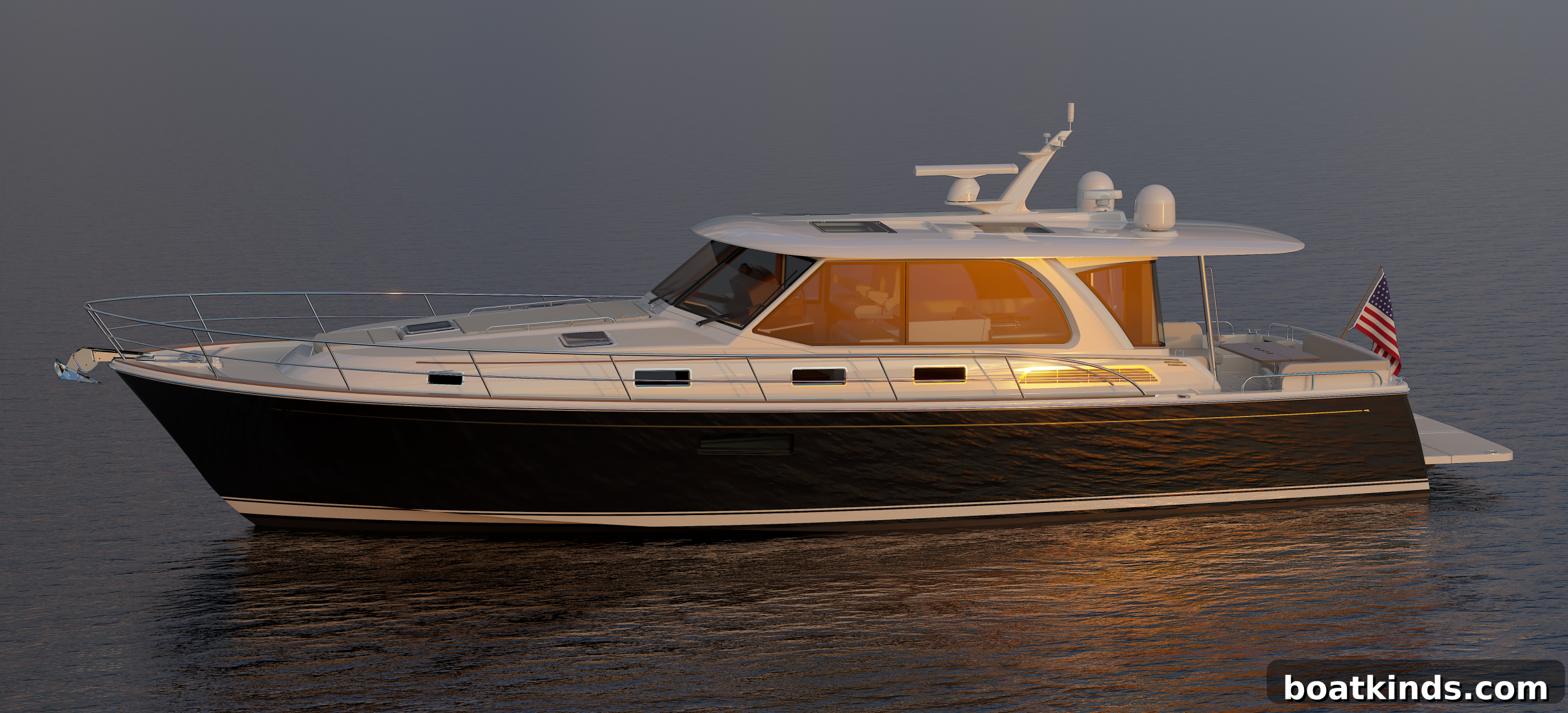
Designing a new boat model is a meticulous process, and at Sabre that attention to detail can come down to arguing over fractions of an inch in the sheerline. The Sabre 51 Salon Express is the result of years of refinement, owner feedback and careful engineering aimed at delivering more interior volume and thoughtful features without changing the classic Sabre profile.
“When we’re developing a model like this, it’s years in the making,” says Kevin Burns, Sabre’s vice president of design and product development. “A lot of thought goes into these things.”
The 51 builds on the success of the Sabre 48. More than 200 hulls of the 48 have been built, sold and resold over the past dozen years, providing extensive owner and dealer feedback. Burns estimates the team spoke with more than 300 owners and dealers about the 48 and the larger 58. From those conversations two clear objectives emerged: increase usable features and interior volume by moving up from 48 feet, while avoiding the steep step up to a 58-foot model that many owners find intimidating.
“We’re deliberately building these boats for lifelong boaters,” Burns explains. “They’re doing this for fun, and we want that to outweigh any nervousness around boat handling.”
To achieve those goals the Sabre team rethought several elements. The windshield was moved forward to create more salon volume, a change that required innovations in composite structure so the salon and lower-deck spaces could coexist without altering the boat’s signature profile. Frameless glazing with smaller mullions and advances in helm ergonomics let natural light flow down into the lower deck, while eliminating a traditional port dashboard layout.
“We’ve wanted to increase the volume of these salons over the years, and it’s been a very important design point,” Burns says. “It required a significant amount of structural engineering and thoughtfulness with the composite tooling.”
The hardtop was another area of focused refinement. Over successive Sabre models the hardtop has progressively lengthened, and that evolution is more pronounced on the 51. The visor above the windshield balances thermal loads for the air conditioning with the need for interior daylight. Along the side decks, a subtle drip edge protects the windows without intruding into the walk path—designed so you don’t feel like you’ll bump your head while moving about.
At the stern the hardtop extends aft to protect the cockpit and the beloved aft-facing seats that many Sabre owners prize, yet the designers avoided making the area feel enclosed. Those choices paid off for longtime Sabre owners like Jeff Harris and Joyce Pratt, who cruised their Sabre 52, It’s A Blast, from Chesapeake Bay to New England and the Carolinas for 14 years and found the 51 to be an immediate favorite.
Harris says it took only about 30 seconds to decide on purchasing Hull No. 2. He and Pratt appreciated the cockpit overhang: on their 52, the overhang provides little coverage, and they had been using an aftermarket shade at anchor. “By extending it, they have met the need for a good-looking boat with this feature,” Harris says, noting the importance of sun protection without sacrificing aesthetics.
Belowdecks, Sabre preserved a versatile space just abaft amidships that owners had often used for crew quarters, storage or other needs. On the 51 this area is redesigned as a walk-in space large enough to handle everyday tasks like carrying a laundry basket. “When you look at this layout next to the 48, the strategy of the interior is similar,” Burns says. “You have the amidships master stateroom with the ensuite head forward, and then the guest stateroom up in the forepeak. But the practical improvements to these spaces are pretty significant. When you walk into the head, on paper it’s more or less in the same location, but the volume inside the head is different. The same with the guest head and the galley.”
The galley is located belowdecks to port and benefits from natural light coming through the forward windshield and five rectangular ports. Compared with the 48, the 51’s galley gains additional countertop space and smarter storage—important for homeowners who want space for espresso makers, blenders, air fryers and other appliances that collectors of countertop real estate often struggle to stow.
Pratt contributed directly to the galley design after reviewing early plans. She requested more usable counter area for organizing the refrigerator and unloading groceries, as well as better-sized storage for entertaining. “If you entertain a lot and your galley is down, you need a way to get things up to your guests,” she says. Her suggestion for a vertical cabinet for serving trays made efficient use of space and became part of the final layout.
Sabre also responded to owners’ requests for foredeck seating and sunpad options. For the first time on a Sabre model the foredeck offers both a sunpad and a double seat with fold-up backrests that lie flat when not in use. Burns emphasizes that the design team worked to preserve the classic Sabre profile while integrating these features so they disappear into the silhouette when folded down.
The first Sabre 51 is expected to be completed in the fall of 2025. Harris and Pratt expect to take delivery of Hull No. 2 in about a year. They’ve yet to decide on a name for their new boat, but they look forward to turning heads with the exterior lines and deep-blue hull that Burns and the team prioritized. “As we get down into the southern bay, we anchor alongside and walk up to the clubhouse for cocktails. People will stop and say ours is the prettiest boat in the marina,” Jeff says. “A lot of it is the dark blue hull. Two-thirds of the boats are white. You come in with the Sabre lines and that color, and people want to see the boat. Then we’ve made friends.”
Specifications:
LOA: 57’5”
Beam: 15’11”
Draft: 4’1”
Fuel: 600 gals.
Water: 160 gals.
Power: (2) 600-hp Volvo Penta D6-IPS800