
Before the era of internal combustion engines, travel by boat meant sailing, paddling or rowing—arduous work but no tailpipe emissions. Today, moving across the water without exhaust fumes is achievable without endless effort if you put the sun to work.
Last summer, retired Iowans Ed and Eileen Pauley proved that point by cruising from Olympia, Washington, to Wrangell, Alaska, and back, pausing at scenic anchorages along the Inside Passage. Their vessel: the 42-foot solar-electric catamaran Electric Philosophy.
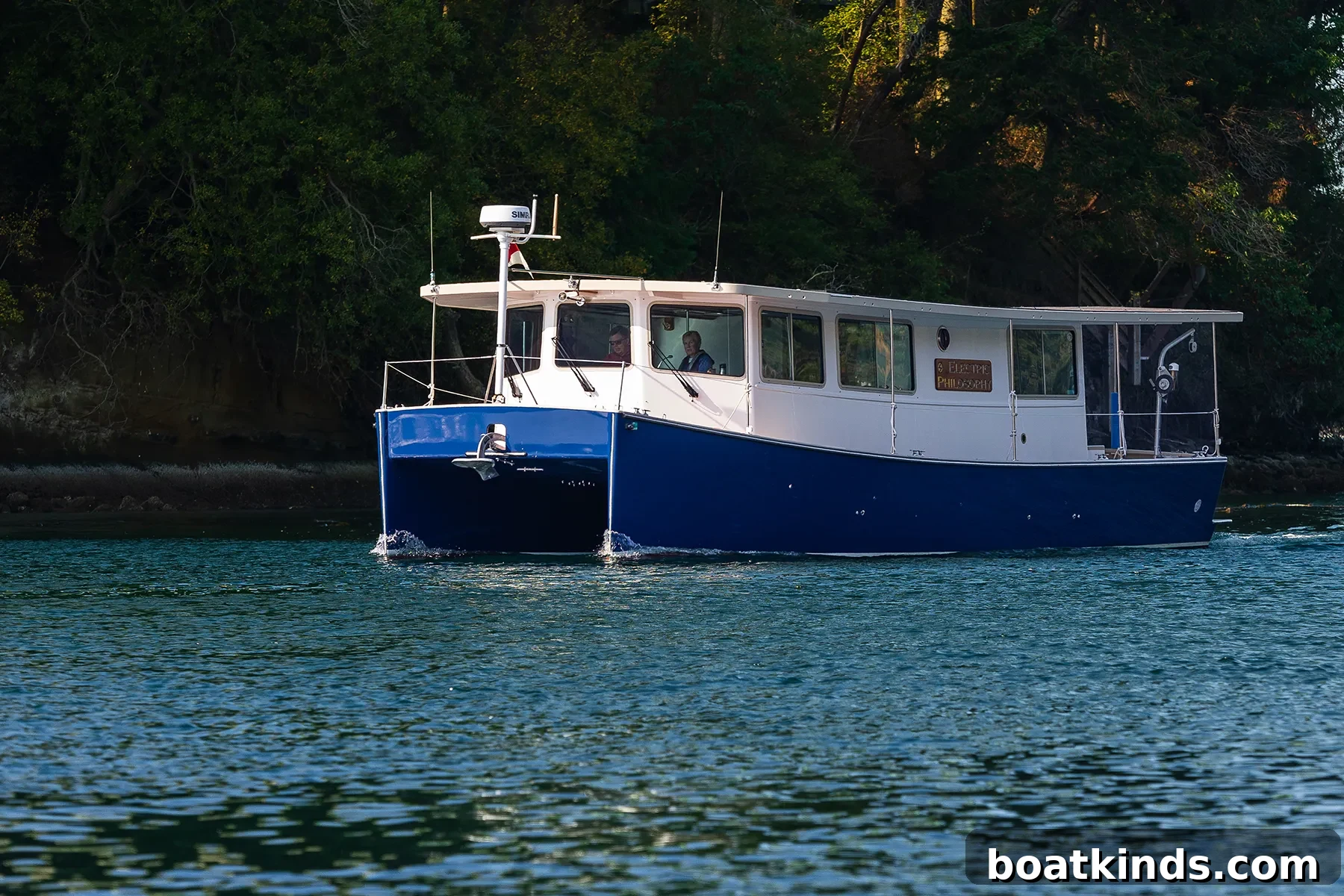
Their craft was unmistakable: a roomy deckhouse topped by an expansive “solar farm” covering more than 500 square feet. The Pauleys, both in their late 60s, didn’t break global records—the 115-foot Tûranor PlanetSolar circumnavigated the world in 2012—but their trip is no less impressive. As relative newcomers to cruising, they took an electric boat through some of the most demanding coastal waters in North America without a generator or shore power, and without major mishaps.
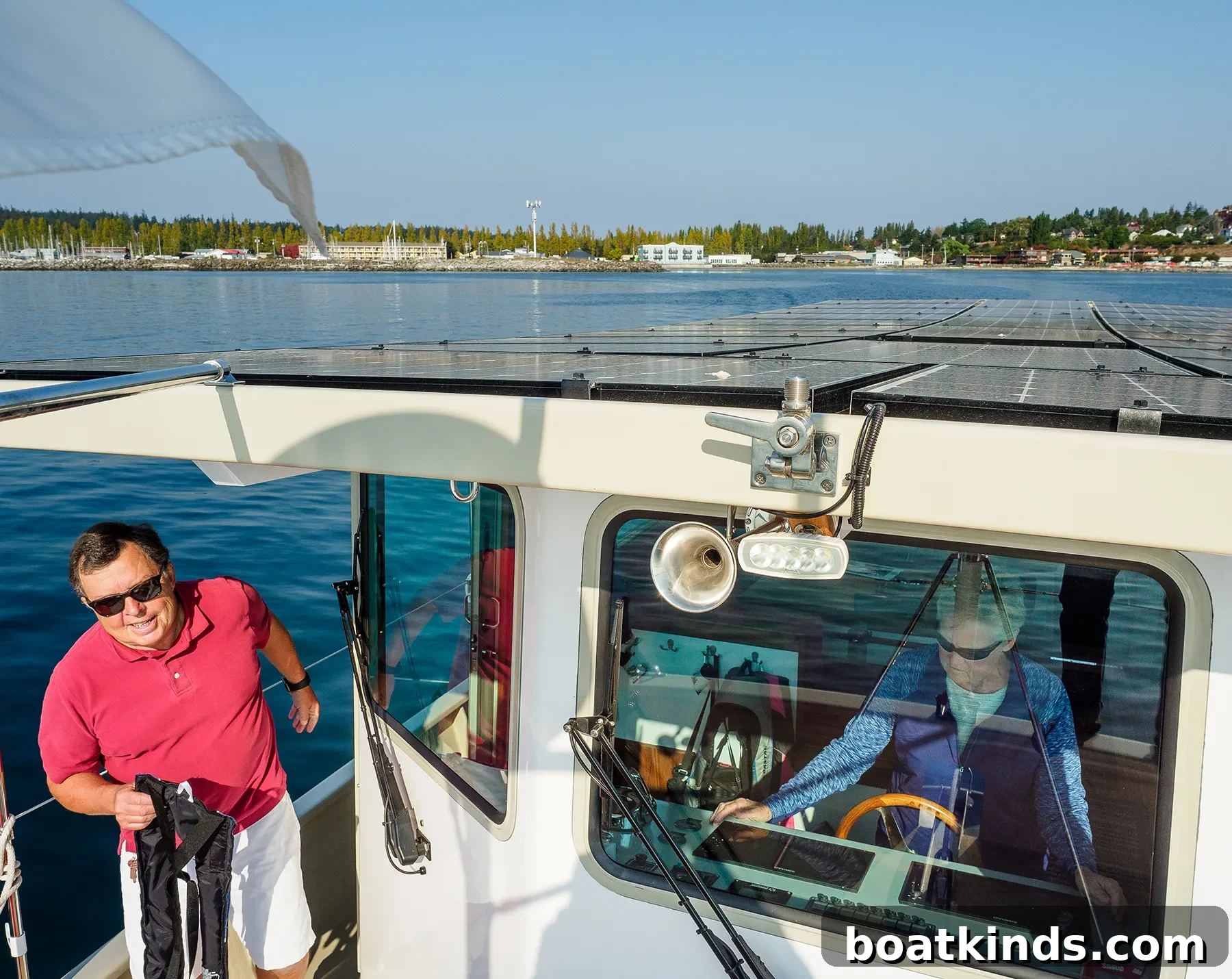
Although they didn’t hoist sails, they treated the voyage with a sailor’s sensibility—monitoring wind and tides, choosing routes carefully and traveling mostly during daylight when solar input is highest. The northern summer sun provided ample energy, even under overcast skies, to recharge the hull’s battery banks and run two 20-kW Electric Yacht motors. That setup delivered a comfortable cruising speed of roughly 5–6 knots. When conditions demanded patience, they anchored, relaxed, read, connected to Starlink for internet, or ashore via dinghy for walks.
“We really had the luxury of time,” Eileen said. “We had no reason to rush. Because you’re moving slower, you drive more hours. Our longest day was 84 miles, about 18 hours—sunrise to sunset.” On that long run the propulsion draw averaged about 3.5 kW per motor (7 kW total). Departing Ketchikan at 4 a.m. with propulsion batteries at 99 percent charge, they reached the customs dock in Prince Rupert, British Columbia, at 10:30 p.m. with 42 percent remaining—testimony to continuous solar charging while underway.
Electric cruising uses far less energy than high-speed diesel passages, but it also means more time on the water. “Not more than 20 or 30 percent longer than anybody else,” Ed noted, comparing their pace with conventional trawlers that typically do 7.5–9 knots. The silver lining: more time to enjoy places like Behm Canal and Misty Fjords National Monument Wilderness.
They did encounter one serious sea state—fighting heavy chop in Knight Inlet that sent water over the cabin—but otherwise the voyage stayed calm. That lack of drama suited the Pauleys just fine. “The biggest advantages of the electric boat are quiet running, reliability and low maintenance,” Ed said. Beyond silence and zero fumes, their experience highlights how dependable and low-maintenance an electric driveline can be: over 3,500 nautical miles they experienced only a burnt-out anchor light and one loose drive belt.
Still, success required skill and preparation. Both Pauleys brought useful technical backgrounds: they met in a Minnesota rowing club, and Ed’s career as a research scientist in product development and his experience outfitting an Airstream with solar and lithium batteries provided practical knowledge. Eileen’s 35-year career as a test engineer at John Deere made her the project’s detail-oriented systems manager—she jokingly calls herself “the corporate worry wart.”
Before attempting Alaska, they spent a full season refining the boat in Puget Sound and adjacent islands, logging roughly 3,000 nautical miles. They replaced an early battery management system, hauled out to address Cutless bearing and shaft-seal issues, and experimented with propeller and motor setups. Eileen compiled an illustrated owner’s manual for troubleshooting electrical systems, firmware quirks, connectors and wiring—an invaluable guide for hands-on cruising.
For redundancy they replaced an unused propane generator with two portable 3.6-kWh EcoFlow units, which can be charged from 110V, 12V, or portable solar panels. “That gave us a power source not wired into the boat,” Eileen explained. “If everything went to crap, we could power electronics and phones to call for help.” So far, those backups haven’t been needed.
Ed designed the boat’s 9.5-kW solar array—25 monocrystalline panels on the cabin top—adding about 1,000 pounds. To minimize shading he mounted the radar mast on the bow centerline and uses a long-handled sponge/squeegee to keep panels clean. He built four battery banks: two house banks totaling 82 kWh and two propulsion banks totaling 164 kWh, all using lithium iron phosphate (LFP) chemistry. Ed chose LFP for safety, cost and longevity: while LFP is less energy-dense than nickel manganese cobalt (NMC) cells, it resists thermal runaway, is less reliant on expensive minerals and endures many more charge cycles without significant capacity loss.
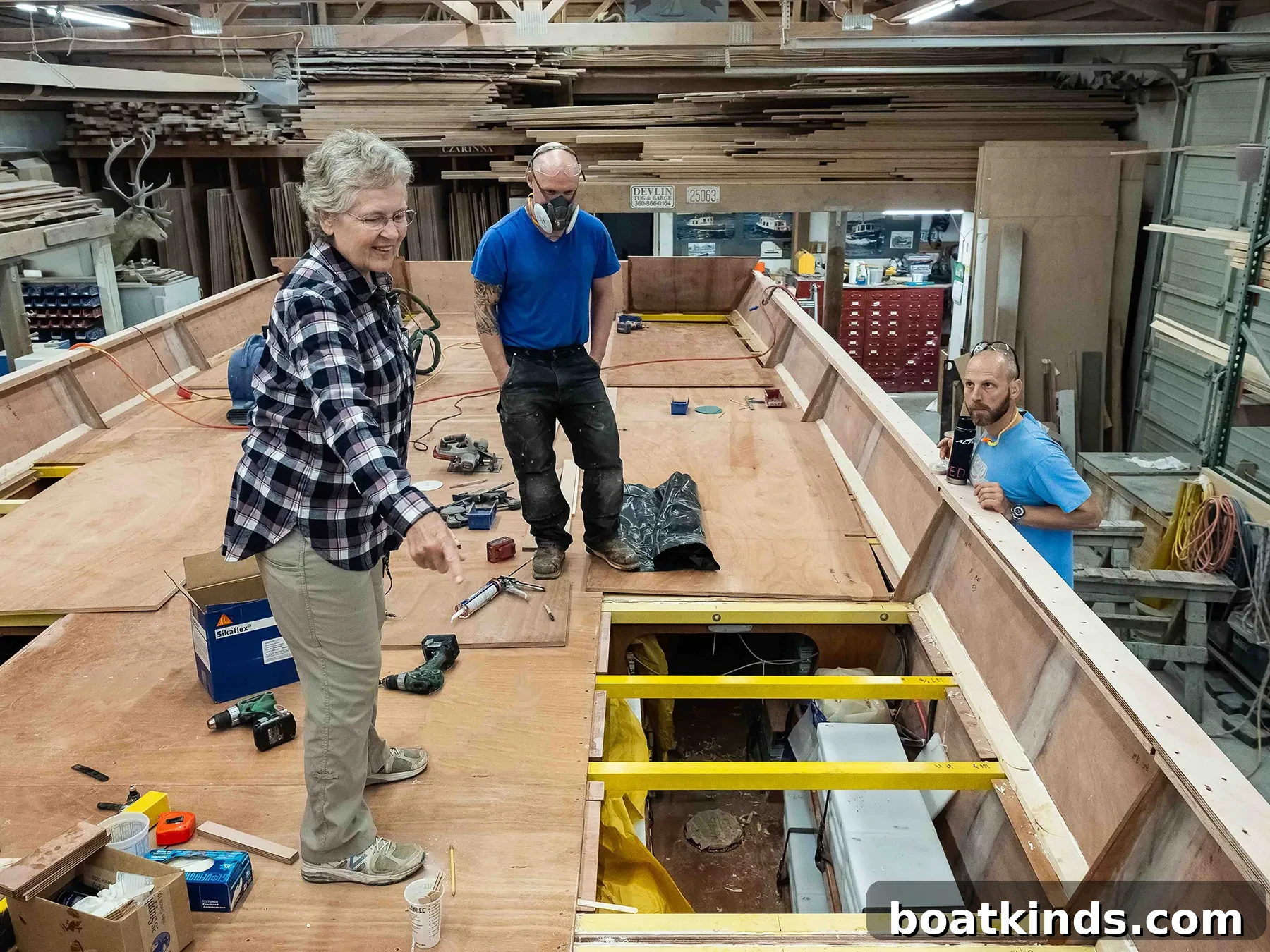
Family and community played a role in the project. Cousin Phil Hallin, a software engineer and early supporter, inspired part of the boat’s name—the “Phil” in Philosophy—and the Pauleys first encountered the idea of solar-electric propulsion after attending talks at the Wooden Boat Festival with their Airstream in 2017. They commissioned builder Sam Devlin in 2019 to construct a robust 41-foot plywood-epoxy catamaran tailored for the Pacific Northwest coast, with living spaces in a deckhouse and systems stowed in the hulls. Devlin’s stitch-and-glue building technique and prior experience with solar-electric launches made him a strong fit; the Pauleys collaborated with his crew to install batteries and electrics.
Devlin and other designers stress two key limitations of solar-electric cruising: speed and weight. Near-displacement speeds dramatically increase energy consumption, and excess weight undermines redundancy and range. Despite careful design, Electric Philosophy ended up heavier than planned—fully provisioned she tops out north of 26,000 pounds—but the interior is comfortable, with Iowa black walnut trim, large panoramic windows, a master suite aft and a dinette that converts to a guest bunk.
Onboard comforts include a warm-water shower, a gravity-fed head and a well-equipped galley with a refrigerator, induction cooktop, espresso maker and electric griddle—Ed’s tool of choice for baking his near-famous eggless buttermilk blueberry pancakes.
When Electric Philosophy returned from Alaska to the 2023 Wooden Boat Festival, crowds toured the boat and admired its purposeful simplicity. Naval architect Tim Nolan praised the design as well executed and a sound example of electric propulsion applied to cruising needs.
Out on the water, running the boat felt a bit like sailing—calm, unhurried and quiet. The large solar array is unmistakable from the air, and the couple’s philosophy is simple: if the boat is your home, install the systems to support how you want to live aboard. “We certainly are not camping, so we draw a lot of power and that’s why Ed put all these solar panels on,” Eileen said.
Going places at a measured pace, in style, without emissions or shore power is exactly what this boat was built to do—and it does it well.
This article was originally published in the January 2024 issue.