
Look back through the history of watercraft—tall ships, dugout canoes, fishing dories—and you’ll find moments when a single innovation changed how we travel and work on the water. From sails to steam, each leap improved speed, range or convenience. Today, a new shift is reshaping many designs under 30 feet: the widespread adoption of modern four-stroke outboard engines. Quiet, fuel-efficient, reliable and easier to install than many inboard powerplants, four-stroke outboards are enabling designers to rethink layouts, interior volume and onboard functionality.
Contemporary four-stroke outboards eliminate large inboard mechanical systems and free up interior space, giving builders fresh design options across categories—from dual consoles to compact cruisers. Below are several recent models that illustrate how outboard power is changing the market for 30-foot and under boats.
Dual Console: Cobia 330 DC
Based in Fort Pierce, Florida, Maverick Boat Group has guided the Cobia brand through steady evolution since acquiring it from Yamaha Marine. One clear shift has been the addition of dual-console models alongside Cobia’s center-console heritage. The flagship of that line is the 330 DC, engineered around a pair of Yamaha XF425 four-stroke outboards.
“We knew we wanted the XF425s for the 330 DC,” says Maverick president and CEO Scott Deal, “but adapting the hull and stern to handle their torque required significant engineering.” The reinforced transom and systems tuning yield a boat that negotiates turns and accelerates with sports-car confidence. With optional XF425s, Cobia reports a 52-knot top end and an efficient cruise in the high 20-knot range.
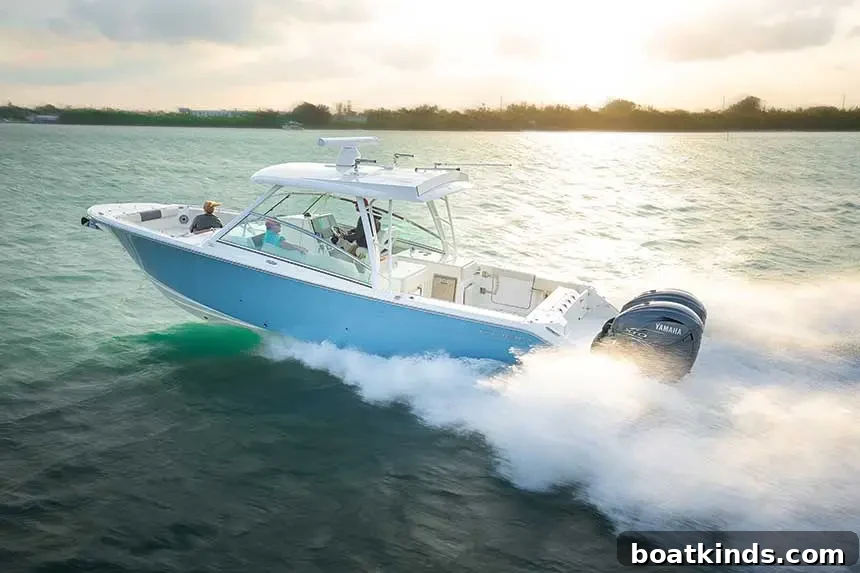
Putting the engines aft — instead of inboard — preserves interior volume and lets designers pack the cockpit with versatile amenities. The 330 DC’s stern area features a dive door, convertible seating, insulated fish boxes, and a compact galley with grill, sink and a pullout refrigerator. Forward of the wraparound windshield sits an L-shaped lounge with an aft-facing chaise opposite the helm, which accommodates twin multifunction displays and a swiveling captain’s chair. A U-shaped bow lounge converts into a large sunpad with a drop-in cushion.
Fishing features are abundant: twin insulated fish lockers (70 and 45 gallons, macerated pump-outs), a 28-gallon livewell in the transom, flush rod holders and multiple access points for bringing big fish aboard via a starboard cockpit dive door or a transom walkthrough with swim platform access. The XF425s’ high-output alternators can run substantial loads like air conditioning, and their direct injection contributes to both economy and performance—making the 330 DC appealing to anglers and families alike.
Fishboat: Bayliner Trophy T22CX
Trophy, a familiar name in fishing boats since the 1990s, recently returned under the Bayliner umbrella with a line of modern outboard-powered center consoles. Bayliner’s new Trophy models blend efficient four-stroke power with practical hulls—two using the Element hull and others built on new deep-V platforms designed for coastal fishing and family use.
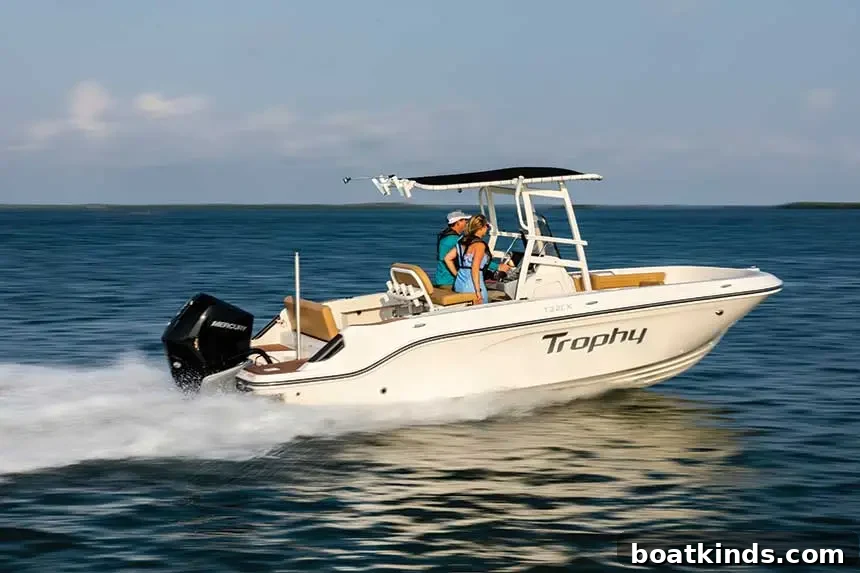
Mark Wyrick, Bayliner’s brand manager, explains the goal: craft outboard-powered coastal center consoles that combine all-day comfort, fishability and easy weekend fun. The T22CX is the largest and most equipped of the new models. With a single 150-hp Mercury FourStroke and trailer, its base price sits near $44,000, though most buyers are likely to choose 200 hp or higher. With a 200-hp Mercury, owners can expect top speeds in the mid-30s and cruising speeds in the low- to mid-20-knot range.
The T22CX rides on a deep-V hull with an 18-degree transom deadrise, a broad bow and generous freeboard for a dry, comfortable ride. Standard boat features include under-gunwale rod stowage, flush rod holders, forward and aft casting platforms and a leaning post with a livewell. Popular options add a T-top with rocket launchers and an aerated livewell. Seating is provided at the helm, in the cockpit and forward; a drop-in bow cushion converts to a sunpad and a porta-potty fits beneath the console. Optional extras include a water-sports pylon and a removable bow table for dining or drinks.
With its efficient four-stroke outboard options, deep-V hull and a strong set of standard features, the T22CX presents a compelling value in the under-30-foot center-console segment.
Sportboat: Chaparral 257 SSX OB
Chaparral’s SSX bowrider series has long been a sterndrive staple, particularly the popular 257 SSX. To give buyers the benefits of outboard power—reliability, quieter operation and simplified maintenance—Chaparral introduced the 257 SSX OB, preserving the signature layout while adapting the platform for an outboard motor.
“Adding an outboard to the 257 SSX opened up additional stowage and maintained the well-liked interior layout,” says Mike Fafard, Chaparral’s senior vice president of engineering. The outboard variant is slightly longer at the stern—an extra six inches—to keep the swim platform useful for lounging and water activities.
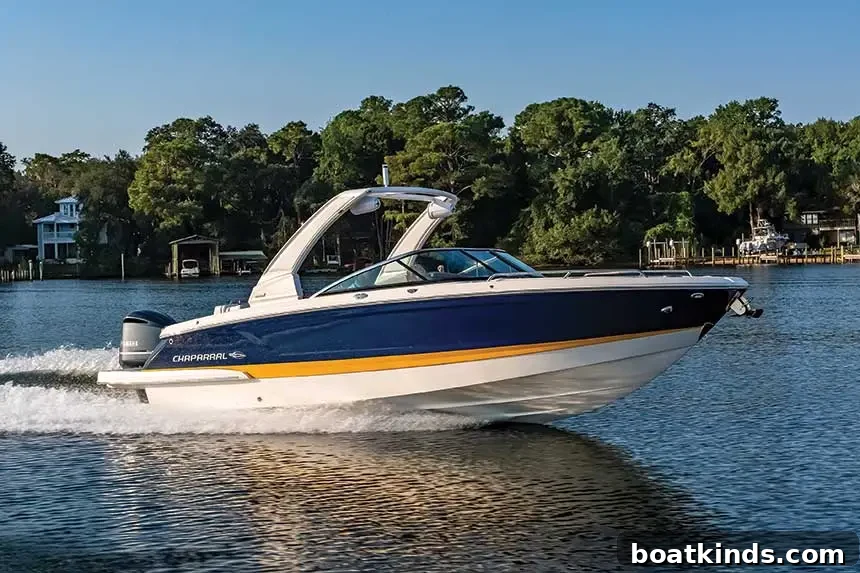
The 257 SSX OB accepts single Yamaha F250 and F300 four-strokes or Mercury 250-, 300- and 350-hp four-stroke outboards. Chaparral reports that a Yamaha F300 will push the boat to about 46 knots at 5,900 rpm, with a comfortable cruise near 25 knots at 3,500 rpm and a fuel burn around 9 gph.
Interior appointments focus on social boating: forward diamond-stitched U-shaped seating with stowage below, twin captain’s chairs behind a wraparound windshield, a port-side compartment with electric head and sink, and cockpit lounging that includes an L-shaped sofa, a bench with cooler storage and an aft-facing transom lounge. A starboard walkthrough provides easy access to the swim platform, delivering a design that feels familiar to SSX owners while offering the specific benefits of outboard propulsion.
Flybridge Cruiser: Cutwater 32 OB
Outboards on flybridge cruisers are still uncommon, but Cutwater’s C-32 Command Bridge OB flips convention by mounting twin 300-hp Yamaha F300s on a comfortable, versatile flybridge cruiser. Designers extended a large swim platform around the outboards and kept a relatively flat sheer and low cabin top so the lines remain cohesive and the boat performs like a nimble cruiser.
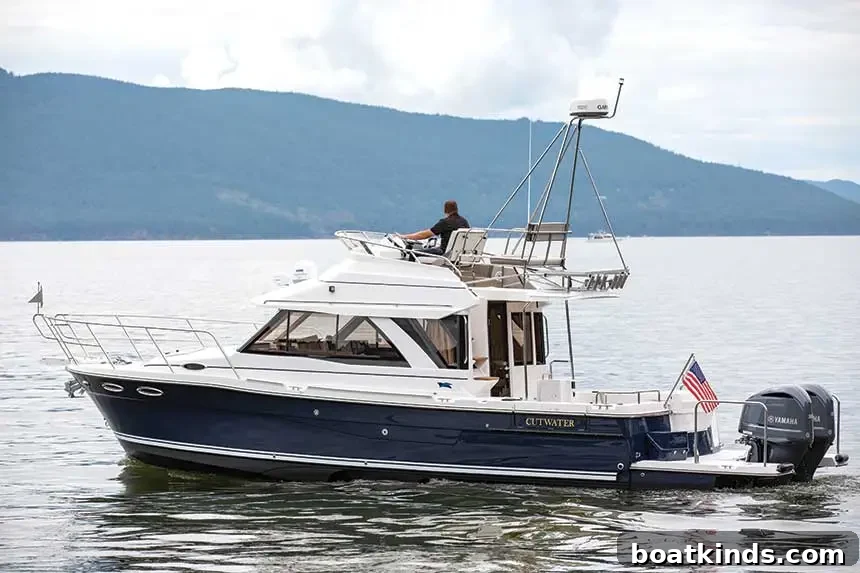
Cutwater aimed to match the comfort and cruising capability of its semi-planing, inboard-powered models while adding the speed and simplicity of outboard propulsion. The C-32 OB delivers a reported 48-knot top end and an efficient cruise near 30 knots. Interior flexibility is a hallmark: a salon dinette converts to a hidden berth, companion seats hinge to serve multiple roles, and the port galley tucks away under a flip-up counter. The master stateroom forward includes an offset berth, enclosed head/shower, storage and entertainment features, with ample natural light from opening ports and a hatch.
Abovedecks, Cutwater emphasizes social spaces: flip-out gunwale seats that appear to hover over the water, a mini galley with sink and electric grill, refrigeration under the flybridge stairs and a modest Command Bridge with a two-person bench at the helm and guest seating abaft. The result is a practical, owner-friendly cruiser that benefits from the easier maintenance and increased interior volume four-stroke outboards provide.
This article originally appeared in the July 2020 issue.