
“You’ve got 10 days to take it off our hands and insure it.”
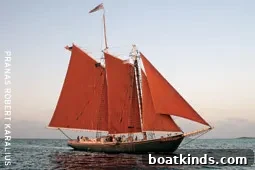
Those words launched an improbable rescue of the 137-foot schooner Roseway, a 1925-built Grand Banks fishing schooner that had fallen into disrepair in Rockland, Maine. Abby Kidder and Dwight Deckelmann found themselves unexpectedly responsible for a historic wood-hulled vessel after the offer from the bank arrived in August 2002.
The Roseway was already a familiar name along Maine’s Midcoast. Registered as a U.S. National Historic Landmark, she had once set a record by hauling in 74 swordfish in a single day in 1934. Later she served the Boston Harbor Pilot Association and was pressed into wartime service as part of the First Naval District, even fitted with a 50-caliber machine gun. The schooner earned a bronze plaque for World War II service and made a screen appearance in a 1977 television remake of Rudyard Kipling’s Captains Courageous. Today she is believed to be one of only six Essex-built Grand Banks fishing schooners still in existence.
Kidder and Deckelmann had long shared a vision dating back to their college years: to run an educational program aboard a sail training vessel that would teach young people how to live responsibly in small, collaborative communities. Kidder, who grew up in nearby Camden, had personal ties to the Roseway—she’d sailed aboard her as a girl for her grandparents’ wedding anniversary. When the First National Bank of Damariscotta took possession of the schooner and offered it for sale, the couple wrote pleading their case. To their surprise, the bank agreed to sell the vessel to them for $10.
The agreement came with a strict deadline: they had 10 days to insure the schooner—at an estimated cost of roughly $25,000—and remove her from the Rockland dock. It was a steep challenge for two people who were just beginning to organize a nonprofit they would call the World Ocean School, but Kidder and Deckelmann embraced the opportunity.
“We saw the boat as a platform for learning how to live together, solve problems, and be responsible to a community larger than yourself,” Kidder explains. The couple felt the moment demanded action; in the aftermath of Sept. 11, 2001, they committed themselves to building a program that could help young people develop leadership, teamwork, and stewardship.
A plan takes shape
They envisioned international sail-training expeditions paired with community service projects: a gap-year–style experience where recent high school graduates would first spend time at sea learning about themselves, navigation, seamanship and the marine environment, and then apply those lessons in service-based work ashore. Their goal was to make these programs affordable and accessible, particularly to underserved youth, unlike many semester-long travel programs that can be prohibitively expensive.
After securing the schooner, the immediate practical tasks were daunting. Using borrowed funds, they towed Roseway to Boothbay Harbor Shipyard where she was hauled out—260 tons of vessel—and surveyed by a team of experienced sailors, a naval architect and a boat designer. While much of the below-water planking remained sound, the interior spaces needed a complete overhaul to meet the educational and safety requirements of living and learning aboard a sail-training vessel.
The work begins
Kidder and Deckelmann both left their jobs to devote themselves full time to restoring Roseway. They recruited friends and professionals from the maritime community; a dedicated crew of around ten men averaged 40 hours a week on the project, supplemented by smaller weekend teams. Over 18 months, the schooner underwent a painstaking renovation costing approximately $1.3 million—just under the original estimate. Every dollar came through donations, grants, and loans. As Deckelmann puts it with a wry smile, “There is no such thing as a free wooden boat.”
Restoring Roseway meant balancing historic preservation with the practical needs of a modern educational vessel: structural repair, rewiring, plumbing, outfitting cabins and common spaces for students, and installing safety and navigation systems suitable for extended voyages. The couple drew on maritime expertise and community support to complete the transformation.
The ocean as school
By 2004 the restored Roseway was ready to carry students. The first season served as a testbed: working out operational details, offering tourist sails to help offset costs, and refining curricula developed with educators. Kidder and Deckelmann realized their programming needed a mix of education and revenue-generating sails to remain sustainable.
To establish year-round operations they moved Roseway’s winter base to St. Croix in the U.S. Virgin Islands, while summer months bring her to Boston, docked at the Fan Pier by the Federal Courthouse. The World Ocean School developed a structured curriculum with the help of teachers and education partners; part of the program receives federal grant support through the United States Virgin Islands Department of Education.
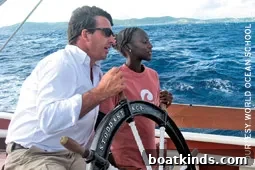
Each winter roughly 700 seventh-grade students from St. Croix public schools come aboard, experiencing hands-on lessons in seamanship, marine science, teamwork and personal responsibility. Crew members—ranging from literature majors to engineers and criminal justice students—rotate by season, bringing diverse perspectives while maintaining consistency in training and mentorship. Summer expeditions offer a deeper immersion: the Summer Ambassador Program runs a 26-day voyage where students learn navigation, history, environmental stewardship, team building and language arts while voyaging through New England and Atlantic Canada.
On a typical summer, Roseway departs from Boston and sails north to Maine and Nova Scotia, participating in tall ship events and connecting students to maritime culture across the North Atlantic. Kidder and Deckelmann continue to refine and expand the Boston-based programming, always seeking supporters and partners to broaden access and reach more young people.
Looking forward, Deckelmann has contemplated adding another vessel to increase capacity. “If I could have my choice,” he says, “I’d build another Roseway.” For now, the restored schooner continues to serve as a living classroom—preserving maritime heritage while teaching generations of students to be responsible, engaged members of their communities and stewards of the ocean.
For information: www.worldoceanschool.org
See related story: Inside the making of today’s Roseway
This article originally appeared in the New England Home Waters section of the August 2009 issue.