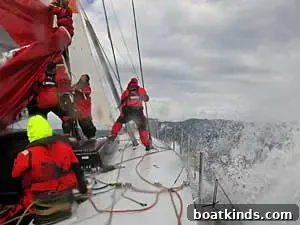
One week into the fourth leg of the Volvo Ocean Race, the fleet is being tested by extreme conditions: sustained winds approaching 50 knots and towering seas with maximum wave heights reported at 46 feet. These raw elements push both boats and crews to their operational limits, turning routine sailing tasks into high-stakes decisions where seamanship, preparation and teamwork determine whether a boat thrives or simply survives.
In this kind of heavy weather, every aspect of onboard life and racing strategy changes. Steering becomes a continual balancing act between keeping the boat moving efficiently and protecting the structure and crew from damaging shock loads. Helmspersons must read breaking waves, gusts and shifts in pressure, deliver smooth inputs and coordinate closely with trimmers to prevent broaches or pitchpoling. Autopilots are frequently used but must be monitored and backed up by manual steering during critical moments.
Sail selection and trim are equally crucial. Crews will work through a small, incremental set of sail plans to reduce power while retaining control — reefed mains, storm jibs or trysails, and strongly reefed headsails where appropriate. Hoists and sail changes in heavy seas require exact timing, secure communications and well-drilled safety procedures to minimize the risk of injury. Rigging and deck hardware are under enormous strain in these conditions, so routine inspections, prompt repairs and preventative reinforcement can mean the difference between finishing the leg and ending it early with gear failure.
Watch systems and human performance take on heightened importance. Sleep becomes fragmented and recovery periods are shorter and less restorative, so teams rely on strict watch routines, hot meals, and rapid medical checks to keep fatigue and hypothermia at bay. Crew rotations and workload management are optimized to keep the most experienced hands on deck during the worst patches, and every crew member must be familiar with emergency protocols, from MOB (man overboard) recovery to securing a damaged sail or jury-rigging a critical fitting.
Route choice and weather routing play a central role under such conditions. Skippers and onboard meteorologists analyze the trade-offs between speed and safety, seeking the smoother pressure gradients and wave angles that reduce pounding while maintaining good VMG (velocity made good). Sometimes a slightly longer but more stable path is faster overall than pushing directly through a storm front. Communicating with shore teams and relying on updated grib files and satellite reports allow the crew to anticipate the worst and take mitigating actions early.
Maintenance routines that might be easy to defer in fair weather take priority when storm systems are forecast. Winches, halyards, running rigging and electronics are kept under continuous scrutiny, and long-term preventative routines—such as periodic lubrication, tension checks and reinforcement of high-load points—pay off when the sea state turns nasty. Fuel and power management also become tactical concerns, as generators, hydrogenerators or other power sources must be relied upon to keep navigation, communications and heating systems functional.
Safety equipment and readiness are non-negotiable. Harnesses, tethers, redundant life-saving appliances, and clear, practiced emergency procedures provide layers of protection. Crews rehearse emergency scenarios in calmer conditions so that in the heat of a storm actions are automatic and coordinated. Liferaft deployment, MOB recovery and damage control drills are reviewed regularly to keep response times low and ensure that no single failure cascades into a serious incident.
Beyond the technical and tactical demands, heavy-weather legs test leadership and morale. Effective communication, calm decision-making, and confidence in shared training reduce the psychological friction that can arise when conditions are relentless and progress is slow. Teams that maintain discipline, conserve energy where possible, and support one another psychologically tend to sustain performance better across grueling stretches.
At this stage of the fourth leg, with wind speeds near 50 knots and waves up to 46 feet, the fleet’s crews are proving the core elements of offshore racing: seamanship, endurance, and adaptability. These conditions separate the well-prepared from the under-prepared and highlight how thorough maintenance, practiced safety routines and strong teamwork combine to meet the challenge of the open ocean.