
Ask nearly any Maine boatbuilder where they source quality lumber and they will point to Richard Simon and his business, America’s Wood Company. For builders who need specialty planking, interior joinery, or long, wide boards, Simon’s inventory is a consistent go-to.
“It’s a great place,” says Sam Temple, owner of Rockport Marine in Rockport. “Rich accommodates nearly all of our needs from planking stock to interior joinery.”
America’s Wood Company operates from a modest location in the inland town of Washington, a 25-minute drive from Maine’s coast on state Route 17. From the road the buildings are easy to miss, but inside the 15,000 square feet of sheds the scale is impressive: over a hundred thousand board feet of lumber stacked to the rafters. Boards more than 20 feet long, three feet wide, and six inches thick sit organized by species, creating a resource any boatbuilder or woodworker would envy.
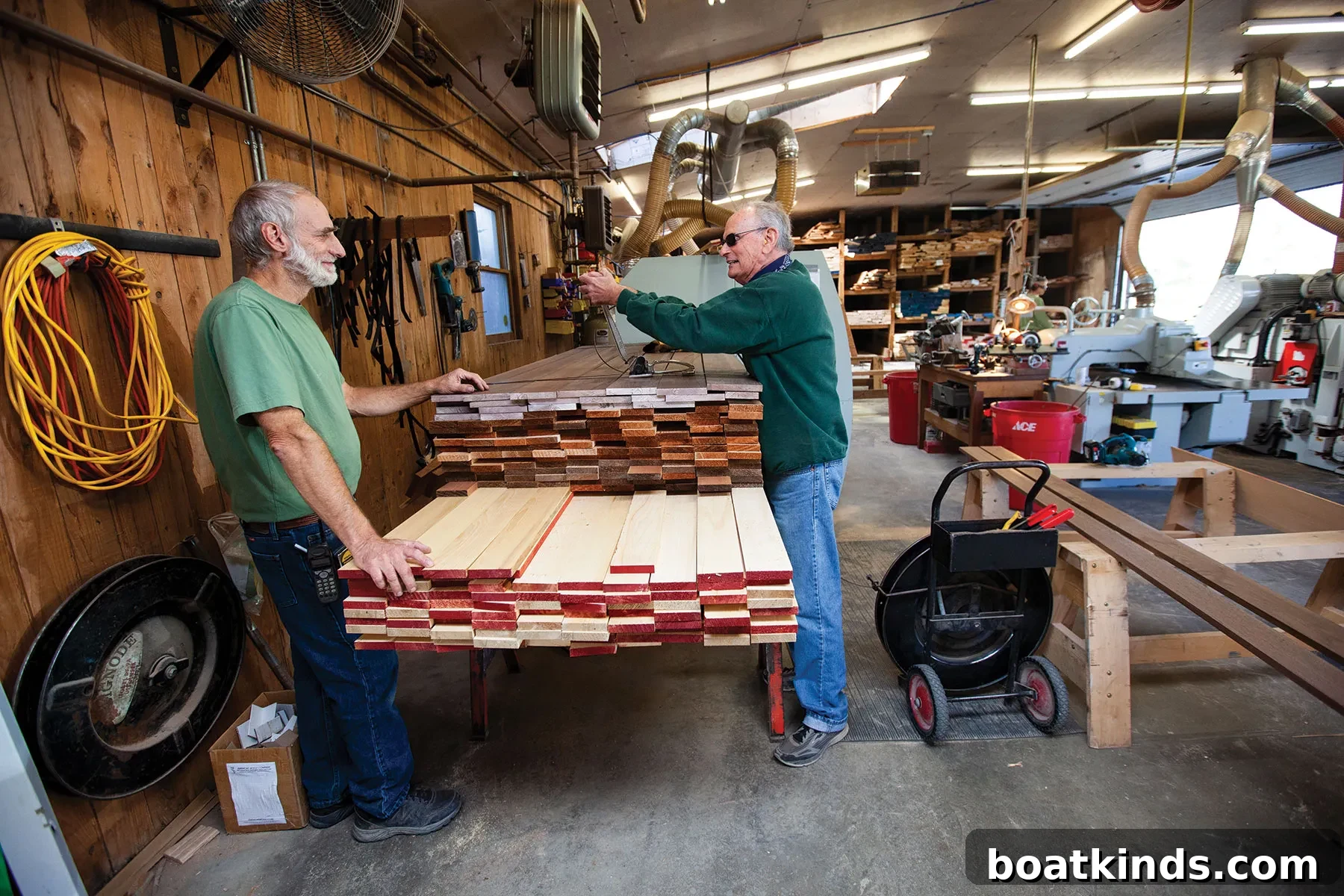
Simon was first introduced to woodworking in the 1970s through vocational classes in Rockaway, New Jersey. After graduating in 1976 he moved to Maine briefly and worked as a carpenter for $8 an hour, but opportunities were limited and he left for California, where he joined a carpenters’ union as an apprentice. Later he returned east and opened a woodshop in Brooklyn Heights building cabinets and doors. A chance relationship brought him back to Washington, Maine in 1992, where he built a house, married, and launched what would become his wood business.
Originally called America’s Door Company when he made and imported doors, Simon later expanded into locally sourced lumber and rebranded the operation America’s Wood Company. He began building relationships by cold-calling boatbuilders, selling wood from trailers at his home and gradually expanding. Early contracts with Hodgdon Yachts in East Boothbay and a 65-foot job at Brooklin Boat Yard helped establish credibility. In 1996 he moved the operation to the Route 17 site, where the business grew into the larger mill and storage facility it is today.
About 80 percent of America’s Wood Company’s customers are boatbuilders; the remainder includes fine home builders, cabinetmakers, and furniture makers. Despite the company’s name, the inventory spans timber from around the globe as well as regional species: white oak for ribs, cedar for planking, teak for decks, spruce for spars, cherry and mahogany for interiors, and many more. The sheds hold ash, basswood, butternut, cypress, fir, ipe, iroko, lacewood, pine, sapelli, sipo, tigerwood, walnut, wenge, and multiple maples. The selection also features less common rot-resistant woods like afrormosia, jatoba, and makore that are valued in marine applications.
Plywood was once something Simon resisted because it consumes a lot of space, but market demand made it a necessary part of his offering. Plywood now accounts for roughly ten percent of sales, including okoume and meranti in various thicknesses down to 1/8 inch for bending and curvature—an important factor in boatbuilding where few surfaces are straight. Sailboat builders often prefer okoume for its light weight, while meranti provides greater density, stiffness, and fastener-holding capacity. The okoume he stocks comes from European suppliers and remains a sustainable choice.
When a traditional species becomes scarce or unavailable, Simon finds practical substitutes that match both appearance and performance. Holly—once a classic accent with teak in soles—is now hard to find. Hard maple can look similar but ages and wears differently, so Simon offers big-tooth aspen (often called “popple”), which closely mimics holly’s appearance and wear characteristics despite lacking the same structural properties.
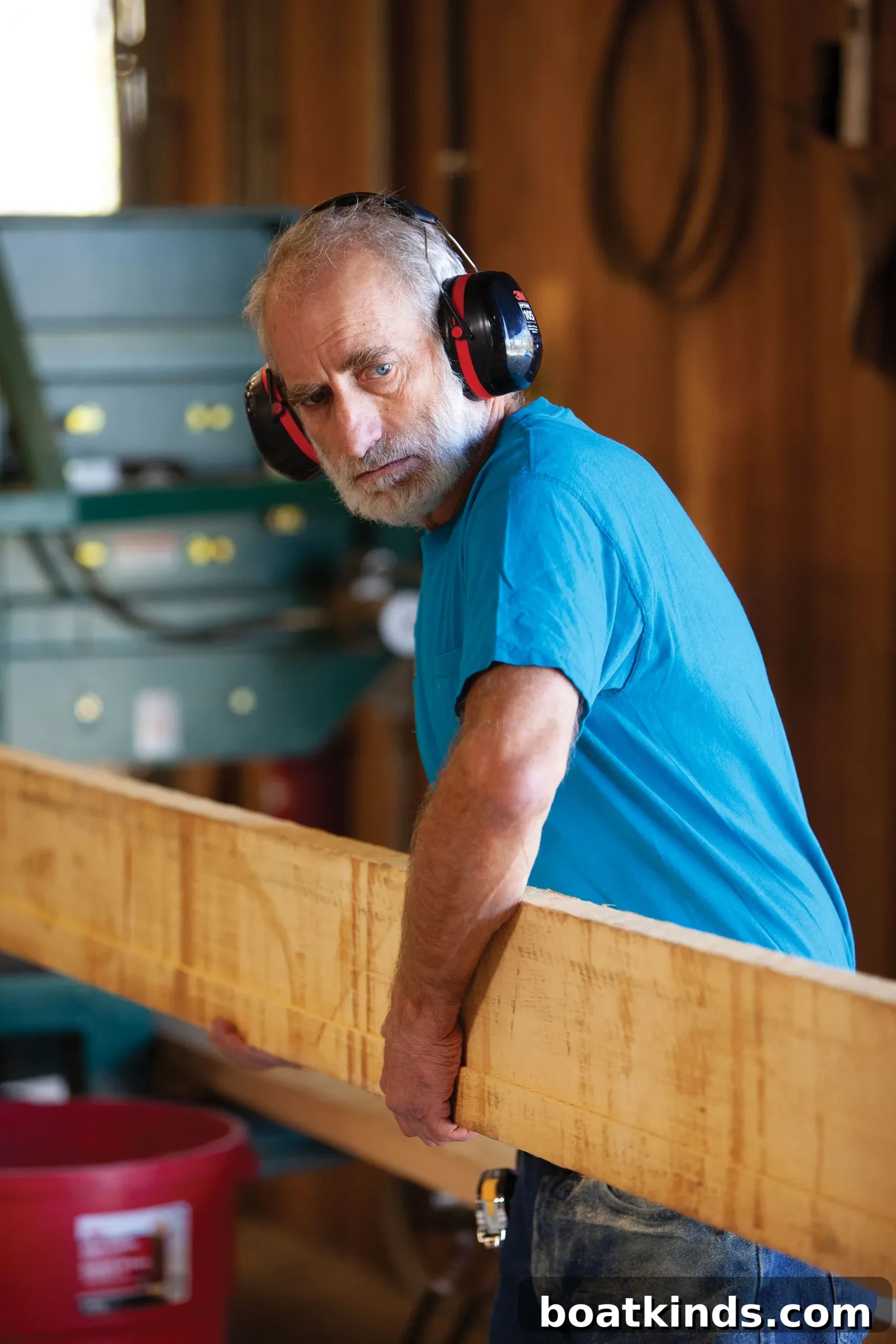
In the mill the team saws, mills, and dresses lumber to client specifications. The goal is to deliver the correct dimensions and quality while minimizing waste and keeping costs reasonable. How a board is sawn affects both its appearance and strength, so planning the cut is critical.
Always with a tape measure and ready to answer client calls, Simon and employee Ned Perkins recently sorted through dozens of 20-foot Alaskan yellow cedar boards to find ideal decking for a 45-foot Bill Tripp sailboat being built at Rockport Marine. The owner chose cedar to reduce weight and prioritize ecological alternatives to teak. To maximize yield, they used a horizontal bandsaw rather than a straight-line rip saw because the bandsaw’s narrower kerf wastes less material.
The workflow is precise and practiced: Perkins feeds boards into the machine while Justice Yanik and Dave Radoulovitch manage guides and outfeed. Simon checks thicknesses with dial calipers and marks faces to preserve vertical grain orientation. The crew’s coordinated movements—feeding, measuring, molding—produce consistent finished stock ready for delivery.
Simon also machines wood for clients beyond Maine. For a Chesapeake Light Craft (CLC) order he ran Peruvian walnut planks through the moulder; those planks will travel to Annapolis, Maryland, where CLC will mill cove-and-bead strips for boatbuilding kits. The dark walnut provides contrast where the chocolate-colored cedar CLC once used has become scarce, supplying an aesthetic solution without compromising supply.
“We’ve worked closely with Richard for years,” says John Staub, CEO of Chesapeake Light Craft. “Whether it’s long-term supply planning, custom millwork, or standing behind his product, he’s always there for us.”
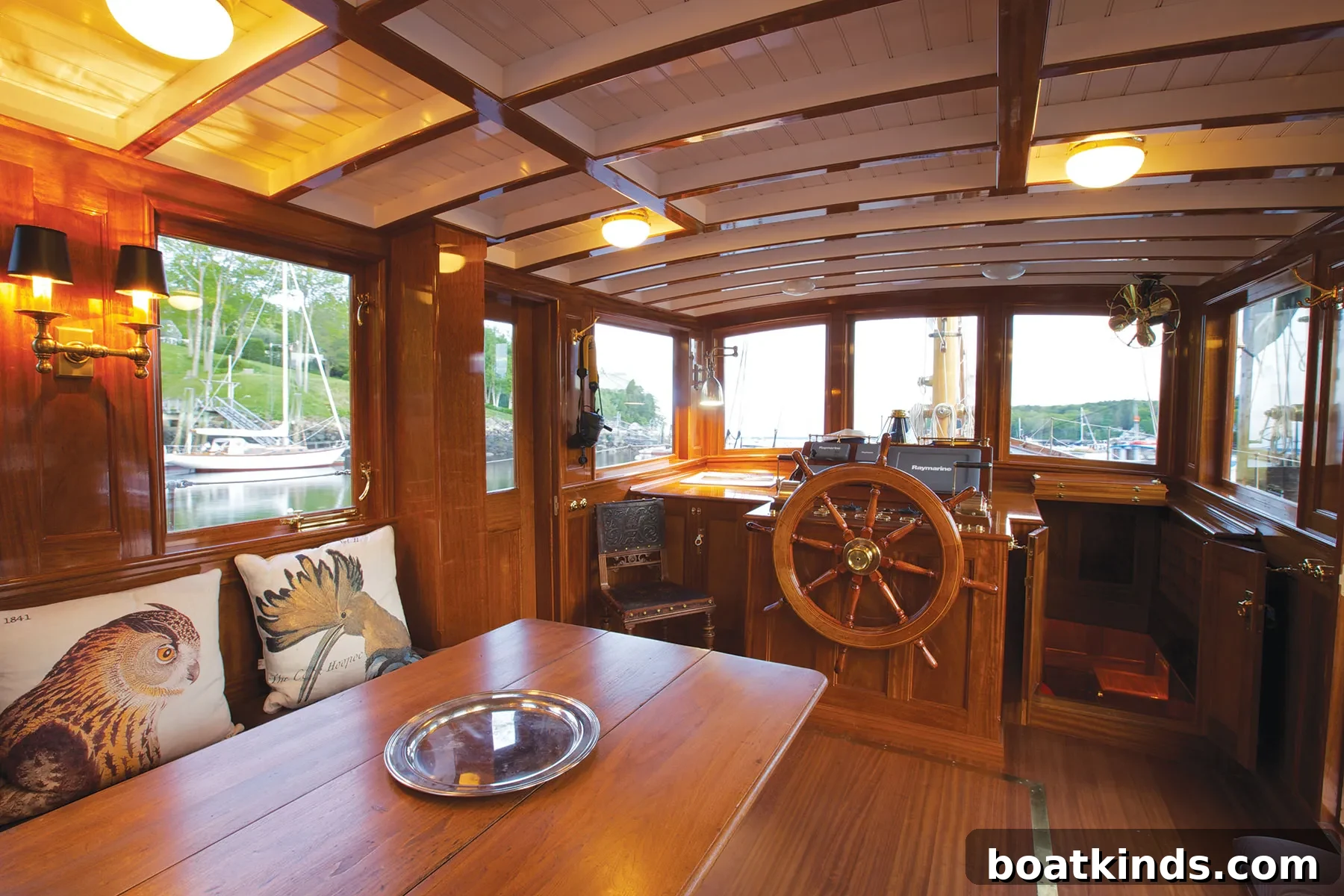
Though Simon doesn’t build boats himself, he keeps a 13-foot Boston Whaler on the Sheepscot River for striped bass fishing—a pastime he’s enjoyed since childhood. His practical experience and long work with boatbuilders give him insight into the qualities they require. “The design drives the species I’m buying,” he explains. “In boatbuilding it’s the wood’s properties that drive the selection. For interiors, wood is more an aesthetic choice.” He cites cherry as a signature interior wood for companies like Hinckley, noting that strict quality standards sometimes require rejecting substandard material.
Today the trailers that once housed stock sit empty on the property—Simon has outgrown them. His client list reads like a roll call of Maine’s prominent builders: Brooklin Boat Yard, Rockport Marine, Hinckley, Back Cove, Lyman-Morse, French & Webb, Artisan Boatworks, Front Street Shipyard, and many meticulous smaller shops such as John’s Bay Boat Company, Eric Dow, and Hylan & Brown. He also supplies the state’s boatbuilding schools: WoodenBoat School in Brooklin, The Landing School in Arundel, The Carpenter’s Boat Shop in Bristol, and the Apprenticeshop in Rockland.
Simon’s reach extends beyond Maine as well. Customers from Cape Cod, the Great Lakes, Albany, New York, and other regions regularly source wood from America’s Wood Company. Yet Maine remains the heart of the business. “This is where the market is for wooden boats,” Simon says, and the concentration of regional boatbuilders has allowed him to focus on service and quality rather than aggressive marketing.
“I’m fortunate that I have a clientele that trusts me and that I don’t have to chase business too much,” he adds. “It’s a competitive business, but I’ve learned that service and quality are important.” More than 25 years after first reaching out to Maine’s boatbuilders, Simon credits their embrace of his business for its success.
“Rich knows what we’re looking for in terms of quality, grain, lengths and widths,” Temple says. “Having him up the road is an enormous asset.”
This article was originally published in the December 2020 issue.