
Tamerlane and the Origins of Offshore Racing — Russ Kramer’s Interpretation
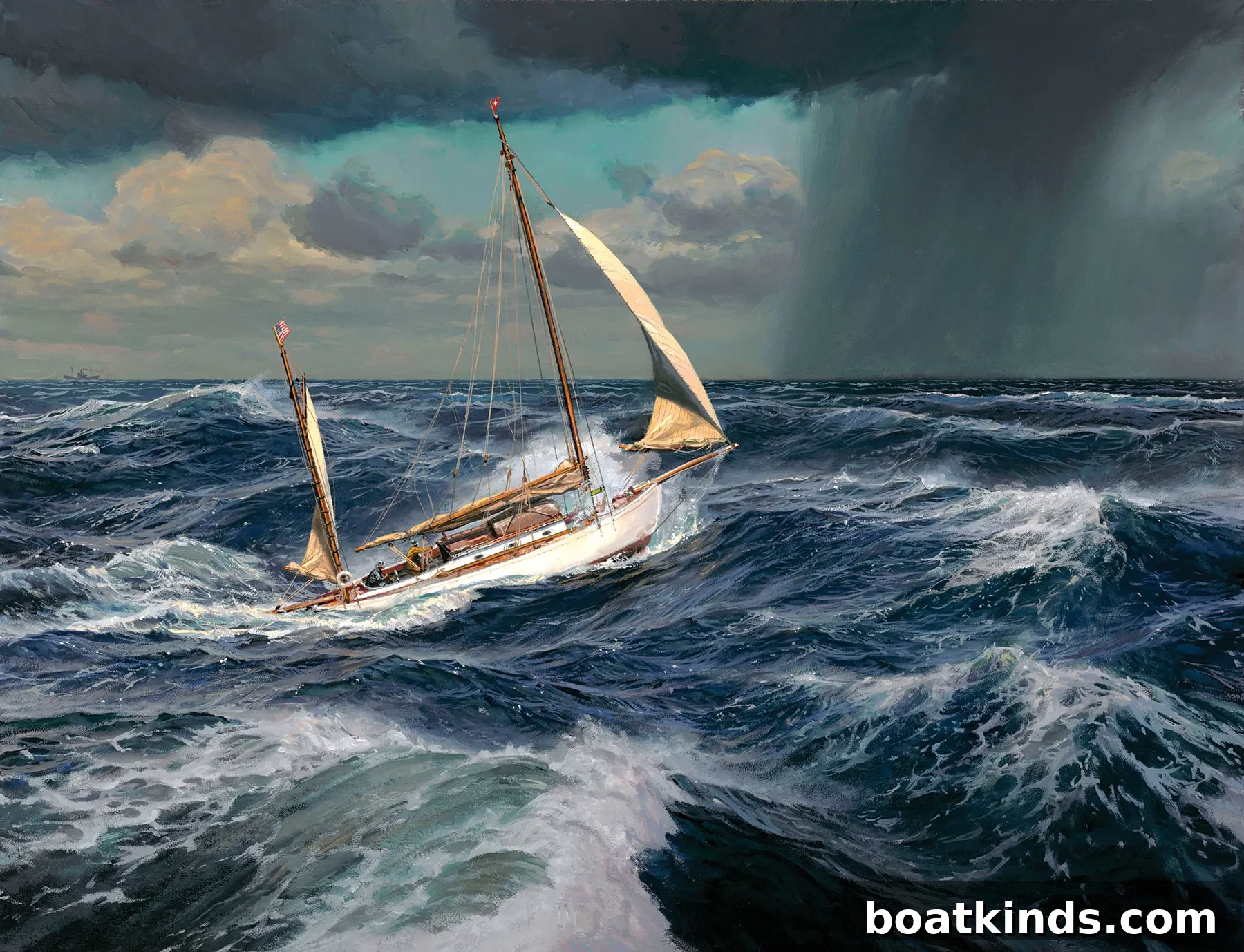
In the wide loneliness of the Gulf Stream, with no land visible for more than 300 miles, the 38-foot yawl Tamerlane faces mounting seas as a storm approaches. At the helm is Thomas Fleming Day, editor of Rudder Magazine, a driven sailor who in 1906 set out to show that offshore racing could be done by modestly sized boats with small crews. Day’s campaign began with a run from Brooklyn, New York, to Bermuda in company with two other boats. One withdrew early, but both Tamerlane and the 28-foot Gauntlet completed the voyage and arrived to wide acclaim. That 1906 effort laid the foundation for what has since become the Newport Bermuda Race, an event held every other year since then; while the starting point is no longer Brooklyn, Day’s determination helped create a lasting tradition in offshore sailing.
Artist Russ Kramer brings a personal understanding of these waters to his work. Kramer has sailed the Newport-to-Bermuda course multiple times and has also completed longer passages, including a 1,100-mile voyage from Bermuda to Jamaica. Those voyages gave him firsthand respect for how quickly the Gulf Stream can become treacherous, and for the courage required to stand watch at a small boat’s helm when the sea turns rough.
For this painting Kramer focused on the human story as much as on the rigging and hull. “I am more intrigued by the people on board and the telling of their stories than the vessel,” he says, explaining why the crew’s presence and the emotional tone of the scene matter as much as nautical accuracy. To arrive at the composition, he constructed a scale model of Tamerlane, placing it in different attitudes to see which position best conveyed the scale and emptiness of the sea. The model helped him judge how the yawl would lean in heavy swell, how sails would react, and how light and shadow might dramatize the approaching storm.
The painting’s mood emphasizes solitude and the unsettled feeling that comes with long passages. Kramer describes a sense of disquiet: out on open water there is a particular quiet that can feel both peaceful and foreboding. The rolling storm in the scene functions as more than weather; it becomes a symbol of the challenges yet to come, both for the sailors and for the idea of small-boat offshore racing itself.
Kramer’s path to marine art is rooted in a lifetime near the water. He grew up boating on Long Island Sound, has owned a small collection of powerboats and spent several years living aboard a 48-foot Hatteras in Florida. He began painting professionally in 2000 after a career in newspaper and magazine advertising, and today lives in Mystic, Connecticut, where he maintains a studio and a downtown gallery on Main Street. For him, being a marine artist is the fulfillment of a boyhood ambition: while some children dream of becoming astronauts or athletes, Kramer always wanted to paint the sea.
While the painting centers on a specific historical voyage, its appeal goes beyond history to explore timeless elements of seamanship: courage in the face of weather, the intimacy of a small crew working together, and the vast, indifferent beauty of the ocean. The 1906 race remains an important milestone because it demonstrated what smaller boats and determined sailors could accomplish, and artists like Kramer continue to bring that story to life for new audiences.
Originally published in the December 2021 issue.