
Preserving a Lighthouse Treasure: Moving and Restoring a Fresnel Lens
In 1822, French physicist Augustin-Jean Fresnel introduced a new type of optical lens that transformed maritime navigation. Composed of precisely arranged glass panels, Fresnel lenses focused and projected light much farther than earlier lenses, prompting the installation of these brilliant assemblies in lighthouses around the world.
At the Chesapeake Bay Maritime Museum, three different-sized Fresnel lenses were exhibited inside the Hooper Strait Lighthouse, a structure dating to 1879 that was relocated to the museum’s Navy Point in 1966. The museum planned to relocate the largest of those lenses — a complex fixture comparable to a chandelier built from roughly 300 glass elements arranged in heavy panels weighing between 75 and 100 pounds each — from the lighthouse’s second floor into a new Welcome Center scheduled to open this fall.
The Specialist Called In: The Lampist
To handle such a delicate operation, the museum turned to a specialist known as a lampist. Kurt Fosburg received the call. “Lampist is an old-world term for the gentleman who went to a lighthouse and worked just on the lens,” Fosburg explains. Historically, lighthouse keepers were responsible for routine care like cleaning and oiling, but only trained lampists performed repairs and complex maintenance on the lens itself. The work is meticulous and requires an understanding of both optics and fragile historical materials.
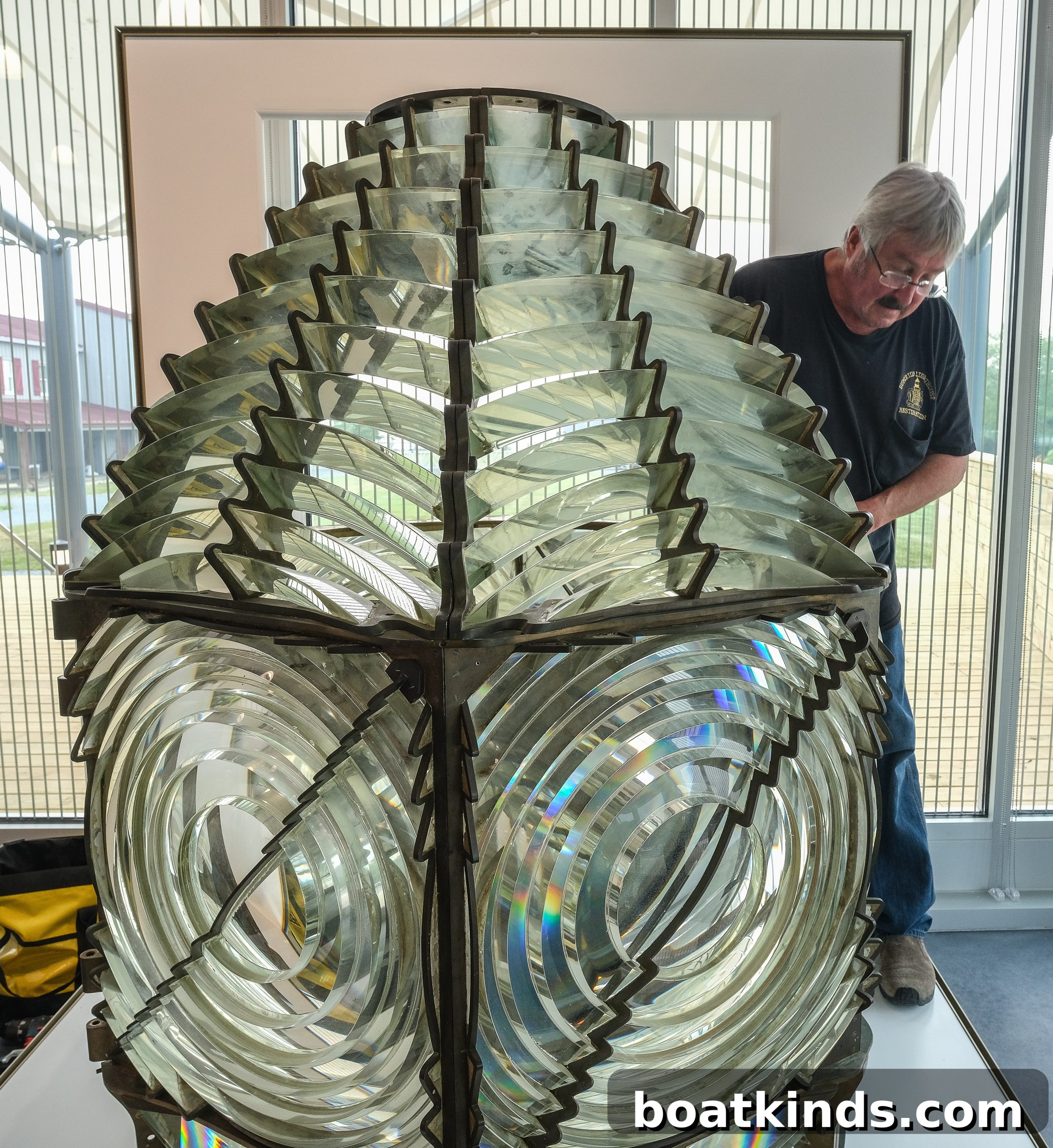
Although hundreds of Fresnel lenses remain in existence, relatively few lampists practice the craft today. The U.S. Coast Guard owns most of the surviving lenses and maintains a short list of trusted conservators. Fosburg is among those few names on that list, which he estimates contains about seven lampists, many of whom are approaching retirement. Many museum lenses are on loan from the Coast Guard, as is the Chesapeake Bay Maritime Museum’s lens.
From Training to Trust
Fosburg’s path to lampistry was unconventional. He studied mechanical engineering in college, spent decades working as a jeweler, and later served as vice president of the Marquette Maritime Museum in Michigan. While at Marquette, he observed a lampist at work on a Fresnel lens from the Stannard Rock Lighthouse on Lake Superior — a moment that sparked his deeper interest. He completed an apprenticeship and progressively gained experience on restoration projects, ultimately earning the Coast Guard’s confidence. “There’s no piece of paper that says you’re certified,” he says. “They just put your name on the list.”
Careful Disassembly, Conservation, and Reassembly
For the Chesapeake Bay Maritime Museum project, Fosburg carefully disassembled the large Fresnel lens for transport. He stabilized the litharge — the mineral used like an old-style caulk between glass elements — with a clear conservation solution, allowing fragile joints to hold through the move. The lens assembly then traveled across the museum campus, where Fosburg cleaned every component, replaced elements that required restoration, and reassembled the whole unit for display.
The restored lens will greet visitors as part of the Welcome Center’s orientation exhibition, placed prominently at the entrance to introduce guests to the museum’s stories and artifacts. “Now it’s right where you walk in, on display,” Fosburg says.
Why Museums Often Make Sense for Fresnel Lenses
Fosburg believes that relocating Fresnel lenses to museum environments is often preferable for their long-term preservation. While many historians and enthusiasts argue for returning lenses to their original towers, Fosburg notes that lighthouses are not always ideal conservation settings. Sunlight and ultraviolet exposure can damage glass and polished components unless specific UV protection is applied. Historically, keepers had to take steps such as closing curtains to shield the lens from sunlight — a task among many others that could be overlooked. In contrast, museums can control lighting, environment, and accessibility, allowing more people, including older visitors and those with disabilities, to see and appreciate these objects safely.
Not surprisingly, removing lenses from towers can be controversial among lighthouse purists who feel a lens belongs in its original setting. Fosburg acknowledges that view but points out a practical reality: those purists are often not the ones who do the painstaking maintenance the lenses require.
Passing on a Specialized Craft
With few lampists left, Fosburg is trying to recruit an apprentice to help ensure the craft continues. He admits it’s a challenge: younger generations are less likely to take up niche, hands-on specialties like lens conservation. For now, he continues doing the work himself, driven by the blend of technical challenge and historical stewardship. “This is a niche job preserving history,” he says. “I hope to be doing this for a long time.”
This article was originally published in the September 2023 issue.