
Coast Guard Swimmer and Auxiliarists Awarded AFRAS Gold and Silver Medals
The U.S. Coast Guard and the Coast Guard Auxiliary in Alaska earned both the Gold and Silver Medals from the Association for Rescue at Sea (AFRAS) for two separate, life-saving operations earlier this year. One award recognizes a daring rescue of four people in a life raft, while the other honors auxiliarists who saved 13 people from a sinking charter vessel.
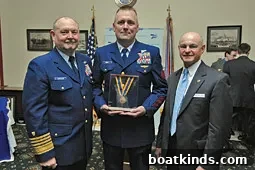
“It is a great honor that Alaska has received both this year,” said Mike Folkerts, recreational boating safety specialist for Coast Guard District 17 in Alaska. “We’ve seen some phenomenal rescues here.”
Alaska faces a higher boating fatality rate than the national average. According to the Coast Guard’s latest statistics, the national boating fatality rate is 5.3 per 100,000 registered boats; in Alaska, that figure rises to about 18 per 100,000. Folkerts attributes the higher rate partly to the state’s vast distances and the extremely cold water, which complicate and slow rescue response.
The AFRAS Gold Medal was awarded to Petty Officer Willard Milam, 42, a rescue swimmer whose actions saved the four crewmembers of a 42-foot fishing vessel on Feb. 10, 2007. The survivors were in a life raft in 15-foot seas off Ualaska Island near Makushin Bay.
Air Station Kodiak received a 406 MHz emergency beacon signal at 11:22 p.m. on Feb. 9, with a confirming signal at 12:01 a.m. A Coast Guard helicopter launched at 12:30 a.m. in near-zero visibility and winds gusting to 60 knots. Surface water temperature was about 40 degrees.
On arrival, the crew observed a flare near the life raft. Milam entered the frigid water approximately 10 yards from the raft and found four drenched survivors, one of whom was severely hypothermic. To reduce exposure, Milam directed the helicopter crew to position the rescue basket as close to the raft as possible. Four survival suits were lowered on the hoist hook to protect the survivors; two suits were swept away by waves, and Milam recovered them to outfit the survivors.
Shortly afterward, Milam discovered his dry suit was rapidly taking on water. He felt the effects immediately: breathing became difficult and his legs went numb. For the first time in his 20-year career, including 15 years as a rescue swimmer, Milam requested an emergency pickup. Back aboard the helicopter, symptoms of hypothermia and declining motor function became apparent. With limited fuel and a strong headwind expected on the return, the crew had less than 15 minutes to complete the rescue. Despite considerations to leave the final survivors to self-embark, Milam returned to the water.
“As far as what gave me the energy to go back in, I really couldn’t say,” Milam recalled. “I knew, though, if I did not go back in, that in all likelihood that one or two of those men down there would probably not survive.”
On the final hoist, the remaining survivor jumped feet-first into the basket and knocked it from Milam’s hands. A wave swept over both men; the survivor panicked and became entangled in the hoist cable. The flight mechanic immediately paid out cable to prevent it from tightening around the man’s neck, an action Milam credits with saving the survivor’s life.
After freeing the cable and placing the man in the basket, Milam and the other three survivors were hoisted aboard. Milam had become hypothermic and began to lose consciousness intermittently. The helicopter returned to Dutch Harbor, arriving about 3:30 a.m., where Milam and the survivors were transferred to awaiting ambulances. Milam later woke in the clinic surrounded by heat lamps and blankets. When released, he was met by family members of the rescued crew, whose gratitude made a deep impression.
The AFRAS Silver Medal recognized Coast Guard Auxiliarists Shane A. Taylor, Richard H. Liebe and Raymond F. Miller, together with Canadian Coast Guard Auxiliarist Michael Cupit, for rescuing 13 people from the 39-foot charter vessel Halibut Endeavor on April 25, 2007.
Cupit was attending a weeklong training session at the Coxswain Academy in Homer, Alaska, as part of an auxiliary exchange program. The auxiliarists were on a 27-foot Coast Guard training boat when they heard a radio transmission to Air Station Kodiak reporting a vessel in distress around 1 p.m. Initial reports suggested only two people were aboard and that the situation might be a minor mechanical issue.
When they reached the scene, however, they found 13 people huddled on the bow of the Halibut Endeavor while the entire aft deck was awash. Water temperature was roughly 39 degrees, with winds of 10 to 15 knots and clear visibility.
“Shane was able to snug the boat up to the port bow as we realized the people were trying to keep the vessel from rolling,” said Richard Liebe. The team transferred passengers over the railing to their boat; Liebe and his crewmates worked quickly to move 11 passengers into the cabin for assessment of hypothermia and injuries. Taylor maneuvered to retrieve the captain and first mate from the bow. Moments later, Halibut Endeavor rolled vertical and sank; its life raft surfaced.
Liebe noted the rapidity of the operation likely prevented fatalities, especially given the age of some passengers and the cold conditions. The entire transfer took about 15 minutes. The Coast Guard cutter Roanoke Island, a 110-foot patrol boat home-ported in Homer, arrived and took the rescued passengers aboard.
Investigators were unable to determine a definitive cause for the sinking. Some crew comments suggested water entering through the aft cockpit, while other descriptions pointed to a possible failure of the raw-water intake rather than visible hull damage.
Liebe and Cupit said the AFRAS recognition came as a surprise and an honor. Cupit, who has served with the Canadian Auxiliary for a decade, praised the training exchange. “We were actually practicing what we ended up doing before we got the call,” he noted. “It was like doing a direct simulation in real life.”
The Association for Rescue at Sea awarded the Gold and Silver Medals in a ceremony in Washington, D.C., honoring the bravery and skill of the crews involved. These rescues highlight the dangers of cold-water operations and the importance of trained personnel, prompt response, and coordinated efforts between Coast Guard units and auxiliarists in Alaska’s challenging maritime environment.
This story first appeared in the January 2009 issue.