
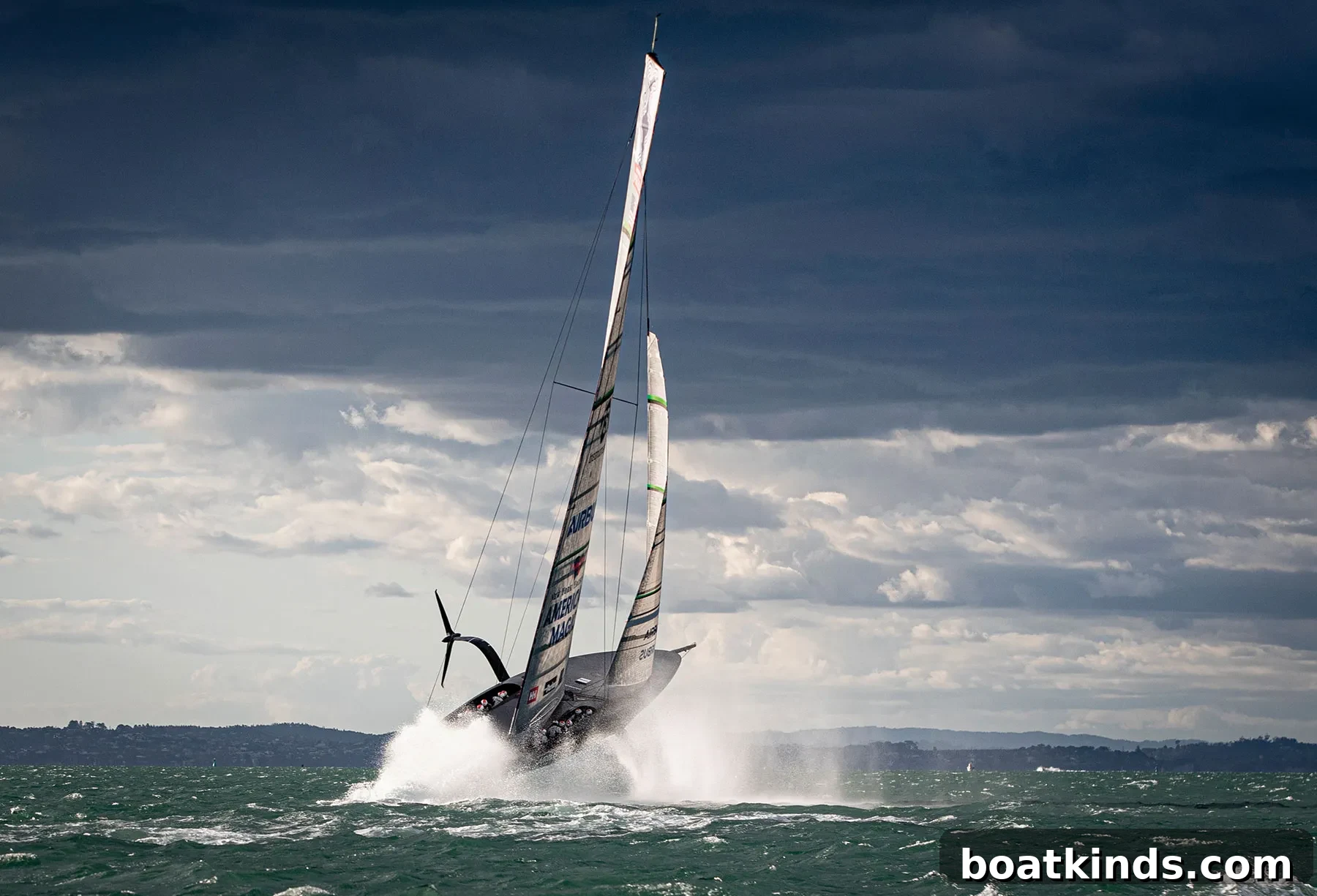
How the AC75 “Patriot” and a New Generation of America’s Cup Boats Took to the Air
A lot can change in two years, and the America’s Cup is a clear example. The American Magic syndicate moved swiftly from testing a half-scale prototype, The Mule, in October 2018 to launching a second-generation AC75 foiling monohull, Patriot, that was racing across Auckland’s Waitematā Harbour by October 2020.
American Magic was not the only team to push quickly into the next generation. Within days, British and Italian challengers also transported their newest AC75s to New Zealand, and within a week all three boats were foiling over Auckland waters. While official top speeds were not publicly confirmed, onlookers estimated Patriot reached speeds in the order of 50 knots during early runs.
“Flying” is an apt description for what the AC75s do. The boats rise and ride on large underwater foils that control direction, pitch and height—functions much like an aircraft’s control surfaces. That comparison extends to potential hazards: just as an airplane can stall if its nose rises too high, a foiling monohull that over-pitches can lose lift and drop suddenly. During Patriot’s first outing in New Zealand, the bow rose unexpectedly and the boat took a sharp plunge. The crew treated it as a routine development incident rather than a crisis. Skipper Terry Hutchinson noted their experience with earlier platforms made the recovery and learning curve manageable, and he expected the team’s familiarity with Patriot to increase rapidly.
Patriot represents an evolution of American Magic’s earlier AC75, Defiant. The two boats are notably different: where Defiant used a flatter bottom, Patriot adopts a deeper skiff-style hull with flared bow decks. The helm and grinding stations sit lower in the deck, and the helmsman’s position has been moved forward, altering ergonomics and weight distribution. Dean Barker, American Magic’s helmsman, emphasized the visible and functional differences between the two boats: “It definitely looks different. There will be no mistaking which one is which.”
Design innovation has always been central to the America’s Cup. The contest dates back to the schooner America in 1851 and the early defenders such as Magic, and the boats have constantly evolved in response to changing rules, technology and local conditions. America was a beamy, shallow-draft schooner that surprised and outperformed slimmer, deeper British rivals in its era. By 1870, the defender Magic bore little resemblance to America: much smaller, with a centerboard, low freeboard and a powerful sailplan better suited to lighter winds—traits that would not have made Magic suitable for long ocean passages under her own hull the way America managed in 1851.
After World War II, campaign logistics shifted from transoceanic sails to shipping the racing yachts. The 12 Metre era saw boats transported by cargo ship, and the first generation of AC75s were also shipped to New Zealand. American Magic’s Defiant, for example, sailed and trained in New Zealand starting in July 2020 after being transported there.
For the latest batch of AC75s, teams adopted a faster delivery method. With the Christmas Cup scheduled to begin on Dec. 17 and the Prada Cup challenger series following in January, several new AC75s were flown to New Zealand aboard one of the world’s largest cargo planes, the Antonov AN-124. Using air freight ensured the boats arrived with enough time for on-water testing and fine-tuning before the official events.
The 36th America’s Cup will begin in March, and the developments witnessed in Auckland underline how rapidly technology and logistics have advanced. Boats that literally fly on foils now also travel by air to reach remote venues—an apt symbol for the pace of change in modern high-performance yacht racing.
This article was originally published in the January 2021 issue.