
At the 2019 United States Sailboat Show in Annapolis, Maryland, many catamarans drew attention, but the Eagle Class 53 stood out as the unmistakable showstopper. Dockside, the all‑carbon, honeycomb‑core catamaran with a distinctive hybrid‑wing mainsail and prominent C‑foils looked as if it had been engineered for pure performance. A nearby broker summed it up as I inspected the boat: “It’s wild, isn’t it?”
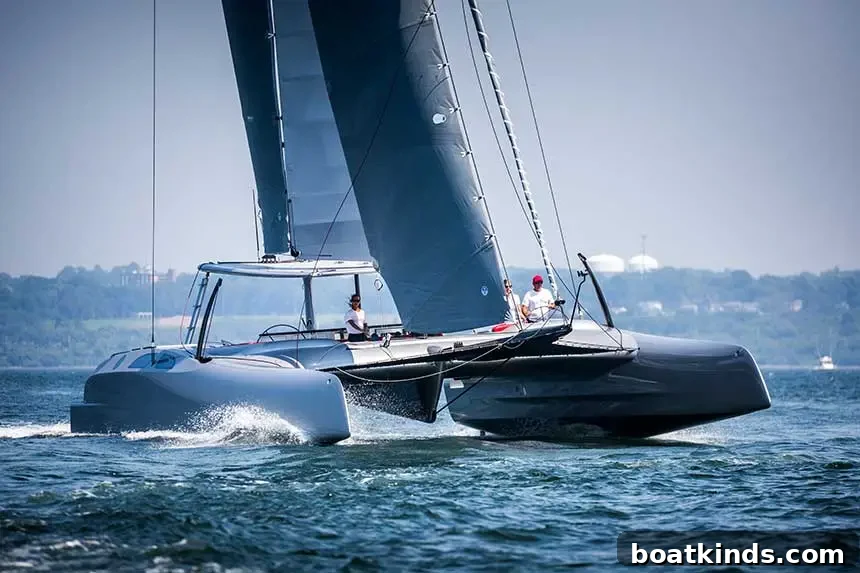
From a distance the EC 53 reads as a high‑performance thoroughbred: T‑foil rudders, an aggressive bowsprit, two forward steering stations and a tall, raking rig give it an athletic silhouette. The exterior is purposefully modern and streamlined, with design cues that emphasize speed and efficient foiling. Beyond looks, the construction is advanced — full carbon with a honeycomb core — and the engineering includes systems intended to make foiling both thrilling and controllable.
One of the most striking features is the open, on‑deck salon. The aft galley, bar‑style seating and curved settees flow together and are intentionally exposed to breeze and light. A sturdy hardcover offers shade and rain protection, but there are no walls, glazing or windshields enclosing the space; the steering positions sit well forward so the helmsman can peer almost straight down at the water. The design assumes the boat will most often be steered from the windward station, which by design should rise above spray when the foils lift the hulls at speed.
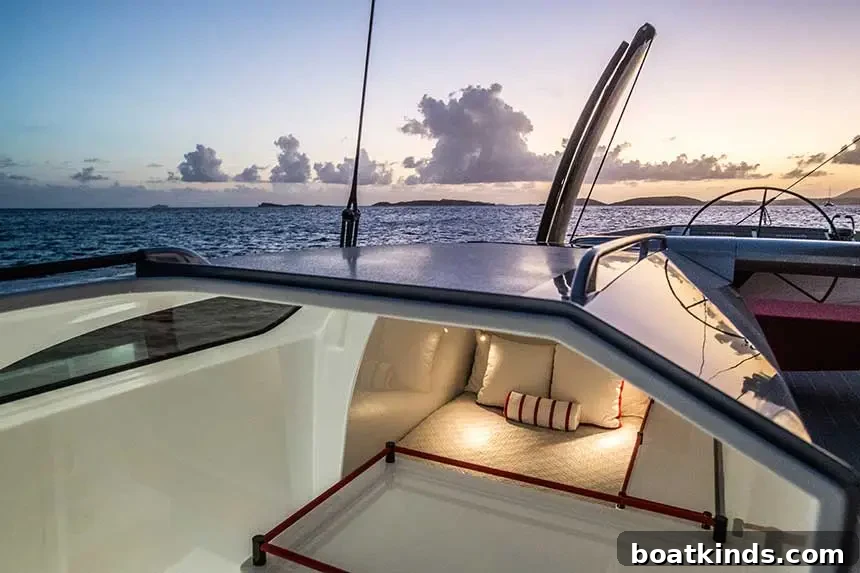
Although the EC 53 can accommodate overnight guests, it is not a traditional, full‑featured cruising catamaran. Each hull contains a double bunk and a head, but the interior remains minimalist and focused on sailing performance. The engines are cleverly stowed beneath the bunks for space efficiency yet retain easy access for maintenance. Overall, the layout and systems emphasize lightness and speed over creature comforts.
Performance numbers reported by the builders underline that intent: the EC 53 has been cruised at a sustained 28 knots in roughly 15 knots of wind. The team has recorded higher speeds, and they continue to refine the foil package to unlock further potential. The current configuration uses C‑foils; the introduction of T‑foils is expected to lift the hulls completely out of the water and increase speed and smoothness, transforming the platform into the EC 53T.
Photos | Have a closer look at the Eagle Class 53 catamaran in the gallery below:
Fast Forward Composites (FFC) of Bristol, Rhode Island, is the builder behind the EC 53. Rachel Fallon‑Langdon, who manages public relations for FFC, describes the boat as originally conceived for daysailing and weekend use in warm climates. The concept was to create a platform where owners could sail safely with family and friends and then enjoy cocktails and social time onboard. At the same time, FFC and the project’s backers wanted flexibility: the EC 53 can serve as a racer, a daysailer, or a lightweight cruiser depending on owner preferences.
The Eagle Class project grew out of a desire to capture the exhilaration of America’s Cup foiling on a smaller, more accessible platform. Donald Sussman, a financier, philanthropist and experienced boater, is the visionary and original owner of the first EC 53. After seeing foiling catamarans on San Francisco Bay and being told that adding foils to his existing boat wasn’t feasible, Sussman chose to commission a purpose‑built design that would deliver the foiling performance he wanted.
Tomas “Tommy” Gonzalez, once Sussman’s Gunboat 90 captain, helped found Fast Forward Composites and serves as its owner and president. Gonzalez assembled an international design team with America’s Cup foiling experience, drawing on talent from programs such as Oracle Racing, Luna Rossa and Artemis Racing. Veteran naval architect Paul Bieker led the design work for the EC 53, collaborating with foiling specialists and composite construction experts to refine the platform.
LOA: 54’2” Beam: 28’0” Draft (C‑foils up): 1’ 2” Displ.: 13,200 lbs. Fuel: 65 gals. Water: 55 gals. Power: (2) 30‑hp Yanmar diesel saildrives
The hybrid‑wing mainsail is a notable technical innovation on the EC 53. Co‑designed with Olympic medalist Randy Smyth, the wing incorporates a battened mainsail that can be reefed. Unlike rigid, multi‑piece wings that require complex derigging, this hybrid wing can rotate 360 degrees, allowing for simplified handling and the ability to use the wing to help control the boat at anchor.
Seattle designer T. Eric Goffrier shaped the EC 53’s ultramodern style and the boat’s interior and exterior arrangements. Goffrier says the brief was to create “an extreme but safe” experience that evokes an America’s Cup feel while remaining seaworthy and accessible. The inspiration included organic lines meant to produce a smooth, gliding motion on the water.
The production timeline includes ongoing foil development: the first EC 53 sails with C‑foils, and FFC is developing T‑foils to fully foil the platform and deliver the EC 53T configuration. The initial boat already includes an automated rudder T‑foil control system that manages level, angle and pitch to keep foiling stable and safe. With those systems in place, the team aims to balance thrilling performance with dependable control.
Fast Forward Composites is also exploring larger concepts beyond the 53, including early-stage work on 80‑ and 118‑foot designs. Interest from potential clients has been reported, and the company continues to refine concepts that scale the foiling, composite construction and design language to larger platforms.
This article originally appeared in the January 2020 issue.