It was a gray day off the coast of California. Under a thinning blanket of fog, the Pacific yawned and stretched toward morning, its surface barely rippled. Aboard the J Class yacht Endeavour — a 130-foot steel leviathan displacing roughly 160 tons — the small residual swell translated into a gentle, noticeable roll.
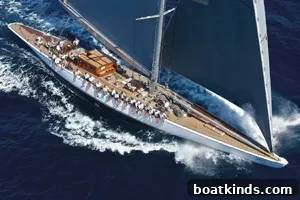
Endeavour flew every inch of canvas to catch the faint breeze, making just enough headway to carve a frothy bow wave along her long, slender hull. The guests on deck relaxed into the rhythm of the boat. For most it was their first experience on a J Class: the kind of sailing where champagne is expected even if the budget leans toward beer. The sensation of heel, huge overhangs slicing the water and the yacht’s pure presence left a lasting impression.
J Class yachts, with their dramatic bow and stern overhangs, once represented the cutting edge of yacht design and the pinnacle of America’s Cup competition in the 1930s. Only ten were built for those match races, and when they moved through any appreciable breeze their sleek hulls and heeling decks were an unforgettable sight — thrilling for spectators and exhausting for the crew.
Ownership and operation have long been the province of the very wealthy: aristocrats and the self-made rich, from Sir Thomas Lipton to Sir Thomas Octave Murdoch Sopwith, who competed against Harold S. Vanderbilt in the 1930s. Today the owners include business leaders and CEOs. Even Endeavour’s modern provenance reflects that world: she was once owned by former Tyco CEO Dennis Kozlowski, who later sold the yacht amid legal and financial troubles.
A rescue with consequences
Sailing a J Class remains a rare privilege, so the hours I spent aboard Endeavour are etched in memory two decades later. She was long considered the belle of any harbor she entered and is one of only three surviving original J Class yachts — alongside Shamrock V and Velsheda — thanks largely to a stroke of luck and a determined restorer.
By the mid-1980s Endeavour had fallen into disrepair, stranded low and muddy in the Hamble River in southern England. In 1984 Elizabeth Meyer, an American yacht enthusiast and patron of restoration, bought the derelict hull. She had it patched and transported to the Netherlands, where the Royal Huisman yard undertook an extensive rebuild. That project is often credited with igniting the modern restoration movement for classic yachts. Meyer later founded the International Yacht Restoration School in Newport, Rhode Island, and became a leading voice for conserving historic vessels.
Today there are seven J Class yachts sailing: the three restored originals and several subsequent recreations and “new” Js built to period-inspired designs. An eighth, referred to as J8, is under commission in Holland. That revival has not been without controversy: class rules and construction practices now allow hull changes, higher freeboard and modern materials such as aluminum, carbon spars and laminate sails.
Aside from the three legacy boats and one wooden or steel-built replica, modern Js are typically constructed in aluminum, fitted with carbon masts, synthetic rigging and contemporary sails. Interiors are lavish, and modern propulsion, generators and systems add 30 to 40 tons of displacement. Yet these yachts are also tuned to race; while the America’s Cup stakes are long gone, owners still expect performance and victory.
“It is a difficult discussion [about originality],” says Dutch designer André Hoek, involved in several contemporary J projects. “But things move on, and we have created an active class, and new boats are being built, so the innovations were successful.” Meyer’s view is sharply different. She calls the modern builds “spirit-of-tradition” boats rather than true J Class yachts, arguing that altered hull lines and modern materials make them ineligible for classic yacht regattas and rob them of historical authenticity.
Splitting tacks on philosophy
When Meyer commissioned Dutch naval architect Gerard Dykstra in the 1980s to restore Endeavour, the aim was fidelity to the original design. Relaunched in 1989, Endeavour visually matched the 1934 Camper & Nicholsons launch, yet she returned with modern amenities: an auxiliary engine, aluminum spars, Dacron sails, a cherry-paneled interior with a fireplace, guest cabins and an owner’s suite. Those additions changed her weight, draft and waterline.
“No alterations were made to the hull shapes or construction materials,” Meyer has maintained, while acknowledging Endeavour sat lower in the water after restoration. Her defense was technical — with the interiors removed, she would have measured as a J — but critics pointed out that the new fittings substantially modified the vessel’s character and performance.
Dykstra followed a more pragmatic route. He allowed sensitive upgrades and helped create a living, competitive class by permitting some modernization. His firm’s designers developed a rating rule based on velocity prediction that assigns handicaps so older and newer Js can race together fairly. Jeroen de Vos, another naval architect involved with many of the existing J projects, praises the new boats’ upwind performance while admitting they are heavier and slower on reaches and downwind legs.
Racing has also professionalized. Top crews now include seasoned pros such as Francesco de Angelis, Ken Read and Brad Butterworth. “You need to sail well and aggressively,” de Vos says. The era of unpaid celebrity owners and volunteer crews that Meyer once championed — when names such as Gary Jobson, Ted Turner and senators would take the helm for fun — has largely given way to a more professional, high-stakes scene.
Meyer eventually sold Endeavour to Kozlowski in 2000, and subsequent ownership and refits further changed the yacht. By 2011 an extensive refit in New Zealand added an aluminum deck, carbon rudder and other modern equipment. Meyer has called that transformation a loss to the class’s authenticity.
The renaissance continues
Despite disagreements over authenticity, interest in J Class yachts remains strong. Plans from the 1930s that were never built have been resurrected for new construction, including designs by Frank Paine and Starling Burgess. Projects on hold have restarted, and new hulls and restorations continue to populate harbors and regatta fields.
Designers admit development is inevitable. “You can’t stop development,” Hoek observes. For owners eager to race superyachts seriously, Js are among the few practical and prestigious options. High-profile owners are drawn to their combination of history, scale and competition — and they still want to win.
Sitting on Endeavour’s massive boom years ago, back against the mainsail and feet dangling over the water, it was easy to understand the enduring appeal of these yachts. They combine scale, elegance and raw power with a single original purpose: to win races. Whatever the rightful path for the class — strict preservation or spirited modernization — Elizabeth Meyer’s revival work deserves recognition. Her efforts helped ensure these magnificent boats survived and that the debate over authenticity and evolution continues to shape their future.
This article originally appeared in the July 2015 issue.