
Last night was the real test. This morning — after more than 600 miles of open-ocean sailing, a brisk west wind, a high overcast above Robin’s mast and Bermuda rising just over the horizon — felt like the reward.
The darkness fell after a spectacular sunset over the intensely blue Atlantic. Puffy clouds blushed pink as they drifted south, and as night closed in, the distant glow of civilization appeared where those clouds had been. After seven days at sea my chest swelled with relief and exhilaration.
So did the wind. First came the Force 6–7 breeze hinted at by mare’s-tail clouds that morning. Then a front arrived with jagged lightning, horizontal sheets of rain and, at times, nearly twice the expected wind. Robin rocketed along at 7.5 knots three miles north of Bermuda’s legendary reefs. In the early hours I could see nothing on the radar but the green smear of a squall. I hove-to and slept for two hours.
With the mainsail double-reefed and the staysail replacing the big genoa, I steered due south, still skirting the reefs but on a nearly direct course for landfall. Robin leaned to port; I stood to starboard with feet braced and both hands on the tiller. We were again making better than 7 knots, surging like a dinghy across the 8- to 10-foot beam seas. Robin strained ahead, a willful horse smelling the barn. On the horizon a small hump appeared. Land. What a wonderful feeling — we’d be in Bermuda before noon.
I was lured from the psychological comfort of coastal cruising by a race — the 2007 Bermuda One-Two. Arriving ashore after nearly eight days at sea is no small thing, but having completed this passage I recommend it to sailors and powerboaters alike, provided their vessels are bluewater-capable.
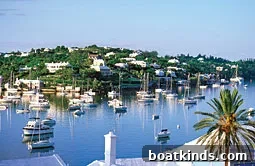
The offshore adventure and the beauty of both the passage and the destination make a cruise to Bermuda from the U.S. East Coast well worth the effort. At sea I landed a radiant mahi-mahi, watched spectacular sunsets and dawns, and stared up at a limitless sky full of stars. Ashore, Bermuda’s lush tropical foliage contrasts with harbor waters that shift between opal and topaz and with pastel houses capped by white roofs. And yes, there’s pink sand — but first you must navigate the formalities.
Approach and formalities
Clearing customs is mandatory and takes place in St. George’s on the island’s east end, which means entering the local harbor through Town Cut. Carved from black limestone atop Bermuda’s volcanic bedrock, Town Cut is a short 300-yard channel between two cliffs. It’s wide enough for cruise ships of thousands of passengers to pass — apparently just barely — at about 200 feet across. Most private boats won’t sail into St. George’s Harbor with the prevailing winds and limited maneuvering room; tacking space is scarce, so you’ll often approach under power.
You won’t see Town Cut the instant you turn west after passing Northeast Breaker, Kitchen Shoal and Mills Breaker Ledge, but you won’t be alone. If you’ve kept VHF channel 16 on during your voyage you’ll, weeks or days out, hear the distinctly British voices of the duty officers at Bermuda Radio communicating with inbound and outbound vessels. When you’re roughly 50 miles out you should attempt to contact Bermuda Radio and file the agency’s requested arrival checklist — they coordinate search-and-rescue operations around the islands and can help guide you in. Communications grow more frequent as you approach; once you reach Mills Breaker Buoy, Bermuda Radio’s operators can help guide you into Town Cut if you wish. From their station atop Fort George Hill they monitor and assisted hundreds of vessels into St. George’s Harbor in past seasons.
Island time
After Robin slid through Town Cut, the duty officer gave me landmarks directing me to the customs office — described as being behind a “colonial-type building,” which was not especially helpful to my landlubber eye. I found the customs dock and, still in a trance from the passage, completed paperwork in about five minutes with the help of a patient and polite official. This was the first of many encounters with the islanders’ genuine hospitality.
I motored my Westsail 32 across the harbor and anchored off the St. George’s Dinghy & Sports Club in about 15 feet of water over good holding ground. Dock fees vary from free to modest: the dinghy club charged $1.50 per foot to use its dock; anchoring there is free. The club — a working-man’s facility — offers showers, laundry, free wireless Internet and a bar. At the Royal Bermuda Yacht Club in Hamilton, facilities are more upscale and slips run around $3 per foot. There are marinas and town docks available when cruise ships are not occupying them.
Many visitors prefer lodging ashore. Options range from modest in-law apartments to posh beachfront hotels. My wife Monica arrived in Bermuda a week after I left Newport and booked the Royal Palms Hotel in Hamilton when I was delayed. The Royal Palms places rooms in cottages and two former manor houses, with an open-sided dining room serving a complimentary breakfast amid gardens of frangipani, oleander and bougainvillea. Rooms there are on the pricier side — roughly in the $375–$500 range depending on location — so in season it’s wise to book well ahead.
Local sailors recommend looking into private homes for economical stays. Eric Johnson of Annapolis, who has cruised to Bermuda several times, advises planning as much as a year ahead for summer travel. He pays $85 a night for a room with kitchenette and laundry in St. George’s and recommends asking experienced racers for tips on affordable private accommodations.
We reunited at the Royal Palms and spent our days exploring the islands. Peter McCrea, a fellow racer, suggested renting a motor scooter — excellent advice. For $178 we had four days to zip the narrow, winding roads on the left side and sample beaches, historic sites and local eateries.
Scents and colors
Four days only scratch the surface of Bermuda’s charms, but you can soak in the essentials: vivid colors, spotless towns and uncommonly friendly people. We visited southern beaches whose sand takes on a delicate pink hue and whose coral formations are breathtaking. Crystal Caves, a limestone cave system fed by seawater, is an impressive half-day visit and costs a modest admission. A high-speed ferry from St. George’s will take you west to the Royal Naval Dockyard and its historic fortifications and museums.
Other visitors offered strong impressions. Dan Stadtlander of Connecticut praises Tobacco Bay on the island’s north side for outstanding snorkeling and tame reef fish; there is no charge to visit. Peter McCrea recalls fragrant flowers near the reefs, the joy of safe landfall, anchored dinners with friends and local dishes — fish chowder spiced with sherry peppers and Gosling’s rum at the Black Horse Tavern, Heineken at Bluebeards, and steak-and-kidney pie at the Hog Penny in Hamilton.
Artist Peggy McCrea describes the sea changing after crossing the Gulf Stream to an almost surreal crystal blue, with tropicbirds and dolphins a frequent sight and the aroma of tropical blossoms washing over you as you approach. Anchored in St. George’s harbor, she says the first night’s sleep is the most restful imaginable; waking to blinding turquoise waters, pink sands and lush green vegetation is unforgettable. She also notes the warmth and friendliness of the people you encounter: smiling, talkative and upbeat.
Practical realities also matter: aside from affordable, reliable mass transit, most things in Bermuda are expensive because nearly everything is imported. Fuel prices can be high — at the time of our visit gasoline was significantly costlier than in the U.S. — so consider duty-free fueling options like the marina at the Royal Naval Dockyard or arranging dockside delivery in St. George’s with other boaters to make it worthwhile for a local fuel truck.
Joining a race is one sensible way to prepare for the passage: race organizers require strict safety standards, which helps ensure you and your vessel are ready for offshore conditions. That said, not everyone races. Mid-passage on a windless night I came upon a Tartan 40 running home under power after a casual cruising visit to Bermuda; when the wind died, her owner simply turned on the engine and motored.
Monica and I returned to Newport double-handed for the race’s return leg. The wind proved fickle and fickle again, and our return took nearly as long as the passage out. Still, for us the voyage and the stay in Bermuda were supremely rewarding — three of the most fruitful weeks we’ve ever spent on a boat. Between the open-ocean passages, the reef-skirting approaches, the island hospitality and the vivid natural beauty, Bermuda remains a voyage worth planning and savouring.